An EAP can be tax-free in the UK, but not every service in a programme automatically qualifies. Whether an EAP is a taxable benefit in the UK depends on whether it meets the conditions for the welfare counselling exemption. Qualifying counselling must be available to employees generally on similar terms, according to the UK Government. Services outside the exemption may need separate tax treatment.
It’s understandable to expect one rule for an employee assistance programme, especially when counselling is offered alongside other support. The key distinction is what each service provides and who can access it.
This article explains which counselling may qualify, how mixed programmes can be treated, and what employers may need to report and pay when a benefit is taxable. It also explains why separating non-qualifying services matters, helping you understand the tax position while keeping sight of the support an EAP is designed to provide.
Key Takeaways
- Identify which counselling focuses on employee welfare and which services fall outside the exemption, as the type of support can change the tax treatment.
- Understand when taxable EAP benefits may need to be reported to HMRC and when employers may have to pay tax and National Insurance.
- Use HMRC guidance EIM21845 to understand how rules apply to services for employees’ families, dependants and volunteers.
- Explore how 360 Wellbeing’s workplace support, including Mental Health Support, can contribute to employee wellbeing alongside a clear understanding of tax responsibilities.
UK tax treatment of employee assistance programmes
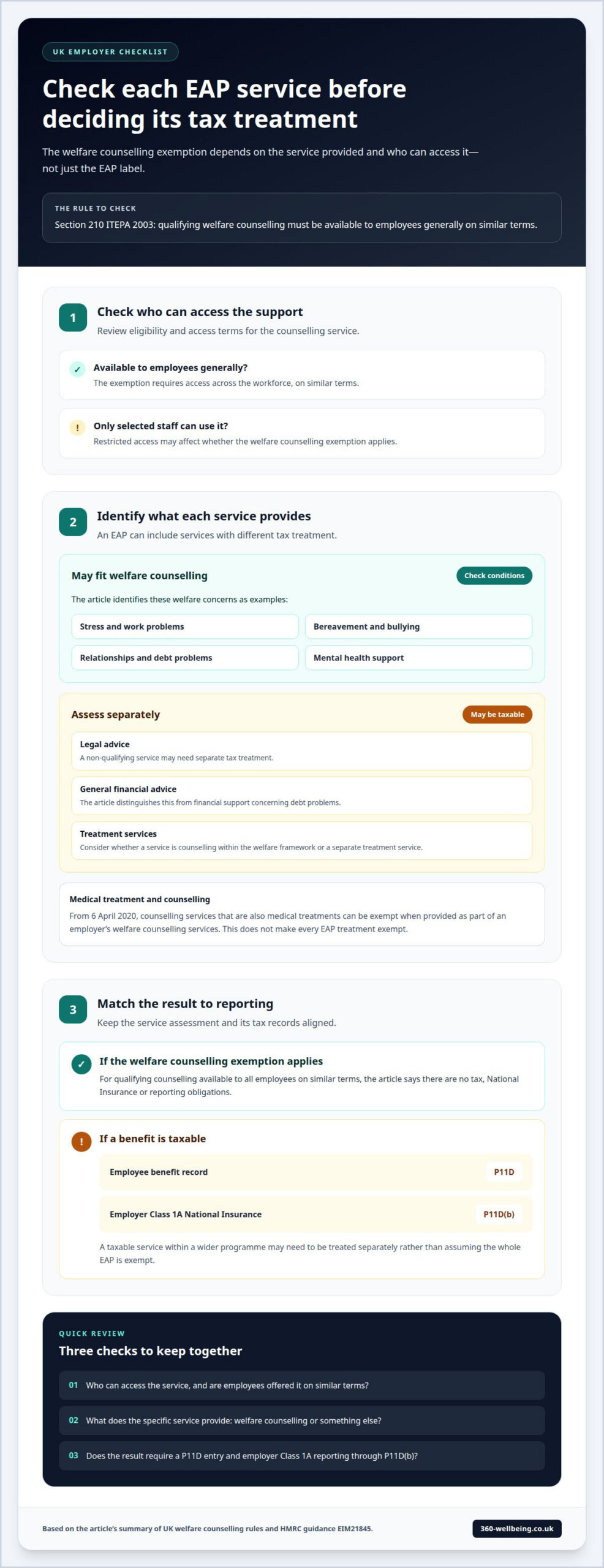
UK tax treatment depends on whether an EAP meets the welfare counselling exemption in Section 210 ITEPA 2003. According to the UK Government, qualifying welfare counselling must be available to employees generally on similar terms.
Employer-Funded EAP Tax Treatment
An employer-funded EAP is a workplace support programme paid for by the employer. Its tax treatment depends on the services it provides and the rules for accessing them.
Under Section 210 ITEPA 2003, qualifying welfare counselling can be exempt from income tax when it is offered generally to employees on similar terms. Support for stress, work problems, debt problems and mental health may fall within welfare counselling, while the programme’s precise services matter.
This distinction helps employers assess how counselling provided through a wider EAP may be treated. For example, support for an employee experiencing work-related stress may qualify differently from services outside the welfare counselling exemption.
EAPs and P11D Benefits in Kind
A P11D reports taxable benefits in kind provided to employees, including an EAP benefit when the relevant exemption does not apply.
An EAP made available across the workforce may qualify for the welfare counselling exemption, so the qualifying benefit does not need to be reported as a taxable P11D benefit. The access condition matters: providing the programme only to selected members of staff may affect whether that exemption applies.
If a service is taxable, the employer reports the benefit on the employee’s P11D. This means the programme’s contents and eligibility rules help determine whether P11D reporting is needed.
National Insurance Treatment
A qualifying EAP is not treated as a taxable benefit in kind for National Insurance purposes. Employers have no tax, National Insurance or reporting obligations for welfare counselling that is available to all employees and meets the stated conditions.
For a taxable EAP benefit, the employer pays Class 1A National Insurance contributions and reports them through the P11D(b) return. The employee’s P11D records the taxable benefit, while the employer’s Class 1A liability is handled separately.
So, the answer depends on whether the service qualifies for the exemption: qualifying counselling does not create a benefit-in-kind National Insurance charge, while a taxable benefit can create an employer Class 1A liability.
Reporting and paying tax and National Insurance on taxable benefits
If an EAP benefit is taxable, the employer must report it to HMRC and account for the relevant tax and National Insurance. The reporting route depends on whether the benefit qualifies for an exemption.
Reporting Tax and National Insurance
Reporting a taxable EAP benefit involves recording its value for the employee and handling the employer’s National Insurance liability. This matters because an EAP may combine counselling with services that aren’t exempt from tax.
The employer reports a taxable welfare counselling or EAP benefit on the employee’s P11D. Class 1A National Insurance is paid by the employer through the P11D(b) return. For example, where a programme includes non-qualifying legal advice, that service may need to be treated as taxable rather than assumed exempt alongside counselling.
By contrast, the UK Government says employers have no tax, National Insurance or reporting obligations for welfare counselling that meets the conditions and is available to all employees. The distinction depends on the service and its eligibility terms, not simply the EAP label.
Checking an EAP Entry on Payslips and P11Ds
If an EAP appears on your payslip or P11D, ask your employer’s payroll team what service the entry represents and how its taxable value was assessed. This can clarify whether the entry relates to counselling, mental health therapy or another programme service.
Then ask whether that particular service was treated as exempt from tax or as a taxable benefit. A P11D entry may reflect a taxable service within a broader programme, rather than all counselling provided. If the entry seems inconsistent with the support you received, raise the details with payroll and request an explanation of any correction they make.
It can help to distinguish welfare counselling from treatment, legal advice or other support, because each may have a different tax treatment. For employers reviewing a programme, workplace wellbeing support can sit alongside careful payroll reporting, with clear attention to which services employees can access.
HMRC guidance EIM21845
HMRC’s EIM21845 explains how the welfare counselling exemption applies to employee assistance programmes. It helps employers distinguish employee-focused welfare support from services that may create a taxable benefit.
The exemption covers counselling about welfare concerns such as stress, work problems, bereavement, bullying, relationships and debt problems. Mental health support can also fall within welfare counselling. The issue addressed matters: financial support must concern debt problems, rather than general financial advice, to fit the stated scope.
Medical treatment requires particular care. From 6 April 2020, counselling services that are also medical treatments can be exempt when provided as part of an employer’s welfare counselling services. This does not make every treatment within an EAP exempt. Employers need to consider whether the service is counselling within the welfare framework or a separate treatment service.
EIM21845 does not extend the exemption to services provided to family members, dependants or volunteer staff. Limited support involving an employee’s family may remain exempt under specific conditions. For example, family access should not use a separate phone line, and face-to-face counselling should be couples or family counselling. Support for an employee’s friends or family should relate to issues that also affect the employee.
Access across the workforce also matters. Qualifying welfare counselling must be generally available to employees on similar terms; a programme restricted to selected employees may not meet this condition. If an employee assistance programme combines qualifying counselling with services outside the exemption, employers should identify the separate elements and assess their tax treatment. A legal information service, for example, is distinct from counselling and has specific limits. Treating every service as exempt simply because it sits within one EAP could lead to incorrect reporting.
What HMRC rules apply to tax treatment of employer-provided EAPs?
UK EAP tax treatment follows the welfare counselling exemption in Section 210 ITEPA 2003 and S.I. 2000 No. 2080. HMRC’s guidance distinguishes qualifying employee welfare counselling from services that fall outside that exemption.
The exemption covers counselling about work problems, stress, bereavement, relationships, bullying and debt problems. It does not cover tax advice, leisure or recreation advice, or financial advice unrelated to resolving debt. Legal advice is also outside the exemption, although limited legal information may remain within its boundaries.
For legal information, the service should use one helpline number, provide high-level general guidance, and signpost employees to independent advice. The guidance describes a single session, rather than ongoing support, and says any necessary lawyer consultation should last less than 15 minutes. Reviewing an employee’s legal documents falls outside these limits.
Medical treatment has a specific rule. From 6 April 2020, counselling services that are also medical treatments can qualify when provided as part of employer welfare counselling. This does not make separate treatment services automatically exempt. Employers should distinguish counselling from standalone treatment when assessing each EAP component.
Mixed programmes need careful analysis. An EAP may qualify if it consists substantially of qualifying facilities and only an insignificant proportion falls outside the exemption. Where separate non-qualifying services can be identified, employers can separate them and treat those services as taxable for employees who use them. If separation is impractical and the outside element is insignificant, common sense applies. By contrast, an EAP containing both allowable and non-allowable counselling may not qualify as a whole.
The exemption also does not apply to EAP services provided through salary sacrifice. If an employer pays or reimburses an employee for further bespoke advice, that payment creates income tax and National Insurance charges. Explore employee assistance programme support as part of a workplace wellbeing approach grounded in these distinctions.
360 Wellbeing
360 Wellbeing supports employers building a broader approach to employee wellbeing, alongside the separate task of assessing EAP tax treatment. Its offerings include Mental Health Support, a 24/7 Virtual GP, Physiotherapy and 360 Rewards, helping address different aspects of workplace wellbeing.
If you’re reviewing how employee support fits your organisation, consider the needs your programme is intended to meet and how its services sit alongside your tax and reporting responsibilities. 360 Wellbeing can help you explore wellbeing support that brings mental and physical health into a more connected picture, without replacing the employer’s responsibility for determining tax treatment.
Contact 360 Wellbeing to discuss employee wellbeing support for your organisation.
Build wellbeing support with clarity
Workplace support decisions can shape employee experience and how your organisation manages its benefits. If you’re reviewing an EAP, consider its role in your wider wellbeing approach, while treating tax status and support design as related but distinct decisions.
Whether an EAP is a taxable benefit in the UK depends on the services and the conditions attached to them. For support beyond counselling, 360 Wellbeing also offers a 24/7 Virtual GP, Mental Health Support and 360 Rewards, helping employers consider a broader mix of employee benefits.
A considered approach can make it easier to align practical support with the needs of your workforce. If you’re exploring how an EAP could fit into that picture, contact 360 Wellbeing about EAPs to discuss the support your organisation is looking for.
Frequently Asked Questions
Are certain types of counselling excluded from the exemption?
Yes. The exemption does not cover tax advice, leisure or recreation advice, legal advice, or financial advice unrelated to debt problems. For example, help with budgeting to manage debt may fit the welfare counselling scope, while investment guidance does not. A service’s label alone isn’t decisive; employers need to consider what help employees actually receive through that part of the programme.
EAP Definition and Purpose: What does EAP stand for?
EAP stands for Employee Assistance Programme. It describes workplace support intended to help employees address personal or work-related concerns, such as stress or debt problems. An employer may provide counselling alongside other support, so the acronym describes the programme rather than confirming its tax status. For tax purposes, the actual services and the conditions for accessing them remain relevant.
Is an EAP affected by tax?
Yes, an EAP can have tax consequences, depending on its services and how employees access them. For instance, an employer-funded programme offered generally may receive different treatment from support delivered through salary sacrifice. Further bespoke advice paid for or reimbursed by an employer can also create tax and National Insurance charges. Consider the programme’s funding arrangement alongside its content.
Is an employer-funded EAP counselling service a taxable benefit?
Not necessarily. Employer funding alone doesn’t determine whether counselling is taxable; the welfare counselling exemption may apply if its conditions are met. For example, counselling offered on similar terms across the workforce may qualify, while a service restricted to selected employees may not. The distinction concerns access and the nature of the counselling, not simply who pays.
Is this an exempt benefit in kind for employment tax purposes?
It can be, if the support meets the welfare counselling exemption’s conditions. The UK Government states that welfare counselling is exempt from the employment benefits-in-kind income-tax charge when made available to employees generally on similar terms. A benefit offered to an employee’s dependant doesn’t automatically receive the same treatment, so the intended recipient matters when assessing a programme’s tax position.
Is an employee assistance programme (EAP) a taxable benefit in the UK?
An employee assistance programme may be exempt or taxable, depending on its design and services. A programme focused on qualifying welfare counselling may meet the exemption, but services outside its scope can change the outcome. For example, general legal advice or financial guidance beyond debt problems may need separate treatment. Employers should assess the support actually provided, rather than relying on the EAP name alone.