What makes a new staff benefits scheme useful is not simply the number of options it offers. Employees need to know what’s available, how to access it and where to get help. A practical guide to launching a new benefits scheme to staff starts with those questions, so thoughtful support doesn’t get overlooked.
When your workforce has different needs, roles and working patterns, it can be hard to know what to tackle first. This guide sets out how to build a launch plan, assign clear owners and milestones, and explain benefits in plain language. It also covers how to gather feedback and review engagement after launch, so communication doesn’t stop with the first announcement.
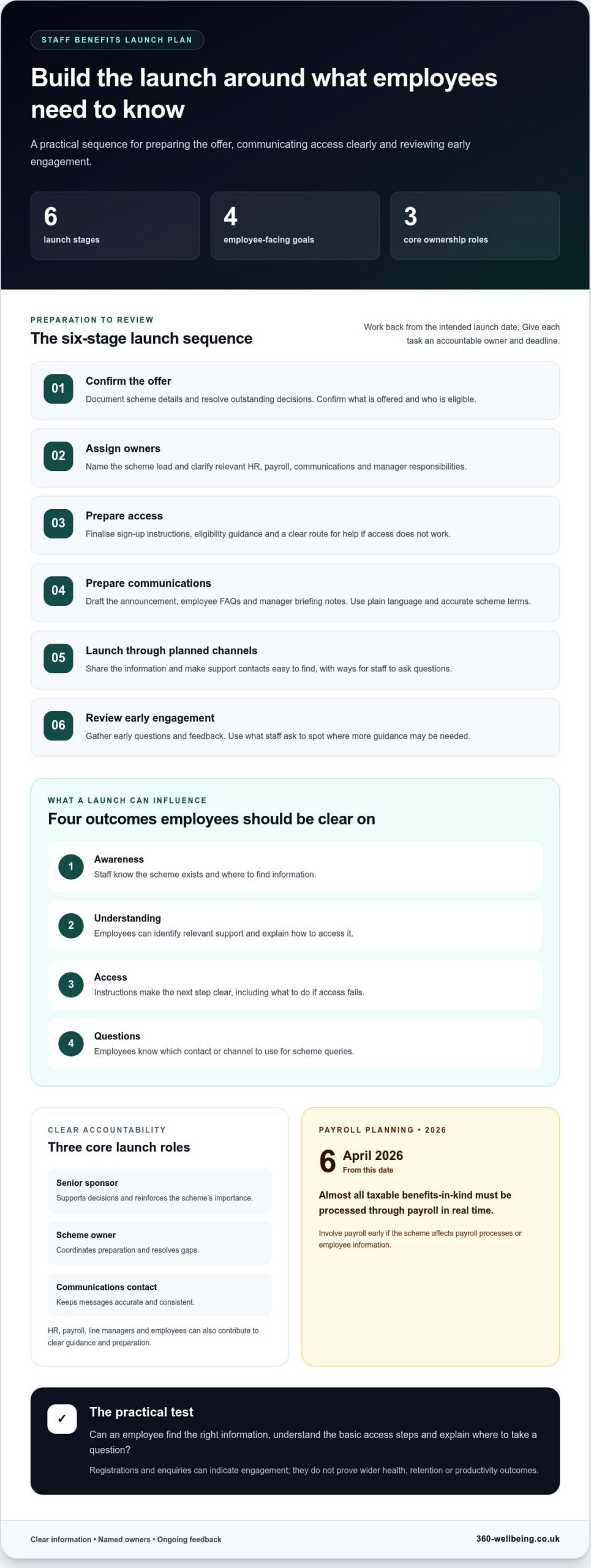
In 2026, payroll planning also deserves early attention: from 6 April, almost all taxable benefits-in-kind must be processed through payroll in real time. Consider this alongside scheme design, accessible communications and ongoing support. The aim is to help employees understand the physical, mental and financial wellbeing options available to them and feel confident about taking the next step.
Key Takeaways
- Use this guide to launching a new benefits scheme to staff to plan each step, from confirming the offer to reviewing how it’s working.
- Assign every launch task an owner and milestone, and give staff a clear route for questions.
- Choose channels that suit different teams, combining broad-reach messages with opportunities to ask questions.
- Look beyond registrations. Awareness, employee questions and feedback can reveal where more guidance is needed.
- See how 360 Wellbeing brings options such as Virtual GP access, mental health support, physiotherapy and life coaching together through an employer platform.
Why a new staff benefits scheme needs a people-first launch plan
A staff benefits scheme is an employer’s organised offer of workplace benefits and support. It might bring together physical, mental or financial wellbeing support alongside other benefits employees access through work. The wider Employee Benefit overview describes the range these schemes can cover. In practice, the value of a particular offer depends on whether staff can find and understand the benefits that apply to them.
That takes more than sending an announcement. Employees need clear information about what’s included, who can access it, how to get started and where to take questions. If the details are hard to find or the process is unclear, staff may lose confidence before they have a chance to explore the support. Treat access and communication as part of the scheme experience, not as an afterthought.
Keep scheme design separate from launch execution. Design determines what the employer offers and who is eligible; launch execution helps eligible staff understand and use that offer. Whatever the final mix, employees need straightforward signposting and a reliable way to get answers. A guide to launching a new benefits scheme to staff should start with what employees need to know and do.
What should a staff benefits launch achieve?
Set goals for communication and access rather than assuming a launch will deliver wider workforce outcomes by itself. For example, check whether employees know where to find benefit information, understand the basic access steps and know where to direct questions. These are specific aims the launch team can influence and review.
- Awareness: Staff know the scheme exists and where to find information about it.
- Understanding: Employees can identify relevant support and explain how to access it.
- Access: Instructions make the next step clear, including what to do if access doesn’t work.
- Questions: Employees know which contact or channel to use for scheme queries.
Registrations and enquiries can indicate engagement, but they don’t prove that a scheme has improved health, retention or productivity. Keep those wider aims separate from measurable launch objectives. A useful test is whether an employee can find the right information and explain what to do next.
Who needs to be involved before launch?
Assign clear ownership. A senior sponsor can support decisions and reinforce the scheme’s importance; a scheme owner can coordinate preparation and resolve gaps; and a communications contact can keep messages accurate and consistent. In a smaller organisation, one person may take on several roles, but responsibilities should still be explicit.
- HR can clarify eligibility, employee guidance and the route for questions.
- Payroll should be involved if the scheme affects payroll processes or employee information.
- Line managers can explain the launch to their teams when they have a defined role in communication.
- Employees can flag confusing language, access barriers and unanswered questions before launch materials are final.
Invite perspectives from employees with different roles and working patterns. Ask whether the information is clear, not for personal health or financial details. This helps the team improve the launch while respecting sensitive information, and creates a sound basis for the practical planning that follows.
Preparing a Benefits Scheme Before the Staff Launch
Before the first announcement, make the employee journey clear from start to finish. Treat preparation as a sequence, with an owner and decision point at each stage. This makes it easier to move from planning to communication without leaving basic questions unanswered.
Confirm the scheme details and employee journey
Create one accurate record of what the scheme offers, who it’s for and how employees access each benefit. Use the scheme’s terms, especially when explaining eligibility and sign-up steps. Map the journey from the first message to registration and first use, then note where employees might get stuck. Resolve unclear details before they appear in an FAQ or manager briefing.
At each step, ask what the employee needs to know or do. Can they find the right information? Do they know what to do if access doesn’t work? Is there a clear contact for eligibility questions? A platform that brings together a Virtual GP, physiotherapy, mental health support and life coaching may still need separate signposting for each option, even if the information is in one place.
Build a practical launch checklist and timeline
Work backwards from the intended launch date, allowing time for review and testing. Give each task one accountable owner and a deadline. Include approval points for scheme wording, eligibility information and employee instructions before any communications go out.
- Confirm the offer: Document scheme details and resolve outstanding decisions.
- Assign owners: Name the scheme lead and clarify relevant HR, payroll, communications and manager responsibilities.
- Prepare access: Finalise sign-up instructions, eligibility guidance and a route for help.
- Prepare communications: Draft the announcement, employee FAQs and manager briefing notes.
- Launch: Share the information through the planned channels and make support contacts easy to find.
- Review: Gather early questions and feedback, then update any unclear guidance.
Before launch, test every link and access step from an employee’s perspective. Check that instructions work on the devices and channels staff are likely to use, and that the help route reaches someone prepared to respond. Make materials easy to scan, use plain English and provide alternatives for employees who don’t regularly check email or an intranet.
Review tax, payroll and employment implications before confirming scheme details. These can depend on the benefits being offered and current UK rules, so use up-to-date, suitable guidance rather than relying on old templates or assumptions. Keep employee-facing explanations consistent with the advice received.
For employers considering connected wellbeing support, 360 Wellbeing’s employer platform brings together options including Virtual GP access, mental health support and physiotherapy. Clear preparation helps employees understand where each type of support fits within the scheme.
How to choose launch messages and channels staff will understand
A clear launch message answers employees’ immediate questions: what support is available, who can access it, how to get started and where to ask for help. Put these details before background on why the organisation introduced the scheme. Staff should be able to scan the announcement and quickly find the information that applies to them.
What should the launch announcement say?
Explain the scheme’s purpose in everyday language, then give a concise overview of its main support categories. For example, an offer might include physical, mental and financial wellbeing support. Name specific services using the scheme’s terms, and make eligibility and access steps precise. Avoid broad phrases such as “available to everyone” or “easy to use” if they don’t explain what employees need to do.
Be encouraging without promising results. Explain what support employees can access, rather than claiming that using it will improve their health, finances or work experience. If the offer includes a Virtual GP, describe that access accurately and provide the relevant route to get started. Put detailed instructions in a central source and link to it from the launch message.
How can employers reach different staff groups?
No single channel suits every working pattern. Email can deliver a consistent message, while briefings let staff hear an explanation and ask questions. An intranet page can hold information that needs to stay current, and manager conversations can make the announcement more personal. Each channel has limits, so combine routes rather than relying on just one.
| Channel | Role and audience | Practical limitation |
|---|---|---|
| Shares a consistent announcement and links with staff who regularly use work email. | Can be missed in a busy inbox or by employees who don’t check email during their working day. | |
| Team briefing | Explains the scheme to a group and creates space for questions. | Live sessions may not suit every shift, location or schedule; consider a repeat or recorded option where appropriate. |
| Intranet page | Provides a central reference for scheme details, access steps and FAQs. | Only helps if staff can access it and know where to find it. |
| Manager conversation | Connects the announcement to a team’s day-to-day context. | Inconsistent explanations can create confusion unless managers receive shared talking points. |
Pair written information with live or recorded briefings where useful. Give managers approved talking points and explain where to direct questions they can’t answer. Account for employees with limited digital access, those who prefer spoken explanations and staff who work outside standard office hours. Make the same core information available through suitable alternatives, and keep a central source current so messages don’t conflict across channels.
Invite questions without asking employees to disclose sensitive personal details in a group setting. A clear, private route for queries helps staff seek clarification comfortably and shows the launch team where messages may need improvement.
How to support staff through launch and measure early engagement
Make support available after the announcement, not just during it. Employees may have questions about access or eligibility, or encounter a technical problem when they try to use the scheme. Make the right contact easy to find, explain what they can help with and provide a private way to raise an issue. A visible route lets the organisation respond without employees having to share personal details with colleagues or managers.
What support should employees receive after launch?
Send a concise follow-up that links to the central scheme information and repeats the essential access steps. Managers can remind teams where to find guidance, but should signpost rather than ask staff to explain personal health or financial circumstances. Make clear how to report a technical difficulty, check eligibility or ask a general question, and who handles each type of query.
Update the central information as questions reveal where instructions need clarification. If an employee is unsure how to begin, for example, that may point to a need for clearer sign-up guidance rather than a lack of interest in the scheme.
How should employers review the launch?
Compare results with the communication and access objectives set before launch. Consider several signals together rather than relying on registrations alone. A low number of registrations, for instance, could reflect limited awareness, an access barrier or a mismatch between the message and staff needs. By itself, it doesn’t show how employees value the offer.
- Awareness: Ask whether staff know where to find scheme information.
- Access: Review registrations or reported difficulties where those measures are available and appropriate.
- Questions: Look for repeated queries that may point to unclear wording or missing guidance.
- Feedback: Invite voluntary comments on what was helpful and what caused friction.
Keep feedback proportionate and respectful. A short, voluntary survey could ask which information was clear, what employees struggled to find and what would make access easier. Avoid collecting health, financial or other sensitive personal details unless there’s a clear, appropriate reason. Explain how responses will be used, and review them in a way that doesn’t expose individuals.
Use what you learn to make practical improvements, such as simplifying instructions, adding an FAQ answer or changing how managers share information. Then schedule a follow-up review to see whether those changes helped staff find and understand the scheme. This turns the guide to launching a new benefits scheme to staff into an ongoing cycle of communication, support and learning, rather than a one-off announcement.
For employers bringing different areas of wellbeing support together, 360 Wellbeing’s employer platform brings a range of staff support options into one place.
How 360 Wellbeing can support a joined-up staff benefits launch
A staff benefits offer can bring different forms of support together, giving employees a clear place to turn as their needs change. 360 Wellbeing’s employer platform combines support across physical, mental, financial and legal wellbeing. A platform is one way to organise benefits, and employers can consider how it fits their goals, existing offer and workforce needs.
How can a wellbeing platform fit into the benefits offer?
360 Wellbeing’s platform includes a 24/7 Virtual GP, mental health support, physiotherapy and life coaching. It also includes financial support and debt advice, legal support, complimentary will writing and 360 Rewards, with a discount marketplace featuring thousands of offers. These options span different areas of life, but employees won’t all need or use the same services. Clear descriptions help each person understand what’s available and decide what may be relevant.
An employer could introduce the platform as a central way to find support, then signpost each service with a short explanation of its purpose and access route. This gives context to a range of benefits instead of presenting a long list of unfamiliar options. A separate resource on financial support for employees can also help employers consider how money-related support fits into a broader wellbeing offer.
The key is to make the employee journey easy to follow. Staff should be able to recognise the different types of support, locate the information they need and understand how to take the next step. The guide to launching a new benefits scheme to staff applies here too: a joined-up offer works best when clear signposting matches its structure. Consider the scheme as a whole, rather than assuming that more options automatically create a better experience.
What should employers do next?
Before introducing a platform, revisit the purpose of your scheme and what employees need to understand. Consider how the offer complements existing benefits, who is eligible, how staff will find each service and where they can get help with access questions. These decisions provide a practical basis for choosing launch messages and identifying what needs to be prepared.
Make sure the communication plan reflects the breadth of the offer. If support ranges from a Virtual GP to financial guidance and rewards, use plain descriptions and clear signposts rather than expecting employees to work out what each option means. Keep information in a useful central location and invite feedback so you can improve how the scheme is explained over time.
If you’re considering how platform-based support could fit your staff benefits scheme, explore 360 Wellbeing’s employer platform. A thoughtful fit between the offer, employee needs and launch communications can make it easier for staff to understand the support available to them.
Make your next step a thoughtful one
A benefits launch can start a more considered conversation about how your organisation supports people. Use the guide to launching a new benefits scheme to staff to turn your priorities into a practical plan, then keep listening as employees explore what’s available.
360 Wellbeing’s employer platform brings together physical, mental, financial and legal support options, including 24/7 access to a UK-registered GP. Consider how this breadth of support could fit within your scheme and how you’ll help employees find the options relevant to them.
Explore 360 Wellbeing for your team and take a considered next step towards a staff benefits offer that’s easier to understand and access. Keep communication clear and use staff feedback to improve the launch over time.
Frequently Asked Questions
Is a staff benefits scheme the same as an employee benefits package?
The terms are often used in similar ways, but they can describe different parts of an employer’s offer. A package usually means the benefits themselves, while a scheme can also refer to how those benefits are arranged and provided. In staff materials, define the terms you use and stick to them. For example, distinguish the overall package from a particular scheme employees need to register for or access.
Can a small business launch a staff benefits scheme?
Yes. A small business can build a scheme around its employees, resources and capacity to manage it. Start with a focused offer that’s straightforward to explain and administer. For example, a business might introduce one clearly defined area of support, then gather staff feedback before making changes. Name someone to handle queries, even if that responsibility sits alongside other duties.
How do you announce a new benefits scheme to staff?
Start with a straightforward explanation of why the scheme is being introduced, then describe what it includes and what employees should do next. Make room for questions people may prefer to ask privately. For example, provide a confidential contact for personal queries, and distinguish the support available from outcomes it can’t promise.
Should employers consult staff before launching a benefits scheme?
Yes. Employee views can reveal practical needs that may not be apparent during internal planning. A short survey or small discussion group could ask which types of support staff find relevant and what makes benefits information difficult to access. Consultation doesn’t mean every suggestion must be adopted. Tell employees how their input influenced decisions, and avoid asking for personal health or financial details unless genuinely necessary.
How can employers measure whether staff are using a benefits scheme?
Use measures that match the scheme’s purpose, such as awareness checks, registration information, recurring questions and voluntary feedback. If staff know about a benefit but aren’t registering, for example, review whether the instructions are clear and the access route works as expected. Treat usage data carefully and explain how it will be handled. A single early figure rarely explains why employees are or aren’t engaging.
Are employee benefits taxable in the UK?
Some benefits may have tax implications, but the treatment depends on the specific benefit and the circumstances in which it’s provided. Don’t assume one rule applies to the whole package. Before setting up payroll arrangements or explaining tax treatment to employees, check current HMRC guidance and seek appropriate payroll or tax advice. Keep staff communications factual, and direct employees to reliable guidance for questions about their own circumstances.
How often should an employer review a new benefits scheme?
Set an initial review after employees have had a reasonable chance to understand and access the scheme, then choose a regular review rhythm that suits your organisation. Consider staff questions, access issues and feedback alongside any suitable usage information. Review sooner if the workforce or scheme changes in a way that affects the employee experience. Share what you’ve learned and explain which improvements you’ll make, if any.