
Last year, 22.1 million working days were lost across the UK due to work-related stress, depression, and anxiety. It’s a staggering figure that highlights a growing challenge for modern businesses. You probably already recognise that your team is your most valuable asset, yet the pressure to maintain productivity while managing rising burnout can feel like an impossible balancing act. Understanding your legal duty of care for employee wellbeing uk shouldn’t feel like a source of anxiety, but rather a foundation for a healthier, more resilient workforce.
We’ve designed this 2026 guide to help you understand your statutory obligations under the Health and Safety at Work Act 1974 while building a proactive strategy that truly protects your staff. You’ll gain a clear perspective on the “reasonably practicable” standard and learn how to implement the new Principles of Workplace Health and Wellbeing Leadership. We’ll also provide a structured framework for conducting stress risk assessments and show you how integrating 24/7 Virtual GP access and mental health support can reduce absenteeism, improve retention, and ensure your business remains a place where people can thrive.
Key Takeaways
- Learn how the “reasonably practicable” standard helps you balance workplace risks, ensuring you don’t overextend while staying fully compliant.
- Understand why modern regulations treat mental health with the same weight as physical injury, helping you fulfill your legal duty of care for employee wellbeing uk.
- Follow a clear five-step framework to conduct effective stress risk assessments that protect both your staff and your business from burnout.
- Explore how addressing financial and legal stress can significantly reduce absenteeism and improve long-term employee retention.
- Discover how accessible digital health tools, like 24/7 Virtual GP access, make comprehensive corporate-level benefits achievable for SMEs.
What is the Legal Duty of Care for Employee Wellbeing in the UK?
At its heart, a duty of care is a promise. It represents the moral and legal obligation you hold to ensure the safety, health, and general wellbeing of your team. This isn’t just about preventing physical accidents or providing ergonomic chairs. In 2026, the legal duty of care for employee wellbeing uk extends deep into the psychological and social aspects of the workplace. It requires a panoramic view of health that treats mental stability with the same gravity as physical safety.
Your responsibilities as an employer stem from two distinct sources. Statutory duties are the specific laws passed by Parliament, such as the Health and Safety at Work Act. Common law duties, however, involve the historical precedents set by court rulings over decades. Understanding Duty of care in English law helps clarify that negligence occurs when an employer fails to act as a “reasonable” person would to prevent foreseeable harm. Today, this is no longer just an HR concern; it’s a governance-grade risk for directors. With poor mental health costing UK employers approximately £56 billion annually according to Deloitte (2024), protecting your staff is essential for business durability and financial health.
The law uses the “reasonably practicable” test to determine if you’ve met your obligations. This means you aren’t expected to eliminate every possible risk at any cost. Instead, you must weigh the level of risk against the time, trouble, and expense of the measures needed to control it. For many SMEs, implementing accessible digital support like a 24/7 Virtual GP or an Employee Assistance Programme (EAP) is a highly effective way to meet this standard without overextending resources.
The Core Pillar: Health and Safety at Work Act 1974
Section 2 of this Act is the foundation of your legal requirements. It mandates that you ensure the health, safety, and welfare of all your employees. The term “welfare” is particularly significant in a modern context. It encompasses the total environment of the workplace, including the mental atmosphere and the support systems available to staff. Failing to comply can lead to severe consequences:
- Substantial fines from the Health and Safety Executive (HSE).
- Costly and stressful employment tribunals.
- Long-term damage to your brand’s reputation, making it harder to attract top talent.
The Role of the Management of Health and Safety at Work Regulations 1999
These regulations take the general duties of the 1974 Act and turn them into specific actions. The most critical requirement is the performance of formal, documented risk assessments. You’re legally required to identify hazards that could cause harm to your staff. In 2026, these hazards are frequently psychological, such as excessive workloads, lack of control over tasks, or poor communication from management. A risk assessment in a modern office is a methodical review of work activities to identify psychological stressors and physical hazards that could undermine a colleague’s health. By identifying these factors early, you move from reacting to burnout to preventing it entirely.
Addressing Mental Health and Stress Under UK Employment Law
UK law now views psychological harm with the same legal weight as a physical injury. If an employee suffers a psychiatric injury due to their work environment, the courts look closely at whether the harm was “foreseeable.” This means that if you’ve noticed signs of struggle or received a direct complaint and didn’t act, your business could be liable. It is a vital part of your legal duty of care for employee wellbeing uk to recognise these signals before they escalate into long-term absence or legal action.
Excessive working hours also present a statutory risk. The Working Time Regulations 1998 set clear boundaries, such as the 48-hour weekly limit and mandatory rest periods. Ignoring these isn’t just an operational choice; it’s a breach of your legal obligation to prevent burnout. Additionally, under the Equality Act 2010, many mental health conditions are classified as disabilities if they have a substantial, long-term impact on daily life. This triggers a legal requirement to make reasonable adjustments, ensuring everyone has an equal opportunity to succeed regardless of their mental health status.
Managing Work-Related Stress (WRS)
To stay compliant, many organisations turn to the HSE Management Standards for work-related stress. These standards focus on six key areas: demand, control, support, relationships, role, and change. By monitoring these, you can identify where pressure is turning into harmful stress. For instance, if a team has high demands but very little control over their schedule, the risk of psychiatric injury increases. Proactive intervention is key. You might find our Workplace Mental Health: A Manager’s Guide helpful for identifying these early warning signs in your team.
Wellbeing Disclosures and Confidentiality
When an employee shares a mental health concern, you must handle that data with extreme care under UK GDPR. Confidentiality is paramount, yet it must be balanced with your duty to provide support. Making “reasonable adjustments”, perhaps flexible hours or a quieter workspace, is a legal necessity once a condition is disclosed. Having a robust Employee Assistance Programme (EAP) in place serves as powerful evidence that you are taking “reasonably practicable” steps to support your staff. It shows a commitment to providing professional, 24/7 care, which can be a vital component of your legal defence if a claim ever arises.
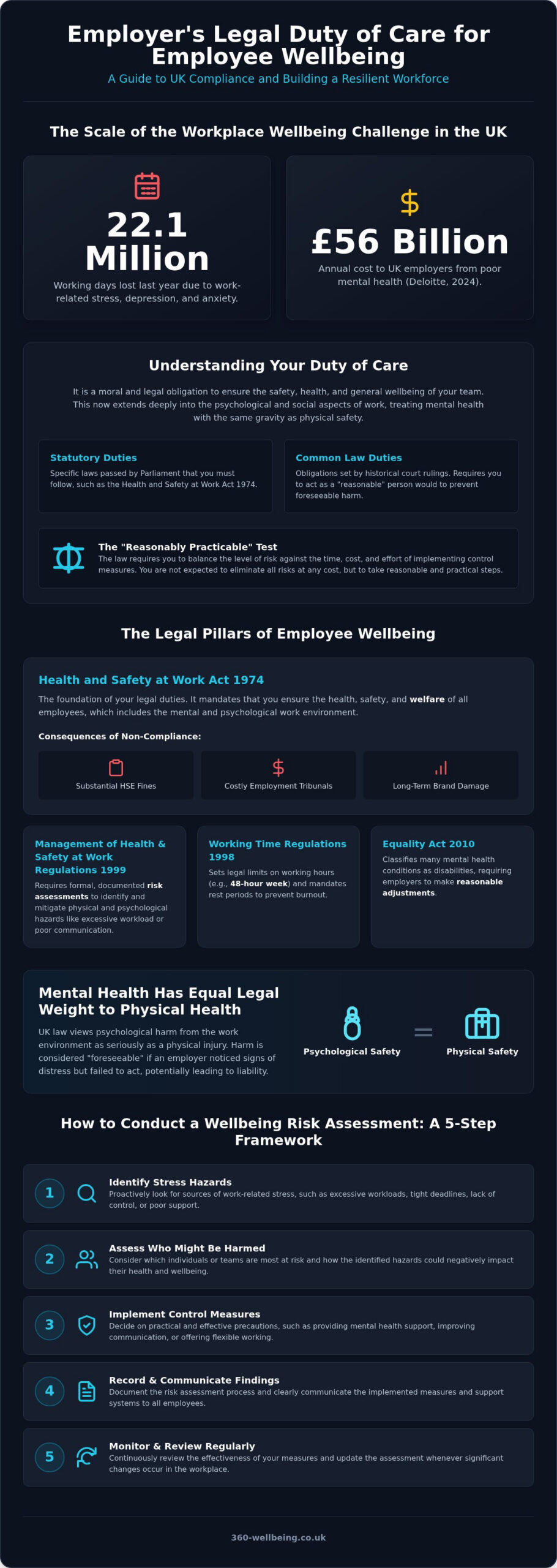
How to Conduct a Wellbeing Risk Assessment in 5 Steps
Moving from understanding the law to implementing it requires a structured approach. A wellbeing risk assessment isn’t a one-off paperwork exercise; it’s a living strategy that evolves with your team. By following these five steps, you can ensure your legal duty of care for employee wellbeing uk is met with precision and empathy.
- Step 1: Identify the hazards. Look beyond physical trips and falls. In a modern setting, hazards include excessive workloads, a lack of managerial support, or a poor physical environment that drains energy.
- Step 2: Decide who might be harmed and how. Different groups face unique pressures. Remote workers might suffer from isolation, while new parents or those with caring responsibilities may struggle with rigid schedules.
- Step 3: Evaluate the risks and decide on precautions. This is the “reasonably practicable” stage. You must decide if the risk of burnout is high enough to justify new support systems, such as mental health therapy or flexible working patterns.
- Step 4: Record your findings and implement them. This creates your audit trail. Documenting your actions proves that you’ve taken the necessary steps to protect your staff.
- Step 5: Review your assessment and update. Workplace dynamics change quickly. If you transition to a new hybrid model or launch a high-pressure project, your assessment must reflect these new realities.
Identifying ‘Invisible’ Hazards in the Modern Workplace
Today’s risks are often silent. Digital presenteeism, the feeling that you must be “always-on” and responsive to emails at all hours, is a significant psychological hazard. It erodes the boundary between rest and work, leading directly to the burnout characteristics seen in 63% of UK employees. We also see a growing link between financial strain and workplace performance. Financial instability is a primary driver of stress and absenteeism, making it a critical factor in any holistic risk assessment. Providing financial support for employees is a proactive way to mitigate this “invisible” risk before it impacts the business.
The Audit Trail: Why Documentation is Your Best Defence
If a wellbeing concern ever reaches an employment tribunal, your documentation is your strongest shield. A written wellbeing policy demonstrates that you have a formalised structure for meeting your duty of care. Regular 1-to-1 meetings are essential here; they serve as an early warning system for foreseeable health risks. To document a wellbeing conversation legally, record the date, the specific concerns raised, any agreed-upon adjustments, and the timeline for a follow-up review in a secure, GDPR-compliant file. This methodical approach ensures that your support is both consistent and legally defensible.
The Intersection of Financial, Legal, and Physical Wellbeing
Wellbeing isn’t siloed into separate compartments. A person’s financial health directly impacts their mental and physical state. In 2026, the ongoing cost-of-living challenges mean that financial anxiety is no longer just a personal matter; it’s a workplace hazard. When an employee is distracted by mounting debt or complex legal disputes, their risk of making errors or suffering a mental health crisis increases. This makes holistic support an essential part of your legal duty of care for employee wellbeing uk. You must view your staff through a panoramic lens, recognising that stress at home inevitably walks through the office door.
Negligence claims often arise when an employer ignores a foreseeable risk. If financial or legal stress is widely known to cause burnout or physical health decline, failing to provide accessible support could be seen as a breach of your duty. Providing a safety net doesn’t just show compassion; it builds a legal defence by demonstrating you’ve taken proactive steps to mitigate stress-related injuries. By integrating these services into your core strategy, you protect your business from the hidden costs of poor employee health and the potential for costly employment tribunals.
Providing 24/7 Access to Clinical Support
One of the most practical ways to support the “welfare” requirement of the Health and Safety at Work Act 1974 is by removing barriers to healthcare. Traditional GP waiting times can often delay diagnosis and prolong sickness absence, causing unnecessary strain on both the individual and the team. By offering 24/7 Virtual GP access, you empower staff to seek early intervention for both physical and mental ailments at a time that suits them. This foresight reduces the risk of long-term illness and ensures that minor health concerns don’t spiral into major operational disruptions or long-term disability claims.
Legal and Financial Safeguarding
We’ve moved beyond a time when debt helplines or legal support were considered mere “perks” for large corporations. Today, they are vital risk-mitigation tools for businesses of all sizes. Significant life events such as divorce, probate, or housing disputes can consume an individual’s mental bandwidth and energy. Within a modern Employee Assistance Programme (EAP), providing access to professional debt advice and complimentary will writing offers a panoramic support system that addresses the root causes of stress. These services allow employees to resolve personal crises more efficiently, returning their focus to their roles and significantly reducing the likelihood of stress-induced absenteeism.
To see how these elements work together to protect your business, explore our holistic employee benefits platform.
How 360 Wellbeing Helps You Fulfil Your Duty of Care
Transforming legal theory into a daily reality for your team doesn’t have to be a daunting task. While the Health and Safety at Work Act 1974 sets the standard, 360 Wellbeing provides the tools to reach it. Meeting your legal duty of care for employee wellbeing uk requires more than just a policy document; it requires a living, breathing support system that’s always available. Our platform bridges the gap between compliance and genuine care, making “corporate-level” benefits accessible to businesses of every size.
For SMEs, the “reasonably practicable” test is often the biggest hurdle. You want to protect your staff, but you must also protect your business’s financial health. 360 Wellbeing acts as your partner in this balance. By providing a suite of services like our 24/7 Virtual GP, mental health therapy, and a comprehensive Employee Assistance Programme (EAP), you demonstrate a proactive commitment to staff welfare. These aren’t just features; they’re evidence of a robust risk-mitigation strategy that identifies and addresses health concerns before they escalate into long-term absence.
A Proactive Vision of Workplace Harmony
We believe in moving away from reactive crisis management toward a proactive health foresight. Our platform offers a panoramic viewpoint of staff health, allowing you to see the connections between physical, mental, and financial wellbeing. This all-encompassing care ensures that your team feels empowered rather than just managed. When an employee can access a life coach or a physiotherapist at the touch of a button, they feel a sense of professional necessity and human entitlement to health. This culture of support is the most effective way to prevent the “foreseeable” psychiatric injuries that often lead to legal complications.
Affordable Compliance for Small Businesses
High-quality wellbeing support shouldn’t be a luxury reserved for global corporations. Our SaaS-based model democratises health benefits, allowing small businesses to offer the same level of care as industry giants. The return on investment is clear. By reducing absenteeism and improving staff retention, the platform pays for itself while safeguarding your legal standing. Integrating these tools into your existing HR strategy is seamless, providing a unified narrative of total wellness that is both scientifically grounded and deeply personal. Explore how 360 Wellbeing can support your team today and take the next step in your journey toward workplace harmony.
Building a Resilient Foundation for Your Workforce
Managing your legal duty of care for employee wellbeing uk is a journey that moves beyond simple compliance. It’s about shifting your perspective from reactive crisis management to a proactive vision of workplace harmony. By conducting regular risk assessments and acknowledging the deep links between mental, financial, and physical health, you create a culture where your team can truly flourish. You don’t have to navigate these complex regulatory standards alone; there are structured paths forward that make this essential work both manageable and rewarding.
Our platform is trusted by UK SMEs to improve productivity and retention through a panoramic approach to wellness. With 360 Wellbeing, your staff gain immediate access to UK-registered 24/7 Virtual GPs and a comprehensive EAP that includes both mental health and legal support. This level of care ensures that every challenge, whether personal or professional, is met with expert guidance. Book a demo of the 360 Wellbeing platform to protect your team today. Investing in your people is the most durable strategy for long-term success, and we’re here to support you every step of the way.
Frequently Asked Questions
Is employee wellbeing a legal requirement in the UK?
Yes, providing for employee wellbeing is a statutory legal requirement under the Health and Safety at Work Act 1974. While “wellbeing” isn’t a single law, it’s woven into your duty to ensure the “welfare” of your team. This means you must take proactive steps to prevent both physical and mental harm. Failing to do so leaves your business vulnerable to legal action and significant operational disruption.
What is the ‘duty of care’ for mental health at work?
The duty of care for mental health is your legal obligation to take all reasonable steps to support your staff’s psychological safety. It requires you to treat mental health with the same priority as physical safety. This involves identifying potential stressors and implementing support systems, such as an Employee Assistance Programme (EAP), to mitigate risks before they lead to serious psychiatric injury.
Can an employer be sued for work-related stress?
Yes, an employer can face legal action or employment tribunals if work-related stress leads to a diagnosed illness and was deemed “foreseeable.” If an employee has raised concerns or if a specific role is known for high pressure, you’re expected to intervene. Failing to act on these signals can lead to claims of negligence or constructive dismissal under the legal duty of care for employee wellbeing uk.
What does ‘reasonably practicable’ mean in a wellbeing context?
“Reasonably practicable” is a legal test that requires you to balance the level of risk against the cost, time, and effort needed to control it. You aren’t expected to eliminate every stressor, but you must implement measures that are proportionate to the risk. For many SMEs, providing digital health tools is considered a reasonably practicable way to offer high-level support without excessive expense.
Do I need a formal written wellbeing policy for my small business?
While there’s no single law requiring a “wellbeing policy,” having one is essential for businesses with five or more employees to meet general health and safety requirements. A written policy provides a clear framework for your team and acts as a vital audit trail. It demonstrates that you’ve considered your legal duty of care for employee wellbeing uk and have a structured plan to support your staff.
How does the Equality Act 2010 affect employee wellbeing duties?
The Equality Act 2010 protects employees with mental health conditions that have a substantial, long-term impact on their daily lives. Under this Act, you have a legal duty to make “reasonable adjustments” to help these individuals perform their roles. This might include flexible working hours, changes to the physical environment, or providing access to specialist mental health support through your benefits platform.
What are the consequences of failing to provide a safe workplace environment?
Failing to provide a safe environment can lead to severe financial and reputational consequences. You could face unlimited fines from the Health and Safety Executive (HSE) or costly settlements in employment tribunals. Beyond the courtroom, poor wellbeing environments often result in high staff turnover and a breakdown in workplace culture. This damage to your brand makes it significantly harder to recruit and retain the talent needed for long-term business durability.
How can a Virtual GP service help me meet my legal obligations?
A Virtual GP service helps you meet your duty of care by providing early intervention and removing barriers to medical advice. It allows employees to address health concerns quickly, often outside of traditional working hours, which reduces the risk of minor issues becoming long-term illnesses. By offering 24/7 access to UK-registered doctors, you’re taking a “reasonably practicable” step to safeguard the physical and mental welfare of your workforce.