Choosing employee benefits for logistics and transport sector teams means thinking beyond the size of the benefits list. Drivers, warehouse teams and office staff may have different roles, schedules and support needs, so practical access matters. Consider whether employees can find and use a benefit around a shift, a route or a depot.
Choosing benefits can feel like a balancing act: you want relevant support for employees while keeping costs and administration manageable. A package designed around office hours may be less accessible to staff who spend much of their working day away from a main workplace.
This guide compares benefit options through the realities of logistics and transport work. It covers physical, mental and financial wellbeing, including physiotherapy, mental health support, financial guidance and 24/7 access to a UK-registered GP. It also sets out practical steps for introducing benefits and explaining how employees can use them.
Key Takeaways
- Build employee benefits for logistics and transport sector teams around the needs of different roles, shifts and work locations.
- Compare benefits by the support they provide and how easily employees can access them in practice.
- Use workforce feedback to shape your package instead of choosing benefits simply because they’re trending.
- Plan a phased launch with clear communications so staff across shifts know what’s available and how to use it.
- Consider a joined-up platform that brings physical, mental and practical support together, including 24/7 Virtual GP access.
Why employee benefits in logistics and transport need to fit real working patterns
A driver starting before dawn, a warehouse operative on a rotating shift, a planner working to delivery schedules and an office-based colleague can all experience work differently. Their routes to support differ too. A benefit promoted only on an office noticeboard, or available only during a conventional working day, may be harder for some employees to use.
When choosing employee benefits for logistics and transport sector teams, match support to people’s working lives without assuming every business has the same roles, risks or priorities. Distinguish benefits employees can use directly, such as physiotherapy, an Employee Assistance Programme (EAP) or financial guidance, from workplace policies and operational provisions, such as shift arrangements, safety procedures and break planning. These can complement each other, but serve different purposes. A general overview of Employee benefits can help frame the range of support employers may consider.
Which workforce needs should employers consider first?
Start by mapping who works where and when. Note role types, shift patterns, travel requirements, depot or warehouse locations, and how employees currently find support. Then gather confidential feedback about physical, mental and financial priorities. Ask practical questions: can people access information during a break, use a digital service while away from a main workplace, and find out where to turn for help? The aim is to identify barriers, not make assumptions about individuals.
Why convenient access matters for shift-based teams
Support available outside conventional office hours can suit employees whose shifts, journeys or days off don’t align with a standard schedule. For example, employers can consider 24/7 access to a UK-registered Virtual GP for a workforce with varied routines. Around-the-clock access describes when a service can be accessed. It doesn’t mean a guaranteed appointment at a particular time or a specific health outcome.
Accessible benefits are support employees can understand and reach in a way that fits their role, schedule and work setting.
Access also depends on how information is shared. Digital support can help reach dispersed teams, but consider whether staff have suitable devices, connectivity and time to use it. Pair digital information with clear communications through channels that reach all shifts, and keep instructions simple. A benefit is more useful when employees know what it offers and how to find it, wherever their working day begins.
Which employee benefits can support logistics and transport staff?
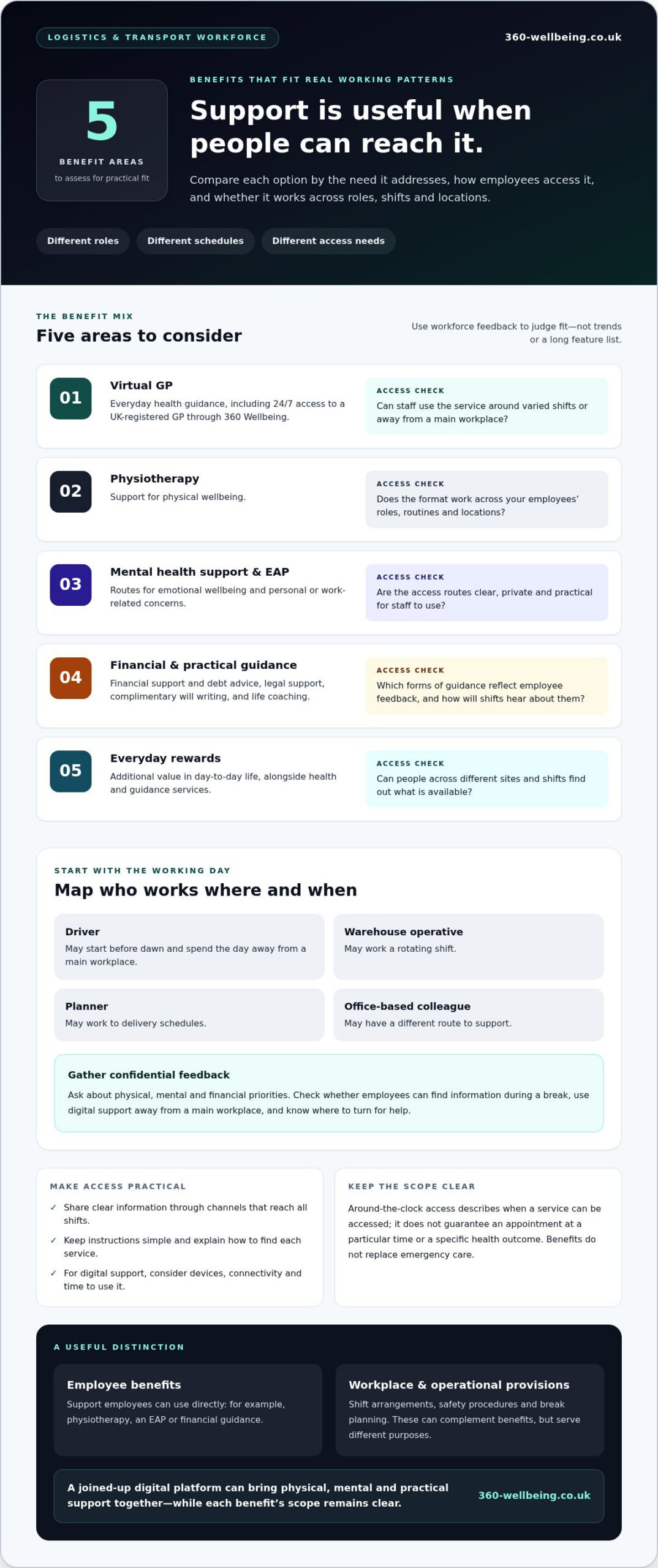
The right mix depends on employees’ needs and how they can access support. Use this comparison of employee benefits for logistics and transport sector teams to assess potential fit, rather than treating any one benefit as the answer for every workforce.
| Benefit type | Employee need addressed | Access considerations | Questions for employers |
|---|---|---|---|
| Virtual GP | Everyday health guidance | Consider access around varied shifts and while away from a main workplace. | Can employees find and use the service at a time that suits their routine? |
| Physiotherapy | Support with physical wellbeing | Consider how employees access information and support across locations. | Does the format work for the roles and routines in your workforce? |
| Mental health support and EAP | Emotional wellbeing and help with personal or work-related concerns | Make access routes clear and consider privacy and time to engage. | Will staff understand what support is available and how to reach it? |
| Financial and practical guidance | Help with debt, legal questions or will writing | Explain access clearly and share information through shift-friendly channels. | Which forms of guidance reflect feedback from your employees? |
| Everyday rewards | Additional value in day-to-day life | Ensure staff across sites and shifts can find out what is available. | How will you make the benefit visible to different teams? |
Physical and mental health support
A Virtual GP gives employees a route to health guidance without requiring them to be at a depot or office. 360 Wellbeing provides 24/7 access to a UK-registered GP, which can suit employees with varied schedules. Physiotherapy supports physical wellbeing, while mental health support and an Employee Assistance Programme (EAP) offer routes for emotional or practical concerns. Needs differ, and these benefits don’t replace emergency care.
A benefits platform brings support together digitally. It is not the same as private medical insurance or an on-site medical clinic. Assess what each benefit is designed to provide, and explain its scope clearly.
Financial, legal and everyday support
Financial Support & Debt Advice supports employees with money concerns, while legal support and complimentary will writing address different practical needs. Life coaching provides another option for employees seeking structured personal or professional guidance. For a closer look at workplace options, read this guide to financial support for employees.
360 Rewards adds everyday value alongside health and guidance services. 360 Wellbeing’s employee benefits platform brings these different kinds of support together, helping employers consider a broader mix for a diverse workforce.
How to compare employee benefit packages for your organisation
Start with your workforce, not a benefits trend or a long list of features. For employee benefits for logistics and transport sector teams, assess whether support matches staff needs and whether people across shifts, roles and locations can find and use it. Then consider the ongoing administration and how you’ll review whether the package remains relevant.
A practical framework for comparing packages
- 1. Identify needs. Use confidential feedback and existing workforce insight to understand which physical, mental, financial or practical support employees value.
- 2. Assess access. Consider how staff discover and use each benefit, including employees working nights, travelling or based away from a main site.
- 3. Compare support. Review what each option is designed to provide, where benefits complement one another and where gaps may remain.
- 4. Review usability. Check whether instructions are clear, access works for different staff groups, and employees can use support with suitable privacy.
- 5. Measure engagement. Decide what to review, such as awareness, feedback and available engagement information. Consider findings alongside workforce needs instead of treating usage alone as proof of value.
These steps help you compare options against what employees have told you, rather than selecting a benefit simply because it’s popular elsewhere. Review costs and administrative capacity internally too. Consider the budget, time needed to manage the package and how you’ll communicate changes. Don’t assume a benefit will deliver savings or a particular return. Set realistic measures your organisation can assess over time.
Questions to ask when evaluating a package
For each benefit, ask which employee need it addresses and how support is accessed. Can a driver away from a depot find the information as easily as an office-based colleague? Is the explanation clear about what the benefit offers, and can employees engage privately? Consider who will manage updates, answer routine questions and keep information current. These details shape the everyday experience as much as the benefit itself.
How to balance breadth with relevance
A broad package can bring different kinds of support together, while separate provisions let employers select individual options. Compare their scope and administrative demands with your organisation’s needs. A lengthy menu isn’t automatically useful if employees don’t recognise what’s available or how to use it. Prioritise support that responds to workforce feedback and can be communicated consistently.
Choose benefits for their relevance, accessibility and manageable administration, then review them using employee feedback and clear engagement measures. A joined-up platform such as 360 Wellbeing’s employee benefits platform brings a range of support together in one digital setting.
How to launch benefits across shifts and keep them visible
A thoughtful rollout helps employees understand what’s available and how to access it, whether they work at a depot, in a warehouse, on the road or in an office. For employee benefits for logistics and transport sector teams, communication needs to reach people beyond a single launch meeting or workplace noticeboard.
Use a clear sequence to make the introduction manageable:
- Align leaders and managers. Explain the purpose of the benefits and give those speaking with employees consistent, accurate information.
- Prepare the essentials. Create concise guidance covering what each benefit offers, who can use it, how to access it and any relevant boundaries.
- Introduce benefits across the workforce. Use suitable digital and workplace channels so staff on different shifts and in different settings receive the message.
- Invite questions. Provide an appropriate route for queries, then share useful answers consistently so employees aren’t relying on word of mouth.
- Review and improve. At planned intervals, assess awareness, engagement and feedback, and refine communications or priorities where needed.
Communicating benefits to a dispersed workforce
Keep messages brief and practical. A driver may need to save information for later, while a warehouse team may benefit from a short briefing during an existing team update. Digital communications can reach employees across locations, but shouldn’t be the only route if some staff have limited access to devices or connectivity during work. Repeat key messages through appropriate channels without sending so many reminders that people start to ignore them.
Use plain language to explain eligibility, how to access each benefit and what kind of support it provides. Make privacy clear, particularly for sensitive support, and don’t imply that a benefit guarantees a particular appointment or outcome. Invite questions through a suitable channel and share answers with all relevant teams, not just the shift or site where a query was raised.
Reviewing engagement and improving the offer
Set review points before launch. Check whether employees know what’s available, whether engagement information shows they’re accessing support, and what staff say about the experience. Compare patterns between roles or locations carefully. Differences may point to a communication or access barrier, but they don’t explain an individual’s circumstances.
Protect privacy by focusing on overall patterns and feedback rather than identifiable health information. If awareness is low, change how the benefit is explained or where information appears. If workforce feedback changes, revisit which support to prioritise. A digital benefits platform can bring support options together, while clear communications help employees find their way through them. Explore 360 Wellbeing’s employee benefits platform to see how joined-up support can serve a varied workforce.
A joined-up employee benefits approach with 360 Wellbeing
For a workforce spread across routes, depots, warehouses and offices, benefits are easier to navigate when employees can find different kinds of support in one place. 360 Wellbeing brings physical health, mental wellbeing and practical guidance together through an employee benefits platform. Employers can consider a broader package while recognising that employees have different needs.
What a broader support platform can bring together
Each service has a distinct role. 360 Wellbeing’s 24/7 Virtual GP provides access to a UK-registered GP, which is relevant for staff working varied schedules. Physiotherapy supports physical wellbeing, while mental health support and the Employee Assistance Programme (EAP) provide separate routes for emotional and practical support. These services can contribute to a wider wellbeing offer, but don’t guarantee a particular appointment, outcome or clinical result.
Life coaching offers a different kind of support for personal or professional development. Financial Support & Debt Advice, legal support and complimentary will writing address practical needs rather than medical care. 360 Rewards adds everyday value. Together, these options let employers consider multiple aspects of wellbeing while employees choose what’s relevant to them.
A joined-up approach still needs clear communication. Explain what each service is for, how employees can access it and where its boundaries lie. This helps staff across different roles and working patterns make informed choices instead of being presented with a one-size-fits-all solution.
A practical next step for employers
Start with the needs and access barriers identified in your workforce. Map each proposed benefit against the people it may support, how employees will find it and the effort required to manage and communicate it. Then assess the package as a whole: does it bring together useful support, or is it a collection of options employees may struggle to navigate?
360 Wellbeing provides a connected platform for organisations seeking support across physical health, mental wellbeing and practical needs. Assess it against your workforce priorities, administrative capacity and plans for keeping benefits visible across shifts and locations.
Explore employee wellbeing support with 360 Wellbeing and consider how a connected approach could fit your organisation.
Build a benefits package that works across your workforce
The most useful employee benefits for logistics and transport sector reflect employees’ different roles and routines, and are easy to understand and access. Start with workforce feedback, compare options by the needs they address, then introduce them through clear communications that reach people across shifts and locations.
A joined-up approach can bring physical, mental and practical support together. 360 Wellbeing’s platform includes 24/7 access to a UK-registered GP, mental health support, physiotherapy, an Employee Assistance Programme, financial and legal support, and 360 Rewards. Consider how this range fits your organisation’s priorities and how you’ll keep the benefits visible to employees.
Explore employee wellbeing support with 360 Wellbeing and take a considered next step towards a package that supports your people with care and flexibility.
Frequently Asked Questions
What employee benefits are most useful in the logistics and transport sector?
The most useful benefits match employees’ needs and are practical to access across different roles and schedules. Options include Virtual GP access, physiotherapy, mental health support and an Employee Assistance Programme (EAP), alongside financial or legal guidance and everyday rewards. The right mix varies between workforces, so use employee feedback and consider whether staff can find and use each benefit across shifts and locations.
How can employers make benefits accessible to shift workers?
Share clear access instructions through more than one channel, such as concise digital messages and workplace briefings that reach different shifts. Explain what each benefit does, who can use it and how to access it in straightforward language. Repeat key information periodically and provide a suitable way for employees to ask questions. Consider practical barriers too, including limited break times, travel, device access and whether staff can read or act on information during work.
Can a wellbeing platform support a workforce spread across different locations?
A digital wellbeing platform can bring support options together for employees working across sites or away from a main workplace. 360 Wellbeing’s platform includes 24/7 access to a UK-registered GP, mental health support, physiotherapy, an EAP, financial and legal support, and 360 Rewards. To make digital access useful, explain how employees reach the platform and consider whether staff have suitable devices, connectivity and time to engage.
What is the difference between an EAP and a Virtual GP service?
An EAP and a Virtual GP serve different purposes. An EAP provides a route to employee assistance, while a Virtual GP service provides access to a GP for health guidance. 360 Wellbeing offers both, including 24/7 access to a UK-registered GP. Explain each service clearly so employees understand which route may suit their needs. Neither benefit should be presented as emergency care or as guaranteeing a specific outcome.
How can employers find out which benefits their transport staff want?
Ask employees directly using confidential feedback methods, and give people across shifts, roles and work settings the opportunity to contribute. Use clear, neutral questions about physical, mental, financial and practical support, as well as barriers to access. Don’t assume one team’s priorities represent everyone’s. Review responses alongside existing workforce insight, then explain how feedback informed benefit choices so employees know their views were considered.
How should employers measure employee benefits engagement?
Track whether employees know what’s available, review engagement information and gather feedback at planned intervals. Consider patterns across roles or locations to identify where communication or access may need attention. Interpret figures carefully: low use may reflect limited awareness or access, rather than a lack of need. Protect privacy by reviewing appropriate overall patterns and avoiding the collection or sharing of identifiable health information as part of benefits evaluation.
Are digital employee benefits a replacement for occupational health support?
No. Digital employee benefits can complement wider workplace support, but they don’t replace occupational health input or workplace policies and provisions. A wellbeing platform may offer access to services such as a Virtual GP, physiotherapy or mental health support, while occupational health has a different role in relation to work and health. Explain these boundaries clearly, and ensure employees know which route is appropriate for their situation.