
Last Tuesday, a senior manager named David discovered that his top performer was facing a sudden, life-altering family emergency. In that high-stakes moment, knowing how to handle an employee’s personal crisis became more important than any quarterly target. You likely want to be supportive in these situations, yet the fear of saying the wrong thing or overstepping can lead to a paralyzed silence. It’s a heavy burden to balance genuine compassion with the pressure to maintain team output, especially when you weren’t given a manual for these human moments.
Mastering this delicate balance doesn’t require you to be a therapist; it requires you to be a bridge. This guide provides a structured framework to help you navigate these challenges with foresight and clinical precision. By viewing wellbeing as a professional necessity rather than a luxury, you can foster a workplace culture defined by durability and mutual trust.
We will provide a clear, step-by-step response plan that moves you from uncertainty to confident action. You will learn how to refer team members to professional resources, such as Mental Health Support or a 24/7 Virtual GP, ensuring they receive all-encompassing care while you maintain a stable and productive environment for the rest of your team.
Key Takeaways
- Shift your perspective to see personal stability as a core business KPI, ensuring the long-term durability of your team through a panoramic approach to wellbeing.
- Learn exactly how to handle an employee’s personal crisis by acting as a reliable bridge to expert care, avoiding the common pitfalls of the “therapist trap.”
- Gain the confidence to set professional boundaries while offering genuine compassion during sensitive disclosures about health, debt, or legal emergencies.
- Implement a methodical five-step framework designed to stabilize acute situations and facilitate a supportive path forward for both the individual and the organization.
- Discover how to integrate professional infrastructure like an EAP or 24/7 Virtual GP into your management strategy to provide immediate, expert-led support.
Understanding the Personal Crisis: Why Workplace Support is a Professional Necessity
A personal crisis in the modern workplace rarely arrives with a warning. In 2026, the definition has expanded beyond traditional bereavement to include acute financial emergencies, digital identity theft, or sudden caregiving responsibilities. Understanding how to handle an employee’s personal crisis requires a fundamental shift in perspective. Instead of viewing these events as external disruptions, leaders must adopt a panoramic view where an individual’s personal stability is recognized as a core business KPI. When an employee is struggling, their cognitive load is compromised, making professional durability impossible without the right support infrastructure.
Employers hold a significant duty of care that is both ethical and legal. Within the UK, failing to provide adequate support isn’t just a cultural lapse; it can lead to long-term absenteeism and potential legal complications regarding workplace stress. Ignoring the signs of a crisis often forces employees to try “powering through,” a strategy that eventually collapses under its own weight. This is why a structured framework is essential for every modern leader.
The Economic Reality of Personal Struggles
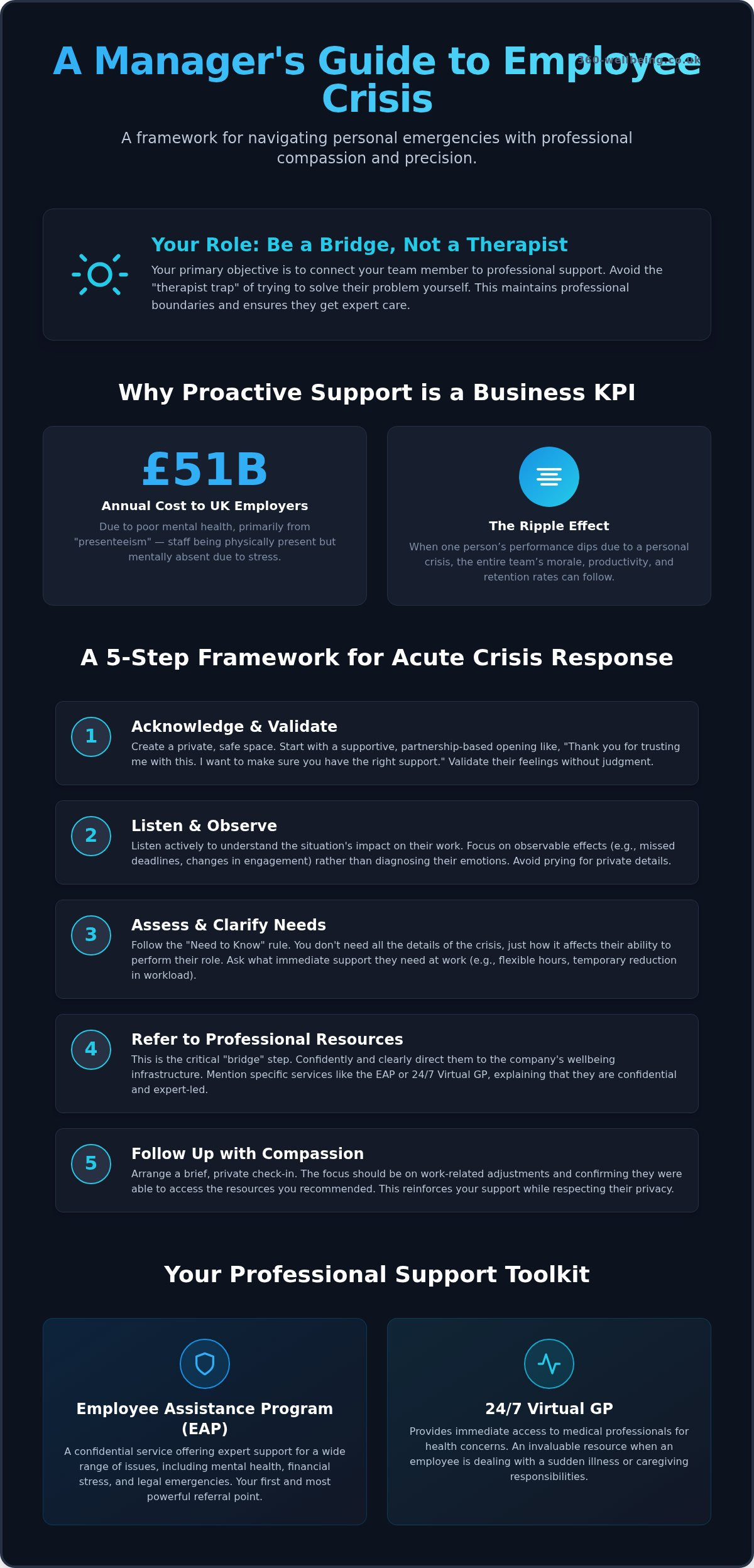
The financial implications are staggering. Poor mental health costs UK employers approximately £51 billion annually. Much of this isn’t due to people being off work, but rather “presenteeism,” where staff are physically present but mentally absent due to overwhelming personal stress. This creates a ripple effect. When one person’s performance dips, the entire team’s morale and retention rates often follow. Integrating robust Employee Assistance Programs (EAPs) isn’t a luxury; it’s a strategic necessity to protect your bottom line and ensure the health of your organization.
Foresight vs. Reaction
Waiting for a crisis to erupt before acting is the most expensive management strategy. We advocate for a shift from fear-based health warnings to proactive wellbeing partnerships. By normalizing conversations about mental and financial health before a crisis hits, you build a culture of trust. This foresight allows managers to refer staff to resources like Mental Health Support or a 24/7 Virtual GP before a situation becomes critical. It’s about moving toward a positive vision of workplace harmony where support is an essential human entitlement, not a one-off service provided in the heat of a moment.
The Manager’s Role: Acting as a Bridge, Not a Therapist
When a team member reveals a personal struggle, your first instinct might be to try and fix the situation. This is what we call the “Therapist Trap.” While well-intentioned, trying to solve the problem yourself is often counterproductive. You aren’t trained to handle clinical, legal, or deep financial complexities; attempting to do so risks providing incorrect advice and creates an unhealthy emotional dependency. Instead, the most effective way to understand how to handle an employee’s personal crisis is to view yourself as a bridge. Your primary objective is to connect the individual to the professional infrastructure already in place, ensuring they receive expert care while you maintain the stability of the team.
Maintaining clinical precision in your language helps keep the relationship professional. Avoid diagnosing or labeling behaviors with terms like “depressed” or “burnt out.” Instead, focus on observable impacts on their wellbeing and performance. This approach ensures you remain an approachable authority figure who prioritizes the employee’s long-term success without overstepping your professional remit.
Defining Professional Boundaries
Professional boundaries aren’t barriers; they’re safeguards for both parties. Following the “Need to Know” rule ensures you respect privacy and GDPR regulations while maintaining a focus on workplace durability. You don’t need the intimate details of a medical diagnosis or a legal dispute to provide meaningful support. Focus on how the crisis affects their daily role and refer them to specialized services. Using partnership-based opening phrases like, “I want to make sure you have the right expert support during this time,” establishes a supportive tone without prying into private matters. By directing them toward your Employee Assistance Programme (EAP), you provide a clear, structured path forward.
The Power of Active Listening
Sometimes, silence is the most empathetic tool in your kit. In an acute crisis, an individual often needs a witness to their experience, not a problem-solver. Validating their situation without offering unsolicited advice prevents you from giving unqualified suggestions that might complicate the issue. In a crisis context, active listening is the practice of providing a safe, non-judgmental space for an individual to feel heard without the immediate pressure of finding a solution. This methodical approach creates a sense of safety and order, which is essential for maintaining a high-trust workplace culture during turbulent times.
Categorising the Crisis: Tailoring Your Response to the Situation
Not all personal struggles demand the same response. Knowing how to handle an employee’s personal crisis effectively depends on your ability to categorise the challenge and deploy the correct resource from your infrastructure. A sudden bereavement requires a different logistical and emotional response than a complex legal dispute or a health scare. By identifying the specific nature of the crisis, you can ensure the support provided is both relevant and impactful, preventing the situation from escalating into long-term burnout or total disengagement.
Health-Related Crises and Virtual GP Access
Health emergencies often trigger high levels of immediate anxiety, which can quickly paralyse a person’s ability to function in their role. When a team member faces a sudden illness or an acute mental health episode, speed and clinical certainty are your most valuable tools. Access to a 24/7 Virtual GP provides immediate reassurance, helping them navigate the diagnostic journey without the added stress of waiting for traditional appointments. As a manager, your focus should be on adjusting workloads to allow for physical health recovery while ensuring the employee feels empowered to use their Mental Health Support sessions to build resilience.
Addressing Financial and Legal Strain
There is a direct, scientifically grounded link between financial stress and workplace productivity. When debt or legal turmoil looms, the resulting cognitive load makes it nearly impossible for an employee to maintain professional durability or focus on complex tasks. Integrating financial support and debt advice helplines into your crisis response provides a methodical path out of the chaos. Legal Support services offer the specialised expertise required to handle these situations, allowing the employee to regain a sense of order and safety that eventually translates back into workplace stability.
Family crises and bereavement remain the most sensitive areas of disclosure. These situations require deep empathy and the immediate removal of professional pressure to ensure the employee feels their wellbeing is a priority. Beyond these visible struggles, a manager must also stay alert to “hidden” crises, such as domestic abuse or addiction. These often manifest as sudden performance drops, erratic behaviour, or social withdrawal. In these cases, your EAP serves as a vital, confidential safety net, providing expert care that protects the individual’s privacy while addressing the underlying factors of the crisis.
A 5-Step Framework for Handling an Acute Employee Crisis
When high-urgency situations arise, a manager’s instinct can often be clouded by the pressure to maintain team continuity. Having a methodical framework for how to handle an employee’s personal crisis provides the necessary order to ensure both the individual and the business remain resilient. This five-step process moves from immediate stabilisation to long-term recovery, ensuring no one is left to navigate the chaos alone.
- Step 1: Immediate Stabilisation. Your first priority is removing professional pressure. If an employee is in acute distress, ensure they’re in a safe environment and grant immediate leave if necessary to allow them to breathe.
- Step 2: The Compassionate Consultation. Once the initial shock has passed, conduct a low-pressure meeting focused entirely on their wellbeing. Listen more than you speak; your presence is a form of support in itself.
- Step 3: Resource Mapping. Identify which professional tools from your infrastructure are needed, whether it’s the EAP for mental health, Legal Support for family turmoil, or the 24/7 Virtual GP for urgent health concerns.
- Step 4: Practical Adjustments. Agree on short-term flexible working or a phased return to duty. These adjustments protect their durability without compromising team output or morale.
- Step 5: Methodical Follow-up. Set a specific date to check in rather than leaving it open-ended. This ensures the bridge to support remains open and the employee feels consistently valued.
The Immediate Response (The First 24 Hours)
The first 24 hours of a crisis disclosure are critical for establishing psychological safety. If a team member shares a crisis mid-workday, stop what you’re doing and give them your full attention. This immediate, non-judgmental support signals that their health is a professional necessity, not a luxury. During this window, start a “Support File” to document facts and agreed-upon next steps. This isn’t about prying into private details; it’s about maintaining a clear record of the support provided while ensuring you remain compliant with GDPR and privacy standards.
Collaborative Problem Solving
Once you’ve stabilised the situation, the conversation must shift toward sustainable recovery. This involves moving from a retrospective look at “what happened” to a proactive discussion on “how can the platform help?” By referencing your wellbeing infrastructure, you provide a structured path forward that doesn’t rely on your personal advice. Setting realistic expectations for the team is equally vital to prevent burnout among other members while the individual is recovering. You can pivot from emotional validation to practical support by asking how the specific tools within our wellbeing infrastructure can alleviate the immediate pressure they’re feeling.
Leveraging Your Wellbeing Infrastructure: The Role of EAPs and Virtual GPs
While the manager acts as the bridge, the wellbeing infrastructure is the destination. Understanding how to handle an employee’s personal crisis effectively means knowing which professional tool to reach for when the initial stabilisation is complete. A comprehensive Employee Assistance Programme (EAP) is a leader’s most powerful ally. It provides the clinical, legal, and financial expertise that falls outside a manager’s remit. By directing a team member to these resources, you ensure they receive all-encompassing care that addresses the root causes of their distress, rather than just the symptoms visible at work.
- 24/7 Virtual GP: This serves as a vital emergency health valve, providing immediate access to UK-registered doctors for urgent health anxieties or physical symptoms of stress.
- Mental Health Support: This moves beyond simple “talk” by offering clinical therapy sessions that help employees build durable coping mechanisms.
- Financial Support & Debt Advice: These services provide a structured path forward for those facing the cognitive paralysis caused by monetary turmoil.
- Life Coaching: For crises that involve a lack of direction or life transitions, coaching offers a proactive way to regain a sense of vitality and purpose.
Normalising the Use of Professional Support
The success of any wellbeing strategy depends on how it’s framed within the team culture. You should pitch the EAP as a professional necessity and an essential human entitlement rather than a mere “perk.” When you reduce the stigma around seeking Mental Health Support or debt advice, you encourage earlier intervention. It’s helpful to emphasise the total anonymity and confidentiality of the 360 Wellbeing platform. Employees are more likely to engage with professional help when they know their privacy is protected and that seeking support is seen as a sign of professional durability, not weakness.
Long-Term Resilience and Retention
Handling a crisis with foresight and compassion builds a level of lifelong employee loyalty that traditional benefits cannot match. In 2026, a proactive wellbeing infrastructure is a significant competitive advantage. Data shows that the return on investment for mental health support programs can be as high as 4 to 1 for every pound spent. Conversely, the cost of turnover related to unaddressed mental health issues can reach up to 200% of an employee’s annual salary. By investing in a panoramic approach to health, you aren’t just solving a one-off problem; you’re securing the long-term interests of your workforce. Discover how 360 Wellbeing can provide the infrastructure your managers need to lead with confidence and clinical precision.
Building a Future-Proof Culture of Care
Navigating the complexities of the modern workplace requires a shift from reactive management to proactive partnership. By viewing wellbeing as an essential human entitlement, you create an environment where durability and empathy coexist. Mastering how to handle an employee’s personal crisis effectively involves recognizing your role as a bridge to professional support. When you rely on a structured framework and robust infrastructure, you protect both the individual’s dignity and the team’s long-term productivity.
The most resilient organizations are those that provide their leaders with a comprehensive “support file” of expert resources. You can Empower your managers with a 360 Wellbeing subscription to give them immediate access to a 24/7 UK-registered Virtual GP, clinical Mental Health Support, and a comprehensive EAP featuring vital Financial and Legal aid. Providing these tools ensures that your response to any crisis is grounded in clinical precision and genuine human care.
With the right systems in place, you’ll navigate even the most sensitive challenges with confidence and compassion. Your team’s vitality is your greatest asset; let’s protect it together through a panoramic approach to health and workplace harmony.
Common Questions on Managing Workplace Crises
How much time should I give an employee for a personal crisis?
Statutory requirements provide a baseline, such as two weeks of paid Parental Bereavement Leave, but most personal crises require a bespoke approach. You should offer immediate short-term leave for stabilization, typically three to five days, followed by a scheduled review. Flexibility is key to maintaining long-term durability. Using a phased return to duty helps the employee reintegrate without overwhelming their cognitive load during the recovery period.
Is it legal to ask an employee about the details of their personal crisis?
You shouldn’t ask for intrusive details, as your focus must remain on the workplace impact and support requirements. Under GDPR and UK privacy laws, employees have a right to confidentiality regarding their health and private lives. It’s better to ask how the situation affects their role and what adjustments they need. This approach ensures you understand how to handle an employee’s personal crisis without overstepping legal or ethical boundaries.
What should I do if an employee refuses professional help during a crisis?
You must respect an employee’s right to refuse support, as engagement with services like Mental Health Support or Life Coaching must be voluntary. Your role is to ensure they’re aware that the infrastructure is available whenever they feel ready. Continue to monitor their performance and wellbeing objectively. If the crisis begins to impact team safety or core deliverables, you may need to pivot toward formal performance management processes.
How do I manage the rest of the team while one member is in crisis?
Managing the wider team requires a balance of transparency and confidentiality. You don’t need to share specific details of the individual’s crisis, but you should communicate that a temporary workload adjustment is in place. Reallocate critical tasks fairly to prevent burnout among other members. This proactive redistribution maintains team morale and ensures that the collective output remains stable while one person focuses on their personal recovery.
When does a personal crisis become a disciplinary or performance issue?
A personal crisis transitions into a performance issue when prolonged instability affects core responsibilities despite reasonable adjustments being made. If an employee isn’t engaging with support and their output remains consistently below the required standard, you must follow your standard disciplinary procedures. The goal is always to provide a bridge to recovery first, but the business eventually requires a return to professional durability to maintain operational harmony.
Can I refer an employee to a Virtual GP for mental health crises?
Yes, referring an employee to a 24/7 Virtual GP is an excellent first step for acute mental health symptoms or physical distress. These UK-registered doctors provide immediate clinical reassurance and can offer guidance on the next steps for care. While the GP provides medical oversight, the employee can also access dedicated Mental Health Support sessions through the platform for longer-term therapeutic intervention and resilience building.
What is the difference between an EAP and private medical insurance?
An Employee Assistance Programme (EAP) provides holistic, proactive support for mental, financial, and legal challenges, whereas private medical insurance typically focuses on acute physical treatments or surgeries. Our EAP includes immediate tools like Financial Support & Debt Advice and Mental Health Support, which are designed to resolve the root causes of a crisis. It’s an all-encompassing infrastructure that supports an employee’s total wellness rather than just treating medical conditions.
How can I support an employee who is facing a financial crisis or debt?
When learning how to handle an employee’s personal crisis involving money, you should immediately refer them to specialized Financial Support & Debt Advice. Personal financial stress is a major driver of workplace presenteeism, so providing access to expert debt helplines is a professional necessity. Avoid giving personal financial advice or loans; instead, empower them to use the professional infrastructure available to create a methodical and sustainable path toward financial stability.