A benefits package adds support beyond salary. Examples of non-cash employee benefits in the UK include employer pension contributions, private medical insurance, mental health support, and fitness or physiotherapy services. Some benefits have tax implications, so it’s important to understand both what they offer and how they’re treated.
Choosing benefits means balancing different needs: financial security, physical health, and emotional wellbeing all matter. This guide explains what employee benefits packages can include, with practical examples ranging from pensions and medical cover to mental health and fitness support. It also shows how different benefits can work together to support people at work.
Key Takeaways
- Employee benefits packages combine non-cash support with salary, and the right mix can address financial security, health and wellbeing.
- Compare pension contributions and private medical insurance with care, as their tax treatment can differ.
- Explore mental health and fitness benefits alongside practical perks to build a more rounded package for employees.
- Consider how virtual GP access, mental health support, rewards and physiotherapy could complement the benefits you already provide.
Pension contributions and private medical insurance
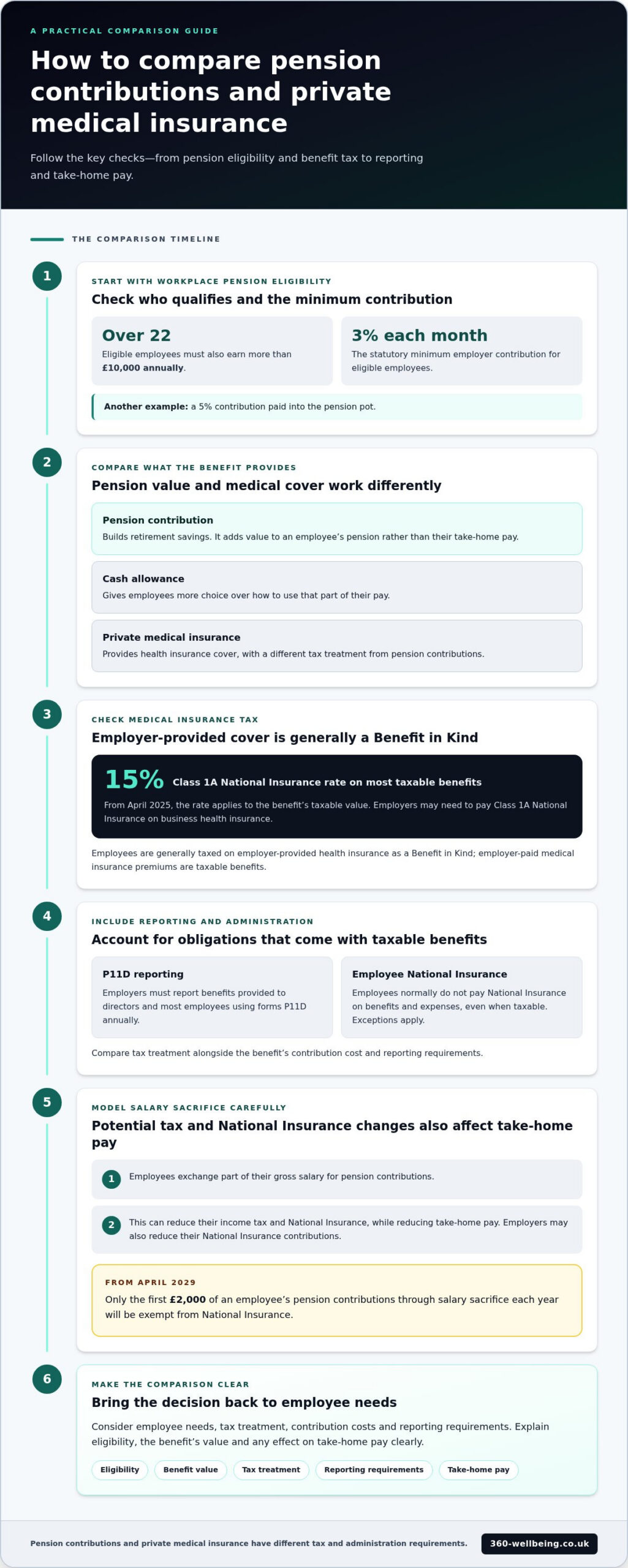
A workplace pension is a core part of a UK benefits package. Employers must offer one to eligible employees over 22 who earn more than £10,000 annually, with a statutory minimum employer contribution of 3% each month. An employer contribution adds value to an employee’s pension rather than their take-home pay. A 5% contribution is another example of a contribution paid into the pension pot.
Unlike salary or a cash allowance, a non-cash benefit provides a specific service or future value rather than money employees can spend freely. Pension contributions build retirement savings, while a cash allowance gives employees more choice over how to use that part of their pay.
Private medical insurance is another example, but its tax treatment differs from pension contributions. Employees are generally taxed on employer-provided health insurance as a Benefit in Kind, and employer-paid medical insurance premiums are taxable benefits. An employer may also need to pay Class 1A National Insurance on business health insurance. From April 2025, according to HM Revenue & Customs, the UK employer Class 1A National Insurance rate on most taxable benefits is 15% of the benefit’s taxable value.
Employees normally don’t pay National Insurance on benefits and expenses, even when taxable, although exceptions apply. Employers must report benefits provided to directors and most employees using forms P11D annually. These reporting and National Insurance obligations matter when comparing insurance with pension payments, because each benefit can carry different tax and administration requirements.
Salary sacrifice can change the National Insurance calculation: employees exchange part of their gross salary for pension contributions, which can reduce their income tax and National Insurance, while reducing take-home pay. Employers may also reduce their National Insurance contributions. From April 2029, only the first £2,000 of an employee’s pension contributions through salary sacrifice each year will be exempt from National Insurance.
When choosing benefits, consider employee needs, tax treatment, contribution costs, and reporting requirements. Explain eligibility, the benefit’s value, and any effect on take-home pay clearly. A pension contribution or medical insurance policy can make a useful example when communicating these details.
Mental health support and fitness benefits
A wellbeing package can support emotional health and physical activity alongside salary. Mental health support might include confidential counselling, structured therapy, or an Employee Assistance Programme (EAP). Employees can use these services to discuss work pressure, personal concerns, or practical challenges. An EAP may qualify as tax-free welfare counselling when it meets HMRC’s definition and is generally available to all employees.
Make access straightforward. Explain how employees can reach support, what help is available, and how confidentiality works. A benefit people understand and can use is more meaningful than a line in an annual package. For example, managers can share EAP details during onboarding and remind staff where to find them later.
Fitness benefits can include gym access, guided exercise sessions, or support for staying active during the working day. Physiotherapy provides professional support for movement or discomfort concerns. Health screening and medical check-ups offer another form of provision, giving employees a structured opportunity to discuss health questions and understand appropriate next steps.
Group health cash plans work differently from private medical insurance: employees may claim towards eligible healthcare costs under the plan. The value provided to employees is taxable as a Benefit in Kind, and employers may need to pay Class 1A National Insurance on the benefit. Consider this tax treatment alongside the actual services covered when assessing how a cash plan fits the wider package.
Choose benefits that complement one another. A counselling route, practical wellbeing resources and fitness support address different needs, rather than treating health as a single issue. Clear communication helps employees understand what each option is for and how to access it. Employers looking to strengthen emotional wellbeing can explore mental health support as part of a broader approach.
What are employee benefits packages?
A UK benefits package combines salary with employer-provided goods, services, and workplace arrangements. It may include flexible perks, but each item has its own tax treatment. Some benefits are taxable; others qualify for exemptions. Distinguishing between these categories helps employers explain what employees actually receive.
HMRC’s Benefit in Kind rules apply when employees receive goods or services free or at a greatly reduced cost. A taxable perk is generally treated as additional income and can affect an employee’s tax. For most benefits, the taxable amount is the cash equivalent: the employer’s cost minus any amount the employee pays. This is why a perk’s stated value and taxable value may differ.
A trivial benefit can be tax-free if it costs no more than £50 and meets the other qualifying conditions, according to HM Revenue & Customs. A modest non-cash gesture may qualify, but it is distinct from regular salary. Employers should record each item and its cost to apply the relevant treatment consistently.
Private-use assets have a specific calculation. According to HM Revenue & Customs, when an asset is made available for private use rather than given outright, its annual taxable benefit is 20% of its market value when first made available. That valuation rule can apply even when the employee doesn’t own the asset.
Accommodation also requires careful consideration. Employer-provided accommodation required for the employment may be exempt, while rent-free or below-market accommodation is normally taxable on the difference between rent paid and the property’s annual value. Company cars, living accommodation, and cheap loans have specific valuation rules rather than the general cash-equivalent calculation.
Salary sacrifice can affect which amount is taxed. An employee may be taxed on the salary they give up rather than the benefit’s value. The arrangement must change the employment contract before the employee becomes entitled to that cash remuneration. Keeping clear records of the scheme, benefit, and salary exchanged helps explain the tax treatment.
Examples of non-cash employee benefits
Useful benefits can meet different needs, from equipment and time away from work to health support. Examples include a work mobile phone, cycling equipment for commuting, group life insurance, extra paid leave, and mental health or fitness support. Match each option to employees’ circumstances, then explain its value and tax treatment clearly.
Remote and hybrid workers can receive an employer-provided mobile phone, with the exemption applying to one mobile phone per employee. Employers can also provide bicycles and cycling safety equipment for commuting between home and work. Digital wellbeing resources and flexible access to support can help remote staff engage, while making the same benefits available across different workplace arrangements.
Tax treatment varies by benefit. A company car is taxable, with its value calculated using the list price, emissions, and fuel type, then adjusted for the days it’s available. By contrast, qualifying group life insurance is generally not taxed on the employee. These distinctions matter: taxable benefits can count as additional income, while exempt benefits don’t create the same tax charge.
Workplace events offer a shared experience rather than extra earnings. According to HM Revenue & Customs, qualifying annual staff social events can be exempt from tax when their combined cost is no more than £150 per person per tax year. This can cover more than one qualifying event, provided their combined cost stays within the limit.
Other options include enhanced paid leave, volunteering time and relocation support. UK employees have a statutory minimum of 5.6 weeks’ paid annual leave, and employers can offer more. Removal and relocation expenses can be non-taxable up to £8,000 per move. For each benefit, make eligibility, access and any employee contribution easy to understand. To explore practical ways to support workplace wellbeing, discover employee wellbeing support.
360 Wellbeing: 24/7 Virtual GP
360 Wellbeing brings practical health and wellbeing support into an employee benefits package. Its 24/7 Virtual GP gives employees access to a UK-registered GP, while Mental Health Support includes therapy sessions. Physiotherapy can complement these options with support for physical wellbeing, and 360 Rewards adds a discount marketplace.
This combination may suit employers who want to complement pensions or other workplace benefits with accessible health support. It can bring physical, mental, and everyday wellbeing into a more connected package, rather than treating each need in isolation.
If you’re considering wellbeing benefits for your team, visit 360-wellbeing.co.uk to learn more about 360 Wellbeing.
Build a benefits approach that grows with your team
A benefits strategy works best when it reflects how people work and what helps them feel well and valued. Use employee feedback to identify priorities, then make access and eligibility easy to understand. Reviewing the package regularly can help keep it relevant as roles, working patterns, and team needs change.
When considering examples of non-cash employee benefits in the UK, focus on how each option fits alongside your existing support. The aim isn’t to offer every possible perk, but to take a considered approach that employees can understand and use. Clear communication turns a benefit from a policy detail into practical support.
If you’re shaping your next steps, contact 360 Wellbeing about employee benefits. A considered conversation can help you explore support that fits your workplace and take a positive step towards a more connected approach to wellbeing.
Frequently Asked Questions
Are they taxable?
Some non-cash benefits are taxable, while others qualify for an exemption. Treatment depends on the type of benefit and how it’s provided. For example, employer-paid health insurance is generally taxable for the employee, while qualifying employer pension contributions receive different treatment. Assess each item separately rather than assuming every perk in a package has the same tax outcome.
What are common examples of non-cash employee benefits in the UK?
Common examples include employer pension contributions, private medical insurance, a work mobile phone, cycling equipment, extra leave, and mental health support. The mix can reflect how a team works: a remote employee may value a work phone, while someone commuting by bicycle may benefit from cycling equipment. Compare options by considering who can use them and which needs they address.
Are non-cash employee benefits taxable in the UK?
Yes, some are treated as taxable income, but there isn’t one rule for every perk. Tax treatment depends on the benefit and how it’s provided. A company car, for example, follows specific valuation rules, while some benefits may be exempt if they meet qualifying conditions. Assessing each benefit separately helps employers understand what needs to be reported and what employees may owe.
Which UK employee benefits are tax-free or exempt from tax?
Examples that may qualify for an exemption include an employer-provided work mobile phone, bicycles and safety equipment for commuting, qualifying canteen meals, and accommodation required for the job. A trivial benefit may also be tax-free when it meets HM Revenue & Customs’ qualifying conditions. Exemptions depend on meeting the relevant criteria, not simply on a benefit being a workplace perk.
Are workplace pensions, health insurance and company cars non-cash benefits?
Yes. Each is provided in a form other than direct cash pay, although the tax treatment differs. Employer pension contributions go into a pension scheme; employer-paid health insurance is generally a taxable Benefit in Kind; and company cars follow specific valuation rules. When comparing benefits, consider both what each one provides and how it affects taxable income.