
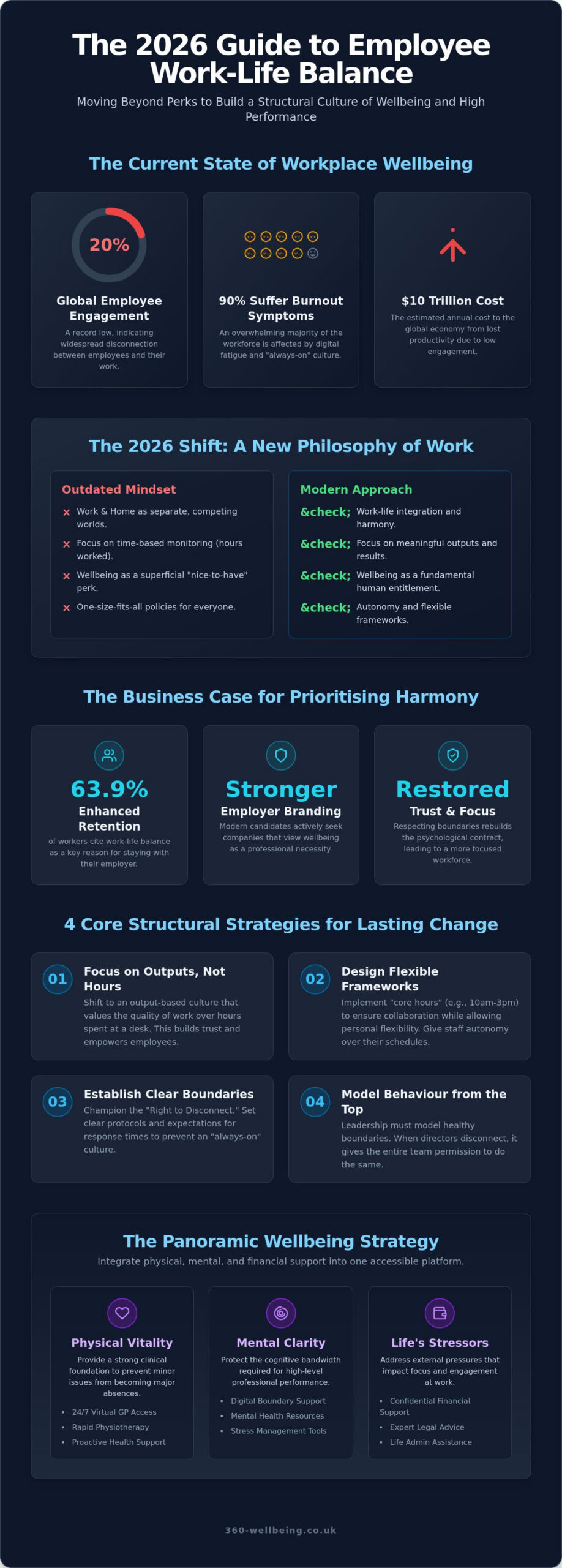
With global employee engagement hitting a record low of 20% and burnout symptoms affecting 90% of the workforce, the standard approach to corporate wellness is no longer enough. You’ve likely seen how the blurring of lines in remote and hybrid setups has made it harder than ever for your team to truly switch off. Promoting work-life balance for employees isn’t just about being a kind employer; it’s a professional necessity that directly impacts your retention rates and long term durability.
We understand that you want to support your people without overstretching a limited budget or sacrificing productivity. This 2026 guide moves beyond superficial perks to show you how to build a structural culture of wellbeing. We’ll explore how to integrate mental, physical, and financial support into a proactive strategy that transforms your workplace into a sanctuary of vitality and focus.
Key Takeaways
- Redefine balance as a fundamental human entitlement by shifting from time-based monitoring to a culture focused on meaningful outputs.
- Discover how promoting work-life balance for employees requires a clinical foundation, such as providing rapid access to a 24/7 Virtual GP and physiotherapy.
- Learn why addressing life’s stressors through financial support and legal advice is essential for maintaining a focused and engaged workforce.
- Explore the benefits of a panoramic wellbeing strategy that integrates physical, mental, and social health into one accessible platform for your team.
What Does Promoting Work-Life Balance for Employees Mean in 2026?
In 2026, the concept of Work-life balance has evolved from a “nice-to-have” benefit into a fundamental human entitlement. We’ve moved past the outdated idea of two separate worlds, work and home, competing for a finite number of hours. Instead, modern leadership focuses on work-life integration. This approach recognizes that our professional and personal identities are deeply intertwined. Promoting work-life balance for employees today requires a panoramic view of health that accounts for physical vitality, mental clarity, and digital boundaries. When these elements are out of sync, the friction doesn’t stay at the desk; it bleeds into every aspect of an individual’s life, eroding their long-term durability.
The 2026 Landscape: Beyond the 9-to-5
The rise of asynchronous work has shattered the traditional 9-to-5 mold. While this flexibility offers immense freedom, it has also created a culture of “always-on” expectations that can lead to rapid burnout. Digital fatigue is currently the primary threat to workplace harmony. In response, the UK has seen a surge in the “Right to Disconnect” movement, where businesses are increasingly establishing clear protocols to protect personal time. Promoting work-life balance for employees in this environment isn’t just about flexible hours; it’s about providing the mental permission and structural support for staff to be truly unreachable during their downtime. Setting these boundaries is essential for maintaining the cognitive bandwidth required for high-level professional performance.
The Business Case for Prioritising Harmony
The financial cost of ignoring this balance is immense for UK firms. According to the Gallup “State of the Global Workplace: 2026 Report,” employee engagement has fallen to 20%, a decline that costs the world economy an estimated $10 trillion in lost productivity. When employees feel overwhelmed, you see a rise in both absenteeism and “presenteeism,” where staff are physically present but mentally checked out. The benefits of a proactive strategy include:
- Enhanced Retention: The iHire 2025 Talent Retention Report found that 63.9% of workers cite work-life balance as a key reason for staying with an employer.
- Stronger Employer Branding: Modern candidates seek out companies that view wellbeing as a professional necessity rather than a luxury.
- Restored Trust: By offering autonomy and respecting boundaries, you rebuild the psychological contract between employer and staff.
Supporting your team’s personal life isn’t a distraction from your goals; it’s the engine that drives them. When people feel their time is respected and their health is a priority, they return to work with the focus and vitality needed to sustain a high-performing business.
Structural Strategies for Promoting Work-Life Balance
Meaningful change within an organisation doesn’t come from surface-level perks like fruit bowls or office socials. To build a resilient workforce, you must implement structural changes that empower your staff to manage their own energy. Promoting work-life balance for employees in 2026 involves a fundamental shift toward output-based management. When you focus on the quality of work produced rather than the number of hours a person spends at their desk, you create a culture rooted in trust and mutual respect. This transition requires leadership to model healthy boundaries from the top down. If directors don’t disconnect, the rest of the team will feel a silent pressure to remain available, undermining even the best-laid policies.
Establishing “wellbeing hours” or mandatory breaks can ensure your team gets the mental recovery they need to stay sharp. These aren’t just suggestions; they’re essential rituals that protect against the cognitive drain of constant connectivity. When you are promoting work-life balance for employees, the goal is to create a sustainable rhythm that benefits both the individual and the organisation. By making recovery a part of the structural workflow, you move away from a reactive “fix it when it’s broken” mindset toward a proactive vision of workplace harmony.
Flexible and Hybrid Working Frameworks
Designing a hybrid policy that actually works requires a commitment to employee autonomy and flexibility. A one-size-fits-all approach is often counterproductive. Instead, consider implementing “core hours,” perhaps between 10 am and 3 pm, which ensures team cohesion while allowing individuals to handle school runs or personal appointments. Clear communication protocols are equally vital. You must ensure that remote workers don’t feel “always on” by setting explicit expectations for response times and using digital tools to signal when someone is in deep-focus mode.
Managing Workloads and Preventing Burnout
Recent industry reports indicate that 90% of employees have experienced burnout symptoms in the past year, making workload management a survival strategy for your business. Regular capacity check-ins allow you to identify over-burdened team members early, before stress turns into long-term absenteeism. You should also actively encourage the full use of holiday allowances to prevent fatigue from accumulating. Automating repetitive tasks through modern software can significantly reduce cognitive load, allowing your people to focus on high-value tasks that drive engagement. If you are ready to move beyond generic benefits, a unified wellbeing platform can help you integrate these structural changes seamlessly into your daily operations.
The Health Foundation: Why Clinical Support is Key to Balance
True work-life harmony isn’t just about managing a calendar; it’s about the physical and mental capacity to enjoy life outside of work. When an employee is struggling with chronic pain or a persistent illness, the very idea of “balance” disappears. Pain is exhausting. It drains the cognitive resources needed for professional focus and the emotional energy required for family life. Promoting work-life balance for employees must therefore start with a solid health foundation. By providing a safety net of clinical support, you ensure that health concerns don’t become the barrier that shatters an individual’s ability to thrive. This proactive foresight is what differentiates successful work-life balance strategies from temporary fixes.
Integrating clinical expertise into the daily employee experience transforms wellbeing from an abstract concept into a tangible reality. It’s about moving away from reactive “sick days” toward a culture of durability and care. When you provide your team with direct access to medical professionals, you’re not just offering a benefit; you’re offering reassurance. You are telling them that their health is a priority, and you’re giving them the tools to maintain it without the stress of long waiting lists or complex referrals.
24/7 Virtual GP Access as a Productivity Tool
Waiting weeks for a doctor’s appointment creates immense worry. For a parent with a sick child or a carer managing a loved one’s needs, that delay is a constant source of distraction. Providing immediate access to a 24/7 Virtual GP removes this burden. It allows staff to get professional medical advice or prescriptions at a time that suits them. They don’t have to take half a day off or sit in a crowded waiting room. This rapid access acts as a vital early intervention tool. It catches minor issues before they escalate into long-term health challenges or musculoskeletal problems that might require intensive Physiotherapy later on.
Comprehensive Mental Health & Life Coaching
We often view therapy as a reactive measure for when things go wrong. However, in a modern workplace, Mental Health Support should be a proactive necessity. It provides a safe space for employees to process the inevitable pressures of life and work before they lead to burnout. Life Coaching adds another layer to this support, helping individuals develop the skills to set and maintain personal boundaries. When you normalise these services within your culture, you remove the stigma that often prevents people from seeking help. This panoramic approach ensures that mental wellbeing is treated as a professional necessity rather than an afterthought. Promoting work-life balance for employees is only possible when your team feels mentally resilient and emotionally supported.
Addressing Life’s Stressors: Financial and Legal Wellness
Work-life balance is often discussed as a simple time-management challenge, but the reality is far more complex. You can provide all the flexible hours in the world, yet if an employee is sitting at their desk worrying about rising debt or an unresolved legal dispute, they are not truly present. These external stressors are silent productivity killers that bleed across the boundaries of home and office. Promoting work-life balance for employees requires a panoramic approach that acknowledges these human vulnerabilities. By providing a safety net of expert advice for life’s most difficult moments, you move from being just a workplace to being a genuine partner in your team’s durability. For a deeper dive into the economic side of this strategy, you can explore our Financial Support for Employees: A Comprehensive Guide for UK Employers in 2026.
Debt Advice and Financial Guidance
Financial anxiety is a leading cause of workplace distraction. In 2026, the pressure of managing a household budget remains a significant weight for many people. Providing confidential Financial Support & Debt Advice through professional helplines gives your staff a safe, non-judgmental space to seek clarity. It’s about empowerment. When employees have access to tools for financial planning or discount marketplaces like 360 Rewards, they feel more in control of their personal economy. This sense of agency directly reduces the mental noise that prevents them from switching off after work or focusing during the day. It’s a proactive way to ensure that money worries don’t become the primary driver of employee burnout.
Legal Support and Life Admin Assistance
Legal burdens are another significant disruptor of mental bandwidth. Whether it’s a dispute with a landlord, a consumer issue, or the complex process of family law, these problems are mentally exhausting. Offering Legal Support through expert helplines provides immediate reassurance and a clear path forward. One of the most valued but often overlooked benefits is Complimentary Will Writing. It’s a high-value service that removes a major piece of “life admin” from an employee’s plate, providing peace of mind for their family’s future. By helping your team settle these long-term concerns, you free up the mental space they need for both professional creativity and personal rest. Promoting work-life balance for employees means looking after the whole person, ensuring that personal admin doesn’t become a second, unpaid job.
If you want to protect your team from the stressors that bleed into the workday, explore our integrated wellbeing solutions to see how we can support your business.
Implementing a Panoramic Wellbeing Strategy with 360 Wellbeing
Building a culture of wellbeing is a journey rather than a destination. To be truly effective, your approach must be as dynamic as the lives of your people. Fragmented benefits, where an employee has one login for a medical service and another for a discount code, often go unused because they are too difficult to navigate during a crisis. Promoting work-life balance for employees is far more successful when you provide a single, unified point of care. This panoramic viewpoint ensures that whether someone is seeking Mental Health Support or looking for Physiotherapy, the path to help is clear and immediate. By consolidating these services, you remove the friction that often prevents staff from seeking the support they deserve.
For many SMEs and sole traders, enterprise-level care has historically felt out of reach. We’ve changed that by creating a managed ecosystem that makes comprehensive support affordable and accessible. Our platform acts as a partner in your business’s durability, providing the foresight to catch health and lifestyle issues before they escalate. It’s about moving away from reactive fixes toward a proactive vision of workplace harmony that evolves alongside your company’s growth.
The 360 Wellbeing Platform Advantage
The modern workforce expects support to be available whenever and wherever they need it. Our mobile technology provides 24/7 access to clinical experts, including Virtual GPs and Life Coaching, directly through a single app. This level of accessibility is a professional necessity in the age of hybrid work. Beyond clinical care, the 360 Rewards marketplace provides tangible daily value, helping to ease the cost-of-living pressures we discussed earlier. For employers, this integrated approach significantly reduces the administrative burden. You don’t have to manage multiple providers or complex contracts; instead, you have one reliable partner looking out for your team’s long-term interests.
Measuring the Success of Your Balance Initiatives
Promoting work-life balance for employees requires constant refinement. You can’t simply “set and forget” a wellbeing strategy. Successful organisations use employee feedback loops to understand which tools are providing the most value. You should regularly track key metrics such as:
- Absenteeism and Presenteeism: Are people taking fewer sick days, and are they more focused when they are at work?
- Retention Rates: Is your reputation as a caring employer helping you keep your best talent?
- Engagement Scores: Do your team members feel empowered and respected in their roles?
The long-term ROI of this empathetic approach is clear. When you invest in the total wellness of your people, you aren’t just protecting their health; you’re protecting your bottom line. A workforce that feels supported, heard, and valued is a workforce that stays loyal and performs at its peak.
Secure the Long-Term Durability of Your Team
True harmony in the workplace emerges when we stop viewing wellbeing as a luxury and start treating it as a professional necessity. By moving beyond surface-level perks and implementing structural changes, you create an environment where your people can truly flourish. A foundation of clinical care and the removal of personal stressors like financial or legal anxiety are the real drivers of engagement and focus.
Promoting work-life balance for employees isn’t just a trend for 2026; it’s a commitment to the human beings who power your business every day. Our platform is designed specifically for UK SMEs and sole traders, providing 24/7 access to UK-registered GPs alongside holistic mental health, legal, and financial advice. It’s time to move toward a proactive and positive vision of workplace harmony that protects your people and your productivity.
Book a demo of the 360 Wellbeing platform and transform your workplace culture today. Your journey toward a more resilient, focused, and empowered workforce starts here.
Frequently Asked Questions
What is the most effective way to promote work-life balance for employees?
The most effective approach is to shift from a time-based culture to an output-based management style. This transition empowers your staff to manage their own energy and schedules around their personal lives while maintaining high-quality professional results. Promoting work-life balance for employees requires a panoramic strategy that integrates physical health, mental resilience, and clear structural boundaries within the daily workflow of the organisation.
Can small businesses afford to provide comprehensive wellbeing benefits?
Yes, small businesses can provide enterprise-level care by using managed ecosystems designed specifically for SMEs and sole traders. Platforms like 360 Wellbeing consolidate various services, such as Virtual GPs and Mental Health Support, into a single affordable package. This approach removes the high costs typically associated with fragmented traditional medical plans, making holistic care a reality for teams of any size.
How does a Virtual GP service help with work-life balance?
A Virtual GP service provides immediate medical advice, which eliminates the immense stress of waiting weeks for a local appointment. It’s an essential tool for promoting work-life balance for employees who have caring responsibilities or young children. By offering 24/7 digital consultations, you help your team resolve health concerns quickly without them needing to take half a day off for a routine check-up.
What are the first signs that an employee’s work-life balance is failing?
The first signs often include a noticeable shift in temperament, such as increased irritability, social withdrawal, or a lack of engagement in team activities. You might also see a rise in minor mistakes or a sudden increase in short-term absenteeism. Identifying these indicators early allows for a proactive consultation before temporary stress transforms into long-term burnout or persistent physical health issues.
Is it better to offer flexible hours or a four-day work week?
The choice depends on your operational needs, but flexible hours generally offer more personalised autonomy for a diverse workforce. While a four-day week is a punchy benefit, flexible working allows employees to integrate daily life admin and family commitments more naturally. The key is to provide a framework that prioritises employee choice while maintaining team cohesion through core hours.
How can managers model better work-life balance for their teams?
Managers model balance by setting explicit boundaries around their own digital availability and taking their full holiday allowance. When leadership openly disconnects, it gives the rest of the team the “psychological permission” to do the same. This creates a durable culture where rest is viewed as a professional necessity and an essential human entitlement rather than a sign of weakness.
What role does financial support play in employee wellbeing?
Financial support reduces the cognitive drain caused by money worries, allowing staff to remain focused and present during the workday. When employees have access to debt advice or financial planning tools, they feel more in control of their personal economy. This stability is a vital component of total wellness, ensuring that financial friction doesn’t bleed into their professional performance or home life.
What is the ‘Right to Disconnect’ and should my UK business have a policy?
The ‘Right to Disconnect’ refers to an employee’s entitlement to ignore work-related communications outside of their contracted hours. While UK legislation continues to evolve, implementing a clear policy now is a forward-thinking move that builds trust. It establishes a sense of safety and order, helping to prevent digital fatigue and demonstrating a proactive commitment to your team’s long-term mental health.