
53% of frontline call centre employees report symptoms of stress. Burnout can develop when demanding customer interactions, performance targets and limited recovery time build up without enough support. Effective stress management solutions for call centre staff combine manageable workloads and regular breaks with access to practical wellbeing support.
It’s easy to see pressure as part of a fast-paced customer service role, but persistent stress shouldn’t be treated as inevitable. Noticing early changes in mood, concentration or work patterns helps managers respond before strain deepens.
This article explains what can drive call centre burnout and how managers can help: from creating space away from the phone to reviewing workloads, offering quiet time and making mental health support accessible. The aim is a more sustainable approach that supports staff wellbeing alongside the demands of the role.
Key Takeaways
- Look beyond call volume: challenging customer interactions, targets, limited time away from the phone and weak team support can all contribute to stress.
- Notice changes in mood, concentration or decision-making, then speak privately with the team member and agree practical steps together.
- Make counselling, support lines and Employee Assistance Programmes easy to access, so staff have a route to support beyond day-to-day manager conversations.
- Protect regular breaks and holiday time. In the UK, workers who work more than 6 hours per day are entitled to at least one uninterrupted 20-minute break, according to the UK Government.
- Review workloads, responsibilities and schedules, and consider quiet time or adjustments that give staff room to recover without shifting excessive pressure onto colleagues.
1. What causes stress at work?
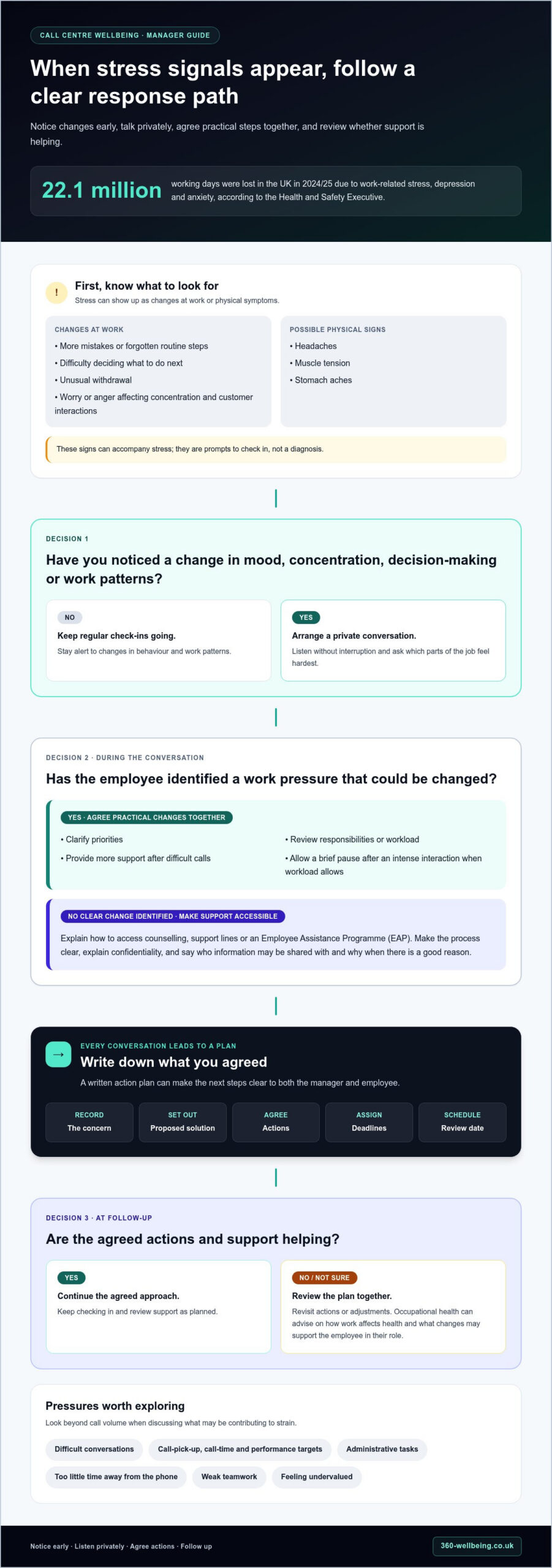
Call centre stress often builds from reactive work: agents respond to customers while meeting call pick-up, call-time and performance targets. Difficult conversations, administrative tasks, insufficient time away from the phone, weak teamwork and feeling undervalued can add pressure. In the UK, work-related stress, depression and anxiety accounted for 22.1 million working days lost in 2024/25, according to the Health and Safety Executive.
Managers can look for changes in behaviour that may be easier to notice at work than private worries. A previously confident employee might make more mistakes, forget routine steps, struggle to decide what to do next or become unusually withdrawn. Headaches, muscle tension and stomach aches can also accompany stress. Persistent worry or anger may affect concentration and customer interactions.
What are the most effective stress management strategies for call centre staff? Start with a private conversation. Listen without interruption and ask which parts of the job feel hardest. Agree practical changes together, such as clearer priorities, more support after difficult calls or a review of responsibilities. A written action plan can record the concern, proposed solution, actions, deadlines and review date.
What workplace changes reduce stress in UK call centres? Give employees a meaningful say in processes, systems and changes that affect their work, and explain the reasons for organisational decisions in good time. The Health and Safety Executive’s Management Standards offer a framework for reviewing demands, support, relationships, role clarity and control. Managers should also address team conflict early rather than leaving it to disrupt cooperation.
Employee control matters because a rigid workflow can make every demanding call feel unavoidable. Where possible, let staff influence how tasks are organised, when focused administrative work happens and how managers give feedback. These changes can protect productivity without treating stress as an individual failing.
Work and personal life boundaries need practical support. Agree when employees should stop checking work messages, and avoid routinely extending shifts to clear administration. A predictable finish gives staff time to recover, while adequate rest can help them return ready to provide attentive customer service.
How can call centre staff manage stress during difficult customer calls? Follow the agreed escalation process, take a brief pause after an intense interaction when workload allows, and tell a supervisor if a pattern of calls is affecting wellbeing. Managers can review the call type and available support, record agreed changes in an action plan and set a follow-up date.
Counselling, support lines and Employee Assistance Programmes
Counselling and support lines give employees a private way to discuss anxiety, difficult customer interactions or work-related stress. An Employee Assistance Programme (EAP) can provide support beyond a manager’s regular check-ins. Make the access process clear, explain confidentiality and tell staff who information may be shared with, and why, when there’s a good reason.
What are the costs and benefits of workplace stress management programmes for call centres? Costs depend on the support provided, such as counselling, training or an EAP, and the time needed to make it accessible. Benefits can include earlier support, improved coping skills and a clearer route to help before stress affects an employee’s ability to work.
Support matters during formal workplace processes, too. If stress arises during a disciplinary or grievance procedure, employers should follow the Acas Code of Practice on disciplinary and grievance procedures. With the employee’s agreement, an employer may seek professional medical advice about conducting the procedure fairly. Communicate respectfully, explain the next steps and consider whether adjustments would help the employee participate.
UCL guidance offers managers a practical model for responding to work-related stress: meet privately, listen to the employee’s experience and agree actions together. The approach includes a confidential stress risk assessment, follow-up on agreed actions and a review of whether support or adjustments are helping. Occupational health can also advise on how work affects health and what changes may support an employee in their role.
Training should continue after induction. Use coaching to practise responses to hostile calls, refresh escalation procedures and build agents’ confidence with complex cases. Regular check-ins also give employees a chance to raise concerns and ask for guidance before a difficult pattern becomes harder to manage.
AI support may help agents during customer interactions, for example by surfacing relevant information or prompting next steps. Treat it as a practical aid, not a substitute for human supervision, counselling or a manager’s judgement. Explain how the tool fits into call handling, and train staff so they understand its role and can raise concerns about its use.
Make support easy to find. Include EAP details in onboarding materials, team briefings and private staff communications, then explain how to access help. If an employee would benefit from dedicated mental health support, a clear route can make it easier to take that next step.
3. Breaks, holidays and burnout prevention
Regular recovery time is a practical part of preventing burnout, not a reward for finishing every task. In the UK, workers who work more than 6 hours are entitled to at least one uninterrupted 20-minute break daily, according to the UK Government. Call-centre schedules should make that break possible without requiring employees to monitor calls or complete routine administration at the same time.
Make breaks predictable. Managers can schedule cover across the team, rotate break times fairly and make it clear that staff should step away from their screens and phones. If a queue suddenly grows, avoid routinely cancelling breaks; review staffing and call patterns instead. A culture that protects recovery sends a practical message that wellbeing matters alongside service targets.
Short pauses between demanding calls can also help staff reset. Where call volumes allow, build brief gaps into schedules for water, stretching or a quiet moment before the next interaction. Supervisors should notice when an employee seems unusually tense or drained, then discuss whether call allocation or break timing needs attention. Small adjustments can ease pressure before stress rises further.
Annual leave offers a longer chance to disconnect from work. Yet only 60% of UK workers take their full holiday entitlement each year. Managers can encourage employees to plan leave ahead, make cover arrangements and avoid creating an expectation that staff remain available while away. A shared calendar, for example, can help a team coordinate time off without leaving one colleague carrying an unreasonable workload.
SPANA found that British employees feel the need for a break every 43 days to avoid total burnout. Its study also found that 56% cited feeling stressed as a sign that a holiday was due, while 53% pointed to their mental wellbeing starting to suffer. Treat these findings as prompts for regular conversations, not as a fixed timetable for every employee.
Burnout risk deserves attention before someone reaches exhaustion. 74% of contact-centre agents are considered at risk, and 30% face severe burnout risk. Employees experiencing burnout are 63% more likely to take a sick day and six times as likely to seek another job. Meanwhile, 52% of call-centre staff believe their company is not doing enough to prevent burnout.
Managers can check whether breaks are taken, review repeated cancellations and discuss leave during one-to-one meetings. Ask what makes it difficult to step away, agree a workable change and revisit it. Protecting regular breaks and annual leave makes recovery part of the workplace routine, rather than something staff arrange only when they feel overwhelmed.
4. Quiet time and workload management
Which breaks, shift patterns and workloads help prevent call centre stress? Build predictable recovery time into shifts, protect breaks from routine cancellations and allow quiet periods for focused tasks. Review call volumes, administrative duties and staffing together, so agents aren’t expected to absorb every demand at once.
Quiet time doesn’t have to mean stopping work. A scheduled period away from live calls can give an agent space to complete case notes, follow up on customer issues or prepare for a complex interaction. Managers can rotate these periods across the team, maintaining phone cover while preventing administration from piling up between calls.
UCL advises managers to review workload, duties and responsibilities when addressing work-related stress. List the employee’s regular tasks, then identify conflicting deadlines or duties that require sustained concentration. Agree what takes priority, what can wait and whether responsibilities should change. This makes workload discussions specific, rather than simply asking someone to work faster.
Working hours and patterns also shape recovery. UCL advises considering adjustments to hours or working patterns, such as changing a shift arrangement when it contributes to strain. Managers should discuss practical options with the employee and consider how changes affect colleagues. Adjustments work best when the wider team isn’t left carrying an unmanageable share of calls or administration.
To manage deadlines, make urgent work visible and agree who owns each task. A team lead might separate time-sensitive customer follow-ups from routine documentation, then redistribute work when call demand rises. If deadlines repeatedly collide, review the process and workload assumptions instead of treating missed targets as an individual performance problem.
Workplace adjustments can include flexible hours, additional rest breaks, different responsibilities, support with prioritising workloads, training or mentoring. Choose changes to match the difficulty the employee describes. Someone struggling with unfamiliar cases may benefit from mentoring, while another employee may need clearer priorities or time away from continuous calls.
Review the effect of each change with the employee and agree a follow-up point. Ask whether the schedule leaves enough time for focused tasks, quieter periods are protected and deadlines feel manageable. If an adjustment shifts pressure onto colleagues, revise the team plan. Regular reviews help the organisation respond to changing call patterns without overlooking staff wellbeing.
A practical workload plan can record the concern, agreed change, person responsible and review date. Keep the conversation open, especially when call volumes or responsibilities change. Combining quiet time with realistic priorities and workable schedules can make the call-centre environment more sustainable for employees and service teams.
5. Access to mental health and wellbeing services
What NHS and UK mental health services can call centre workers access for stress? Workers can contact their GP practice to discuss stress, anxiety or low mood and ask about NHS mental health care. Describe how symptoms affect sleep, concentration and everyday tasks, so the conversation can focus on suitable next steps.
Access should feel straightforward during a busy working week. Employers can explain how to find support in a staff handbook, induction materials and private team communications. A simple route might be to speak to a manager or HR, review workplace support, then arrange clinical advice through a GP practice. Staff should be able to seek help without sharing personal details with their whole team.
Workplace counselling gives employees space to talk through difficult experiences and consider coping strategies. Support lines offer a confidential conversation when someone needs to speak with a trained listener. An Employee Assistance Programme may help connect staff with support. Make instructions clear: where to find the service, how to access it and what confidentiality means in practice.
Different needs call for different routes. An employee who feels overwhelmed after repeated challenging calls may want counselling, while someone with persistent anxiety may want to discuss symptoms with a GP. Managers can explain available options without diagnosing the employee or pressuring them to share more than they choose.
Confidentiality is central to trust. Explain who can access information, why it may need to be shared and how workplace records are handled. If a manager needs to act on a serious concern, they should explain the reason and share only what is needed. Clear boundaries can make it easier for staff to ask for help early.
Access also depends on whether staff have time and privacy to use support. A call-centre employee may struggle to arrange an appointment during a tightly managed shift. Managers can discuss practical scheduling, protect private conversations and make sure seeking support doesn’t bring blame or stigma. These steps make wellbeing services usable, not simply listed in a policy.
After a worker accesses support, agree how workplace follow-up will happen without asking them to reveal confidential counselling details. Ask whether a change to duties or schedule would help them manage work, then review the adjustment together. Keep the conversation focused on practical needs, rather than requiring the employee to prove their distress.
For another route to emotional wellbeing support, explore mental wellbeing support as part of a wider approach to staff care.
360 Wellbeing: 24/7 Virtual GP
360 Wellbeing offers a 24/7 Virtual GP service, giving employees access to a UK-registered GP. It can be a helpful next step when work-related stress is affecting someone’s wellbeing or they want to discuss health concerns with a GP.
Its Mental Health Support includes therapy sessions, offering another route for employees who want support with their mental health. Physiotherapy may also help address physical concerns, while 360 Rewards provides access to a discount marketplace. Together, these offerings can complement workplace action on breaks, workloads and supportive management, rather than replacing those changes.
For organisations looking to make wellbeing support part of their employee benefits, visit the 360 Wellbeing website.
Build a healthier way forward
Sustainable change starts when staff wellbeing is treated as part of how the contact centre operates, not an issue employees must manage alone. Use what you’ve learned to talk openly with your team, identify the pressure points that need attention and agree which practical change to make first. A clear next step can turn stress management solutions for call centre staff into an ongoing workplace commitment.
Wellbeing support can complement those organisational changes. 360 Wellbeing offers a 24/7 Virtual GP, Mental Health Support and 360 Rewards, giving employers options to include in a broader approach to employee wellbeing. These services work alongside thoughtful management practices, not in place of addressing workplace pressures.
If you’re considering how to support your people, contact 360 Wellbeing today to explore the available support. A more sustainable, supportive workplace can begin with one considered step, taken together.
Frequently Asked Questions
What is call centre burnout?
Call centre burnout is ongoing work-related exhaustion that can affect an agent’s mood, focus and ability to handle customer interactions. It may show up as emotional detachment, difficulty concentrating or feeling depleted before a shift begins. It isn’t simply a demanding day. If these changes persist, managers can discuss work conditions and support privately, while the employee can seek appropriate health advice.
Can addressing stress improve employee retention?
Addressing workplace stress can support retention by showing employees that concerns lead to practical action. If agents leave because performance expectations feel unachievable, for example, managers can review how targets are set and gather staff feedback. Better support can’t guarantee someone will stay, but a fair response may strengthen trust and make the organisation a more sustainable place to work.
How Do I Handle Stress in My Team?
Begin with a private, non-judgemental conversation and describe the specific change you’ve noticed, such as more frequent call escalations. Ask what would make the working day more manageable, then agree a practical action and follow-up discussion. Keep personal health details private, and involve HR when a serious concern needs formal attention. Consistent check-ins help staff raise issues before they become crises.
How can proper workforce management reduce burnout?
Workforce management can reduce avoidable strain by matching staffing and task allocation to changing call demand. Review patterns such as repeated queue surges, overtime requests and unfinished case notes, then adjust schedules or redistribute administrative work. Give team leaders a clear way to flag capacity problems early. This helps managers address workload pressures as operational issues, rather than expecting agents to absorb them individually.
How can you tell if workplace pressure is becoming a problem?
Look for changes from an employee’s usual pattern, not one isolated mistake. A previously reliable agent may become forgetful, withdraw from colleagues or struggle with routine decisions. Ask whether the change is linked to work and listen without jumping to conclusions. Keep a factual record of work-related concerns, and agree what support or adjustments to review together.
Is stress management only important when employees are struggling?
No. Preventive support can help teams identify pressure points before they affect health, morale or service quality. Invite regular feedback on processes, include wellbeing in routine one-to-ones and review how changes affect staff. A team might raise concerns about a new call-handling system during its rollout, giving the organisation a chance to address problems early instead of waiting for distress or absence.
What can you do to reduce burnout in your contact center?
Build a practical plan for stress management solutions for call centre staff by combining operational changes with accessible wellbeing support. Ask employees where pressure builds, check whether schedules and performance expectations are workable, and give supervisors a clear escalation route. Make counselling or other mental health support easy to find, then review whether changes are helping without asking staff to disclose private therapy discussions.
What causes stress at work?
Stress can arise when job demands exceed the time, control or support available to meet them. In a contact centre, a process change may create uncertainty, while unclear responsibilities can leave agents unsure who should resolve a customer issue. Poor communication between teams can add friction. Identifying the specific mismatch helps managers choose a useful response, such as clearer guidance, revised priorities or targeted coaching.