
Did you know that poor mental health alone cost UK employers an estimated £51 billion in 2024? This staggering figure reflects a workforce struggling with burnout and a rise in sickness that makes a business case for employee wellbeing programme 2026 investments more urgent than ever. You’ve likely noticed that simply offering a library of disconnected apps isn’t enough to move the needle on productivity or keep your best people from leaving. It’s frustrating to invest in wellness only to see absenteeism rates climb while your team feels more overwhelmed than ever.
We’re here to help you bridge the gap between clinical expertise and corporate results. This guide shows you how to build a robust, data-driven business case for wellbeing that secures stakeholder buy-in and delivers measurable ROI. We’ll provide a clear framework for calculating your return on investment, a list of essential features for a future-ready platform, and the steps needed to secure budget approval for a holistic approach that truly supports your people. It’s time to move beyond simple perks and start treating health as your most valuable strategic asset.
Key Takeaways
- Discover how to transition from reactive crisis management to a proactive, preventative model that safeguards your organization’s operational resilience.
- Learn to quantify the full financial impact of your strategy, uncovering the hidden ROI found in improved productivity and reduced recruitment fees.
- Master the steps to build a robust business case for employee wellbeing programme 2026 that secures executive buy-in through data-driven insights and strategic alignment.
- Explore why fostering a high-trust culture is both a legal and cultural necessity, moving beyond financial figures to create a truly supportive workplace.
- Identify the essential features of a 2026-ready wellbeing platform, including the importance of a single-point-of-access to ensure high engagement and ease of use.
Why the Business Case for Employee Wellbeing has Changed for 2026
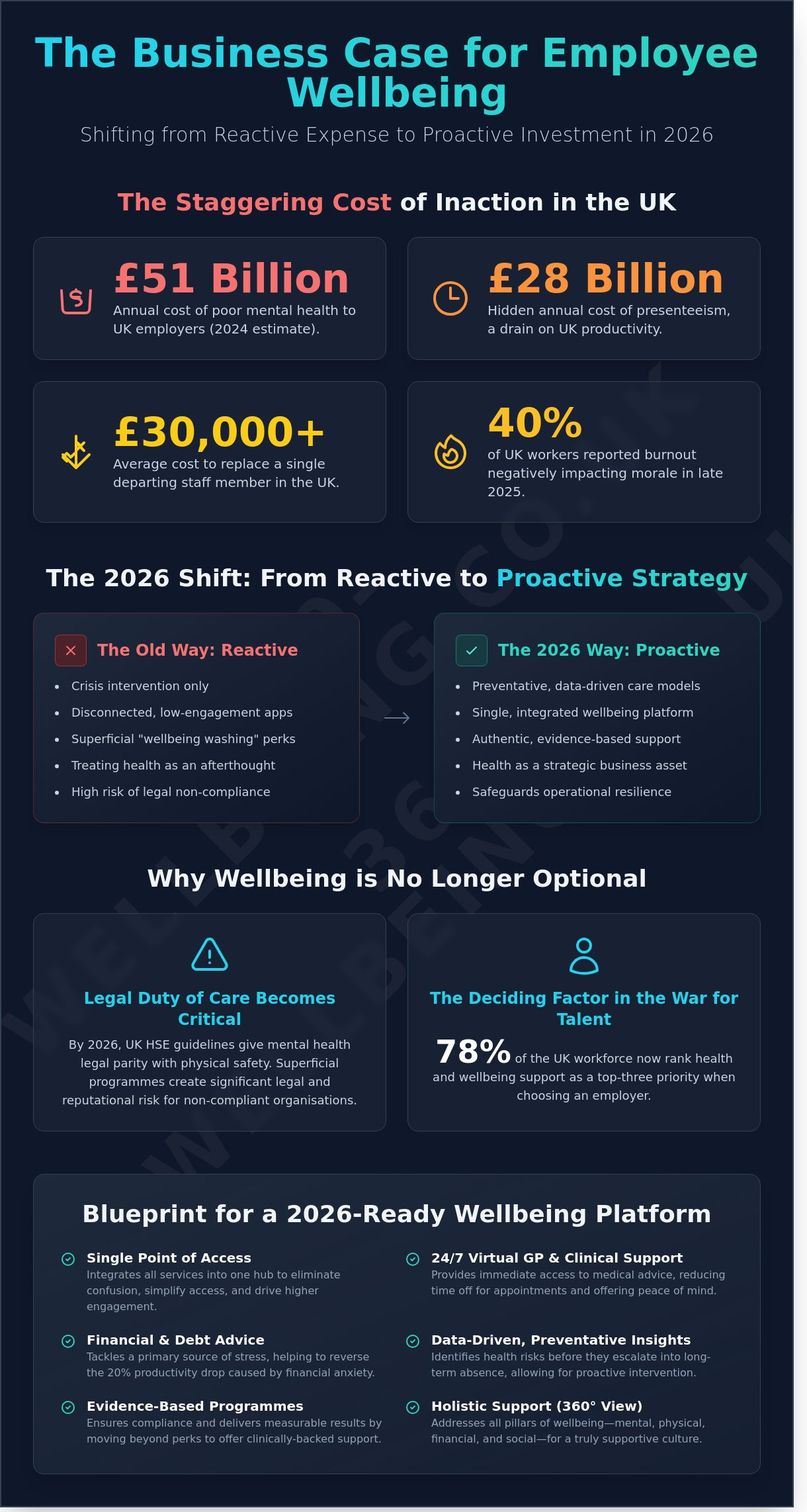
The business case for employee wellbeing programme 2026 has moved beyond simple perks like fruit baskets or gym discounts. In 2026, a robust business case serves as a strategic blueprint that links individual vitality directly to operational resilience. We’ve seen a decisive shift away from reactive crisis management, where employers only intervened when a staff member reached a breaking point. Instead, successful UK organisations now prioritise proactive, preventative care models that identify health risks before they manifest as long term absence. This transition reflects a deeper understanding that a healthy workforce is the bedrock of a stable company.
The economic climate of 2026 makes employee retention significantly more cost effective than recruitment. According to research from Oxford Economics, the average cost of replacing a departing staff member in the UK exceeds £30,000 when accounting for lost productivity, advertising, and training. In a tight labour market, keeping your existing talent isn’t just a HR goal; it’s a financial necessity. Wellbeing is no longer an optional extra in benefit packages. It’s a fundamental requirement for 78% of the UK workforce, who now rank health support as a top three priority when choosing an employer.
The Impact of New Employment Regulations
Legislative changes introduced throughout 2025 have fundamentally altered the UK employer’s duty of care. By 2026, mental health is legally treated with the same weight as physical health and safety under updated Health and Safety Executive (HSE) guidelines. This means “wellbeing washing,” the practice of offering superficial perks without addressing systemic workplace stress, is now a legal and reputational risk. Authentic, evidence based programmes are the only way to remain compliant and protect your organisation from potential litigation. We believe that meeting these standards shouldn’t feel like a burden but an opportunity to build a more supportive culture.
The Cost of Inaction: Presenteeism and Burnout
Presenteeism, where employees show up for work while physically or mentally unwell, remains a hidden drain on UK productivity. Deloitte’s 2024 analysis highlighted that presenteeism costs UK employers roughly £28 billion annually, a figure that continues to climb for those without structured support. When staff struggle through illness, their output drops by an average of 20%, which ripples through the entire team. Burnout rates in the UK reached a peak in late 2025, with 40% of workers reporting exhaustion that negatively impacts team morale. The wellbeing gap is the distance between staff needs and current provision.
- Proactive Care: Reduces long term sickness by identifying issues early.
- Financial Stability: Lowers the £30,000 average cost of staff turnover.
- Legal Safety: Ensures compliance with 2026 mental health parity laws.
- Operational Resilience: Mitigates the £28 billion annual cost of presenteeism.
Building a business case for employee wellbeing programme 2026 requires a clear vision of how health impacts your bottom line. By focusing on a 360 degree perspective of wellness, you create a workplace where people don’t just survive, but truly thrive. This proactive approach ensures your business remains a partner in your employees’ success, fostering a culture of mutual respect and long term growth.
Quantifying the ROI: The Financial and Operational Arguments
Building a robust business case for employee wellbeing programme 2026 requires moving beyond “perks” and focusing on fiscal health. UK employers face rising costs from absenteeism, but the real drain is often invisible. Recent industry data suggests that mental health issues alone cost UK businesses over £50 billion annually. A proactive programme tackles this by providing immediate solutions, such as 24/7 Virtual GP access. This service saves significant operational time. Instead of an employee taking a half-day to travel to a clinic, they can consult a professional during a break. It’s a simple way to ensure they get care without the stress of falling behind on tasks.
Financial anxiety is another silent productivity killer. When staff worry about debt, their focus at work drops by an estimated 20% according to recent workplace studies. By offering debt advice and financial support, you’re not just being kind; you’re protecting your output. This holistic approach ensures that stress doesn’t escalate into long-term physical or mental illness. It keeps your team stable, focused, and present.
Calculating the ROI of Preventative Care
It’s helpful to compare the modest cost of a monthly wellbeing subscription against the heavy price of a recruitment drive. Research from Oxford Economics indicates the cost of replacing a single employee can exceed £30,000 when including lost productivity and agency fees. Investing in early intervention, such as rapid-access mental health therapy, prevents short-term struggles from spiralling into long-term sick leave. Our 360-degree perspective shows that physical, mental, and financial health are deeply linked. Solving a problem in one area often prevents a crisis in another, creating a more predictable and sustainable payroll cost.
Operational Resilience and Talent Attraction
By 2026, a comprehensive benefits package isn’t a luxury; it’s a primary recruitment tool. Top-tier talent now expects employers to provide more than just a salary. There’s a proven link between high employee engagement and superior customer satisfaction. When your team feels supported, they’re significantly more likely to go the extra mile for your clients. You can explore our guide on financial support for employees to see how holistic care builds this loyalty. This level of support creates a resilient workforce that can handle the pressures of a modern market. If you’re ready to see how these numbers apply to your specific team, you might want to speak with a wellbeing consultant to tailor a strategy that fits your budget.
Beyond the Spreadsheet: The Cultural and Legal Necessity
A compelling business case for employee wellbeing programme 2026 transcends simple ROI calculations. While the financial benefits are undeniable, the cultural and legal imperatives are equally vital for UK organisations. Modern employees view wellbeing as a fundamental right rather than a luxury. This shift means that silence on mental health or a lack of support is often interpreted as a lack of care. Building a high-trust workplace requires transparency and tangible action. Research from the Great Place to Work Institute shows that companies with high levels of trust experience 50% less turnover than their competitors.
UK employers face a clear legal duty of care. Under the Health and Safety at Work Act 1974, you must ensure the health, safety, and welfare of your workforce. This includes protecting them from psychological harm. By 2026, the Health and Safety Executive (HSE) expects even more rigorous adherence to stress management standards. Integrating a comprehensive wellbeing strategy also directly supports your Diversity, Equity, and Inclusion (DEI) goals. It provides a safety net for employees from diverse backgrounds who may face specific external pressures, ensuring everyone has an equal opportunity to thrive regardless of their personal circumstances.
Building Resilience through Life Coaching and Therapy
Traditional Employee Assistance Programmes (EAPs) often function as a reactive safety net, used only when a crisis occurs. Modern 360-degree support moves toward proactive life coaching. This approach identifies potential stressors before they escalate into burnout. When employees have confidential, 24/7 access to professional therapists, they resolve interpersonal conflicts more effectively. This reduces workplace friction and improves collaboration. A 2023 study by Mind found that 60% of employees would feel more motivated if their employer took action to support mental health.
Financial Wellness as a Strategic Asset
Financial anxiety is a primary driver of cognitive load. When a team member is worried about debt or family security, their focus on work diminishes. Services like debt helplines and will writing are no longer optional extras; they’re strategic tools. The CIPD reported in 2024 that 28% of UK workers said money worries affected their job performance. By reducing this mental load, you improve workplace safety and decision-making. Employees who feel financially secure are more present, less prone to errors, and better equipped to handle the complex challenges of the 2026 business environment. Strengthening the business case for employee wellbeing programme 2026 requires acknowledging that a focused mind is a productive one.
Evaluating Wellbeing Providers: A 2026 Buying Guide
Selecting a partner for your health strategy is no longer a simple procurement task. It’s a strategic decision that determines whether your investment yields a return or becomes another ignored icon on an employee’s phone. By 2026, the business case for employee wellbeing programme 2026 rests on integration. You must move away from fragmented “point solutions” toward a single-point-of-access. Statistics from 2024 showed that 68% of workers felt overwhelmed by the number of apps they used for work; adding multiple health platforms only increases this “app fatigue.”
When comparing providers, look for a balance between fixed-fee SaaS models and clinical depth. Fixed-fee models provide budget certainty for HR departments, while pay-per-use clinical services can sometimes lead to a “success tax” where higher engagement results in unexpected costs. A 2026-ready platform should offer a comprehensive suite of tools in one place:
- Virtual GP: 24/7 access to UK-registered doctors.
- Mental Health Support: Proactive tools and rapid access to counseling.
- Financial Wellbeing: Practical guidance for cost-of-living resilience.
- Rewards and Recognition: Positive reinforcement for healthy habit formation.
The Importance of 24/7 Virtual GP Access
Speed of access is the top priority for the modern UK workforce. With traditional GP wait times in some regions exceeding 15 days in 2024, providing a digital alternative is a major productivity driver. UK-registered doctors can issue digital prescriptions and specialist referrals during a video consultation, often within two hours of a request. This immediacy saves hours of “presenteeism” where staff are physically present but distracted by health worries. It’s a compassionate way to show your team that their time and health are respected.
User Experience and Engagement Metrics
If a platform isn’t as intuitive as a leading consumer app, your team won’t use it. Low engagement is the primary reason wellbeing programmes fail to deliver a return. You need a provider that offers granular data reporting. This allows you to prove the business case for employee wellbeing programme 2026 to your board by showing real-time usage trends and health improvements. Look for a partner that combines these digital metrics with genuine human support, ensuring the technology serves as a bridge to care rather than a barrier.
Ready to unify your health strategy with a platform your team will actually use? Discover our comprehensive wellbeing solutions today.
Implementing Your Strategy with 360 Wellbeing
Building a robust business case for employee wellbeing programme 2026 requires more than just good intentions; it demands a clear, predictable financial structure. At 360 Wellbeing, we simplify this process through our transparent per-employee model. This approach removes the guesswork from your overheads, allowing you to present a budget to your board that is both scalable and sustainable. By 2026, the most successful UK firms will move beyond “implementation” as a one-time event. They will focus on “integration,” where wellbeing becomes a core thread in the workplace fabric rather than a disconnected benefit.
To ensure your programme delivers a measurable impact, we help you define clear Key Performance Indicators (KPIs) from day one. Whether you are targeting a reduction in the 14.6% of UK sickness absence days currently attributed to mental health or aiming to improve staff retention rates, having a structured launch plan is vital. We work alongside you to ensure the transition is seamless, professional, and deeply rooted in your company’s unique culture. This shift from a “bolt-on” service to a cultural pillar is what defines a modern, resilient business.
The 360 Wellbeing Difference: Holistic Care
Our platform creates a synergy between essential services that usually sit in silos. By combining a 24/7 Virtual GP, a comprehensive Employee Assistance Programme (EAP), and a Rewards marketplace, we provide a 360-degree perspective on health. We act as an expert caregiver for your team, offering support that spans the four pillars of wellness:
- Physical: Rapid access to clinicians to reduce diagnostic delays.
- Mental: Professional counseling and proactive stress management tools.
- Financial: Guidance and discounts to help manage the cost of living.
- Legal: Expert advice to resolve personal pressures before they impact work.
This proactive vitality model ensures your employees don’t just survive the working week; they thrive. Our clinical expertise is always balanced with a warm, human touch, making complex health journeys feel manageable for every individual in your organization.
Ready to Build Your Case?
Every SME has different pressures and priorities. We invite you to a personal consultation where we can help tailor the business case for employee wellbeing programme 2026 to your specific workforce data. Seeing the platform in action is the best way to understand how it supports your long-term strategic goals. You can book a demo of the 360 Wellbeing platform today to start your journey toward a more resilient workforce. We believe that employee wellbeing is not a luxury or a corporate perk, but a fundamental right and a vital strategic asset for any modern business.
Future-Proof Your Workforce for 2026 and Beyond
The UK employment landscape has evolved significantly. Research from Deloitte’s 2024 Mental Health Report shows that proactive wellbeing interventions now deliver an average return of £4.70 for every £1 spent. This financial clarity makes the business case for employee wellbeing programme 2026 undeniable for any forward-thinking SME. Beyond the balance sheet, meeting the Health and Safety Executive’s updated stress management standards is now a legal necessity. You’re not just ticking a box; you’re building a culture where resilience is the default.
True workplace harmony comes from providing immediate, tangible support. Offering 24/7 access to UK-registered Virtual GPs and comprehensive mental health and life coaching addresses health concerns before they escalate. By integrating financial and legal support specifically designed for SMEs, you provide a 360-degree safety net that protects your most valuable asset. It’s time to transition from reactive care to a proactive partnership that values every individual’s health as a strategic priority. We’re here to help you lead this change with confidence and compassion.
Secure your team’s future with 360 Wellbeing
Frequently Asked Questions
What should be included in a business case for employee wellbeing?
A robust business case for employee wellbeing programme 2026 must include current sickness absence rates and the projected impact on staff retention. You should detail the direct costs of absenteeism, which the CIPD reported reached a ten year high of 7.8 days per employee in 2023. Include specific objectives like reducing turnover by 15 percent or improving engagement scores by 10 points. This data creates a clear, evidence based roadmap for your strategy.
How do you measure the ROI of a wellbeing programme in 2026?
You measure ROI by comparing the total cost of the programme against savings from reduced absenteeism and improved productivity. Deloitte’s 2024 analysis shows that UK employers see an average return of £4.70 for every £1 invested in mental health support. Track these figures alongside your insurance premium changes and staff turnover rates. These metrics provide a 360 degree view of your financial gains and the health of your organisation.
Can small businesses afford a comprehensive wellbeing platform?
Small businesses can definitely afford these platforms because modern providers offer scalable, per head pricing models that grow with your company. You don’t need the budget of a FTSE 100 firm to provide high quality care. Research from the Federation of Small Businesses shows that 80 percent of small firms now prioritise mental health. By choosing a tailored solution, you ensure your team gets the support they deserve without overstretching your finances.
How does a virtual GP service help a business save money?
A virtual GP service saves money by reducing the time employees spend away from work for medical appointments. Traditional GP visits often require a half day of leave, but virtual consultations typically take 15 minutes and can happen during breaks. This keeps your team productive and reduces the stress of long waiting times. It’s a proactive way to manage minor health issues before they become long term absences or serious medical concerns.
What is the difference between an EAP and a holistic wellbeing platform?
An Employee Assistance Programme (EAP) is usually a reactive service focused on crisis management, whereas a holistic platform provides proactive, 360 degree support. While an EAP might offer a phone line for emergencies, a holistic platform includes preventative tools like fitness tracking, nutritional guidance, and virtual GP access. This shift from reactive to preventative care helps build long term resilience across your entire workforce, moving beyond simple crisis intervention.
Is it mandatory for UK employers to provide a wellbeing programme?
While a full wellbeing programme isn’t a legal requirement, UK employers have a statutory duty under the Health and Safety at Work Act 1974 to ensure the health and safety of staff. This includes managing workplace stress and conducting risk assessments. Implementing a formal programme helps you meet these legal obligations while demonstrating a genuine commitment to your team’s vitality. It’s about doing more than the bare minimum to ensure workplace harmony.
How do I get board approval for a wellbeing budget?
You get board approval by aligning your wellbeing strategy with core business objectives like talent retention and operational efficiency. Present a clear business case for employee wellbeing programme 2026 that highlights the cost of doing nothing. Use the 2022 Thriving at Work report data to show how mental ill health costs UK employers up to £56 billion annually. This evidence shifts the conversation from a cost center to a strategic investment in your people.
What are the most important KPIs for workplace wellbeing?
The most important KPIs include your sickness absence rate, Employee Net Promoter Score (eNPS), and programme utilisation data. You should also track the “Presenteeism” rate, as the Centre for Mental Health found this costs 1.5 times more than absenteeism alone. Monitoring these figures monthly allows you to adjust your approach and ensure your investment is delivering the support your employees actually need. Consistent tracking ensures your strategy remains relevant and effective.