
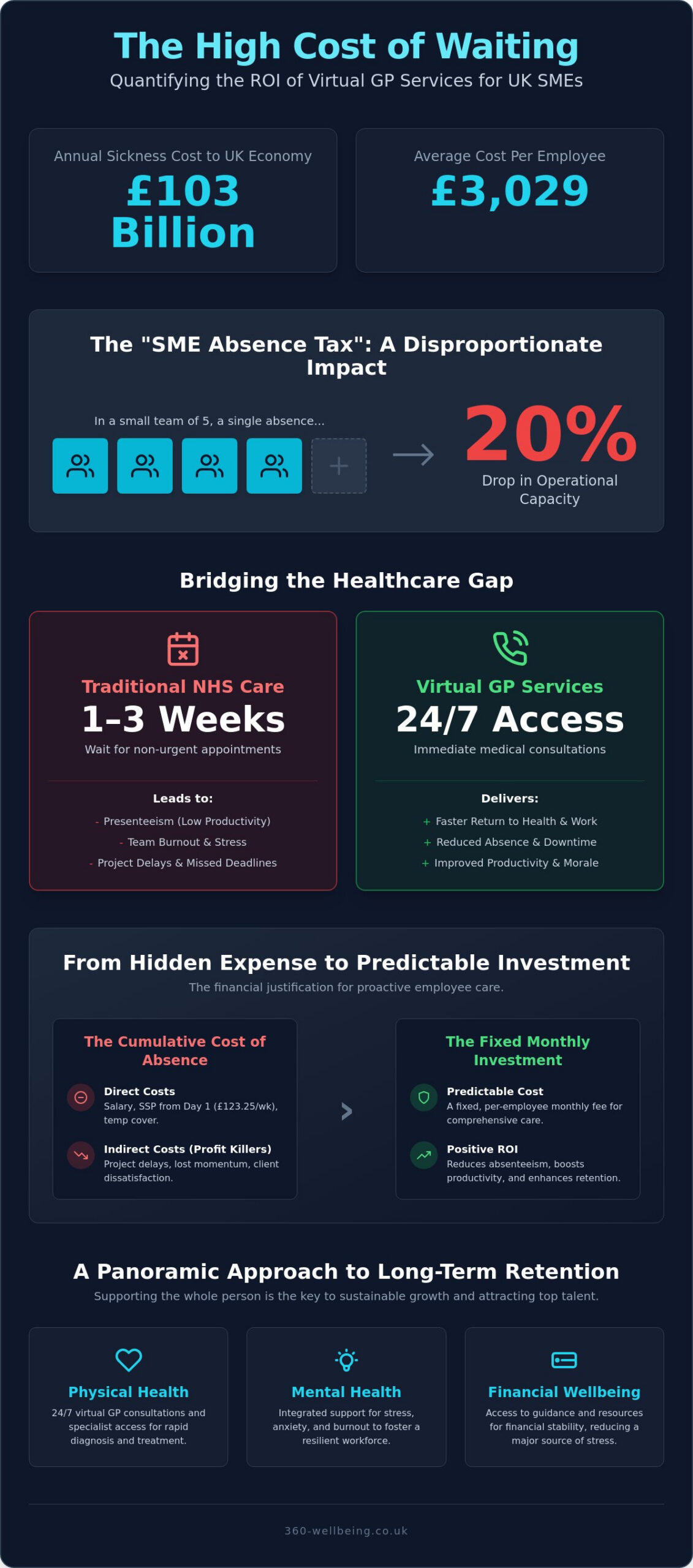
Did you know that workplace sickness now costs the UK economy an estimated £103 billion annually, which averages out to roughly £3,029 for every single employee? For a small business owner, these aren’t just abstract figures. They represent the quiet struggle of a team member waiting weeks for a non-urgent NHS appointment while their desk sits empty and their wellbeing suffers. You likely feel the pressure of maintaining momentum when your most valuable assets are sidelined by a healthcare system under significant strain.
It’s time to shift the narrative from managing illness to cultivating vitality. This guide explores the tangible roi of virtual gp services for smes, helping you bridge the gap between clinical necessity and commercial performance. You’ll learn how to quantify the financial benefits of immediate medical access, especially following the 2026 abolition of SSP waiting days. We will provide a methodical, pounds-and-pence justification for your board, showing how a panoramic approach to health reduces absenteeism and creates a workplace where every individual feels supported, empowered, and ready to thrive.
Key Takeaways
- Understand the “SME Absence Tax” and how to identify the hidden operational costs that occur when small teams face unexpected sickness.
- Learn how to calculate the roi of virtual gp services for smes using a clear framework that weighs predictable monthly investments against the high cost of lost working days.
- Discover how 24/7 access to medical professionals bridges the gap left by traditional NHS waiting times, allowing your staff to return to health and work faster.
- Explore practical strategies for implementing virtual care without a dedicated HR department, focusing on internal engagement and peer support.
- Recognise why a panoramic approach-combining physical consultations with mental health and financial support-is the key to long-term employee retention in 2026.
The Economic Impact of Sickness Absence on UK SMEs
UK workers lost nearly 150 million working days to sickness in recent years. While a large corporation might absorb these gaps through sheer scale, for a small business, a single absence often feels like a missing limb. If you manage a team of five, one person being off represents a 20% drop in your total operational capacity. We call this the “SME Absence Tax.” It’s the disproportionate financial and emotional weight carried by small teams when health issues arise. Understanding the roi of virtual gp services for smes starts with recognising that health is your business’s most volatile variable.
As a business leader, you aren’t just managing a payroll; you’re looking after a community. Ignoring staff health isn’t just a compassionate oversight; it’s a long-term financial risk that erodes the durability of your business. The direct correlation between extended NHS GP waiting times and reduced SME output is becoming a critical bottleneck for UK economic growth. To understand how these digital solutions work, it’s helpful to look at what is telehealth and how it bridges the gap between patient and provider when traditional routes are blocked.
The Hidden Cost of NHS Waiting Lists
In early 2026, non-urgent NHS GP appointments often involve a wait of one to three weeks. For an employee, this means three weeks of living with a nagging health concern. They might be physically present, but their focus is fractured. This “presenteeism” often costs businesses more than the absence itself. When one person is finally forced to take time off, their colleagues must shoulder the burden; this creates a ripple effect that frequently leads to secondary burnout across the remaining team. In this context, providing a “Doctor at Hand” service is no longer a luxury perk; it’s a strategic necessity to keep your operations fluid.
National Trends vs. Small Business Reality
Data from the Office for National Statistics in May 2026 showed a national sickness absence rate of 2.0%. However, these percentages don’t capture the psychological cost within a 10-50 person company. In a close-knit workforce, health uncertainty spreads anxiety. When an employee sees a colleague struggling to access care, it lowers morale across the board. Calculating the roi of virtual gp services for smes requires looking beyond the subscription fee to the hours of productivity reclaimed and the culture of safety you build. Ensuring every staff member feels valued is the most effective way to protect your most vital asset: their collective energy and commitment.
Quantifying the ROI: From Reduced Absenteeism to Talent Retention
Building on the “Absence Tax” concept, the next step is moving from observation to calculation. To truly understand the roi of virtual gp services for smes, you need a clear view of what each empty desk actually costs your business. When an employee is away, the financial leak isn’t just their salary; it’s the lost momentum and the added pressure on those left behind. By quantifying these variables, you can transform health from a hidden expense into a predictable investment.
The ROI Calculation Formula for Small Businesses
To calculate your absence cost, start with direct expenses. This includes basic salary and the Statutory Sick Pay (SSP) rate, which for the 2026/2027 tax year is £123.25 per week. Because waiting days were abolished in 2026, these costs now hit your balance sheet from day one. You must also factor in the cost of temporary cover or overtime pay for other staff members.
Indirect costs are often more significant for smaller teams. These include project delays, missed deadlines, and the risk of client dissatisfaction when a key contact is unavailable. Finally, consider the “Wellbeing Multiplier.” When one employee returns to health quickly through early intervention, it prevents the low morale that often follows a stretched, overworked team. When you compare these cumulative costs to a fixed per-employee monthly fee, the financial justification becomes clear.
Presenteeism: The Silent Profit Killer
Presenteeism occurs when staff show up for work while they’re unwell, leading to sub-optimal productivity and the risk of spreading illness. In a modern, hybrid SME environment, this is often harder to spot. An employee might be logged in but completing tasks at half their usual speed because they’re waiting two weeks for a routine appointment. While there are various benefits and drawbacks of telehealth, the primary advantage for SMEs is the speed of care.
Access to a 24/7 Virtual GP encourages staff to seek help at the first sign of symptoms rather than waiting for a crisis. This foresight ensures health issues are managed before they worsen, protecting the long-term durability of your workforce. Beyond daily productivity, this level of care serves as a powerful retention tool. In a competitive market, showing that you view health as a professional necessity helps you keep your best people, saving you thousands in recruitment and training fees. If you’re ready to move toward a more stable financial future, exploring a tailored wellbeing strategy is a proactive place to start.
Virtual GP vs. Traditional Care: A Comparative Analysis for SME Leaders
When you evaluate the roi of virtual gp services for smes, the most immediate contrast appears in the delivery of care. Traditional primary care in the UK is facing unprecedented pressure; as of February 2026, nearly 17% of non-urgent NHS appointments took place more than two weeks after booking. For a small business, this delay isn’t just a healthcare issue; it’s an operational bottleneck. A virtual GP service doesn’t aim to replace the NHS. Instead, it acts as a vital, complementary layer that ensures your team can access expert advice the moment they need it, rather than waiting for a symptoms to escalate into a crisis.
The “8 AM scramble” for a phone appointment has become a source of significant stress for many workers. By offering 24/7 access, you remove this anxiety and provide a safety net for those who need it most, such as parents managing a child’s sudden illness or shift workers who can’t call during standard office hours. This flexibility communicates a deep sense of reliability and partnership, showing your staff that their time and wellbeing are genuinely respected.
Speed of Access as a Financial Metric
From a financial perspective, the difference between a traditional visit and a virtual consultation is stark. An in-person GP appointment often results in a “half-day lost” once you factor in travel, waiting room time, and the consultation itself. In contrast, a video call typically takes 15 minutes and can be completed from a private space at home or the office. This reclaimed time directly boosts your bottom line.
The efficiency extends to clinical outcomes too. With same-day digital prescriptions and immediate specialist referrals, the path from diagnosis to recovery is significantly shortened. When an employee can have a prescription sent to a local pharmacy within hours of feeling unwell, they’re far more likely to return to full productivity sooner, preventing the long-term absences that drain SME resources.
Clinical Excellence and Employee Trust
For a health benefit to deliver a high roi of virtual gp services for smes, employees must actually trust and use it. This is why UK-registered doctors are non-negotiable. Staff need the reassurance that they’re speaking with clinicians who understand the UK healthcare landscape and adhere to General Medical Council (GMC) standards. Regulation by the Care Quality Commission (CQC) ensures that the digital care provided is as safe and effective as a face-to-face meeting.
Building this trust creates a proactive partnership of care. When your team knows they have a knowledgeable authority looking out for their interests, they’re more likely to engage with preventative health measures. This shift from reactive treatment to proactive management is the cornerstone of sustainable growth, ensuring your workforce remains durable and focused on the journey ahead.
Strategic Implementation: Integrating Virtual Care into SME Operations
Implementing a new benefit shouldn’t feel like another full-time job. For many small business owners, the perceived complexity of rolling out health technology is a significant barrier to achieving a high roi of virtual gp services for smes. However, the process is surprisingly lean. You don’t need a dedicated HR department or a complex internal infrastructure to make a meaningful difference. By focusing on clear communication and establishing a culture of trust, you can integrate virtual care into your daily operations with minimal friction and maximum impact.
Onboarding for Success
The first 30 days are about setting the tone for a proactive health culture. Introduce the service not as a corporate policy, but as a supportive partnership designed to make life easier. The 360 Wellbeing mobile app serves as the central hub for this experience, making it easy for staff to book appointments, access physiotherapy, or seek mental health support in seconds. A simple, personal email from the founder or a mention in a team meeting often drives more engagement than a dense handbook ever could. You might also consider appointing ‘Mental Health Champions’ within your team; these are peers who can offer a friendly, informal nudge toward the service when they notice a colleague is struggling.
Privacy is the cornerstone of this trust. Employees need to feel certain that their medical data remains confidential and is never shared with their employer. When staff know their health journey is secure from the boss’s view, they’re more likely to use the service for sensitive issues. This includes seeking financial support for employees or mental health counselling, which ultimately protects your business from the “Absence Tax” and long-term burnout. Clear, repeated reassurance about data security is essential for high uptake.
Data and Insights: Measuring Success
While individual data is private, anonymised usage trends offer a panoramic view of your workforce’s health. This isn’t about surveillance; it’s about foresight. If you notice a spike in evening GP consultations or a high demand for life coaching, you can adjust your internal support strategy accordingly. This data-driven approach allows you to pivot resources where they’re needed most, ensuring your investment remains effective and relevant. For instance, a rise in physiotherapy requests might suggest a need for better ergonomic setups in your hybrid offices. By refining your strategy based on these real-world metrics, you ensure the long-term durability of your team and your business.
If you’re ready to see how a tailored health strategy fits your specific team size, book a consultation with our wellbeing experts today.
The 360 Wellbeing Difference: Holistic Care for Sustainable Growth
By 2026, a standalone GP app is no longer enough to move the needle on your bottom line. While speed of access is vital, the true roi of virtual gp services for smes comes from a panoramic approach that addresses the root causes of workplace absence. 360 Wellbeing acts as an expert caregiver for your business, moving beyond reactive medical consultations to create a unified narrative of total wellness. We believe that health is an essential human entitlement, and our platform is designed to support every facet of your team’s life, ensuring they remain durable, focused, and valued.
Beyond clinical support, our model includes high-value retention hooks that distinguish your firm from larger competitors. Services like Legal Support and Complimentary Will Writing offer employees a level of security that stretches far beyond the office walls. These aren’t just perks; they’re essential tools for life management that build deep loyalty. When you provide these benefits, you’re telling your staff that you’re invested in their long-term success, which is a powerful motivator for staying with a small business over a faceless corporation.
Panoramic Wellness: Physical, Mental, and Financial
Stress isn’t always caused by a heavy workload; it’s often rooted in external financial pressures. The 360 Rewards marketplace is a central pillar of our health strategy, allowing staff to stretch their household budgets through significant discounts on daily essentials. This direct support for financial wellbeing reduces the background anxiety that often leads to mental health struggles and workplace presenteeism. By helping your team manage the cost of living, you’re proactively protecting their mental clarity and productivity.
We’ve worked hard to make corporate-level benefits accessible for even the smallest sole trader. In a close-knit SME, the synergy between financial stability and physical health creates a more harmonious workplace. When an employee can save on their weekly shop and access a UK-registered GP in the same app, their sense of being supported is total. This completeness is what drives a sustainable roi of virtual gp services for smes, as it fosters a culture where people don’t just work; they thrive.
A Partnership for the Long Term
Sustainable growth requires moving away from one-off health interventions toward a recurring culture of care. Our fixed per-employee monthly fee model is designed to be the most ROI-friendly option for growing businesses. It transforms the “unpredictable tax” of sickness absence into a predictable, manageable investment that aligns perfectly with your financial forecasting. You’ll no longer be caught off guard by the sudden costs of a short-term vacancy or the recruitment fees associated with high staff turnover.
We invite you to view your wellbeing strategy as a professional necessity rather than a luxury. By choosing a partner that integrates physical, mental, and social health, you’re building a foundation for a resilient future. If you’re ready to see how these savings look for your specific business, you can Calculate your team’s potential ROI with 360 Wellbeing and take the first step toward a healthier, more profitable workforce.
Building a Resilient Future for Your Team
Transforming your approach to employee health from a reactive expense into a strategic asset is the key to business durability in 2026. By addressing the “Absence Tax” head-on, you can reclaim the productivity lost to traditional healthcare delays and create a culture where staff feel genuinely supported. The roi of virtual gp services for smes becomes evident when you replace the unpredictable costs of sickness with a predictable, fixed monthly investment that covers the whole person.
With 24/7 access to UK-registered GPs and a panoramic suite of mental, physical, and financial support, you provide your team with the tools to stay healthy and focused. This holistic care doesn’t just reduce absenteeism; it builds the deep loyalty and morale essential for long-term success. It’s time to move beyond managing illness and start cultivating a vibrant, resilient workplace harmony that empowers everyone to succeed. Empower your SME with 360 Wellbeing today and discover a partnership that’s as invested in your team’s success as you are.
Frequently Asked Questions
How do you calculate the ROI of a virtual GP for a small business?
To calculate the return on investment, you should weigh the fixed per-employee monthly fee against the savings generated from reduced absence days and reclaimed productivity hours. Use the formula: (Total Absence Cost Savings – Virtual GP Cost) / Virtual GP Cost. This provides a clear justification for the roi of virtual gp services for smes by demonstrating the financial recovery of every pound invested in your team’s health.
Is a virtual GP service a taxable benefit for UK employees?
Virtual GP services provided as part of a corporate wellbeing package are typically viewed as a Benefit in Kind (BiK) by HMRC. While certain welfare counseling or health screenings may be exempt, most digital healthcare services require reporting on a P11D form. It’s best to consult with your tax advisor or check the latest 2026/27 HMRC guidance to understand the specific National Insurance and tax implications for your business.
What is the average cost of sickness absence for a UK SME in 2026?
Workplace sickness currently costs the UK economy approximately £103 billion per year, which averages out to £3,029 per employee as of May 2026. For a small business, these costs include the Statutory Sick Pay (SSP) rate of £123.25 per week and the significant indirect costs of lost operational capacity. Because waiting days were abolished in 2026, these financial pressures hit your balance sheet from the very first day of an employee’s illness.
How does a virtual GP service help reduce presenteeism?
Virtual GP services reduce presenteeism by offering immediate medical consultations that prevent minor symptoms from escalating into long-term issues. Instead of working at sub-optimal levels while waiting weeks for an appointment, employees can access a 15 minute video call during their lunch break. This early intervention ensures they receive the care or prescription they need to stay focused and productive without the distraction of untreated health concerns.
Can my employees use the virtual GP for their family members?
Yes, our platform allows employees to extend their virtual GP access to their children and partners. Supporting the health of an employee’s entire household significantly reduces the time they need to take off for family-related medical emergencies. This panoramic approach to care strengthens the partnership between you and your staff, showing that you value their life balance as much as their professional output.
Do virtual GP services replace the need for Private Medical Insurance (PMI)?
Virtual GP services don’t replace Private Medical Insurance (PMI), but they serve as a more accessible and cost-effective entry point for primary care. While PMI is designed for specialist treatments and hospital stays, a virtual GP focuses on day-to-day health, digital prescriptions, and referrals. For many small firms, the roi of virtual gp services for smes is more immediate because it addresses the most frequent causes of absence without the high premiums of traditional insurance.
How quickly can an employee get an appointment through 360 Wellbeing?
Employees can typically secure an appointment with a UK-registered doctor within hours, often on the same day they book. This rapid response time is a critical advantage compared to the one to three week waits often found in traditional primary care settings in 2026. Fast access ensures that health concerns are managed instantly, allowing your team to return to their normal rhythm with minimal disruption to your operations.
Are virtual GP services secure and GDPR compliant for my staff?
All reputable virtual GP providers must adhere to strict GDPR regulations and use encrypted platforms to protect sensitive patient data. Clinical records are entirely confidential and are never shared with the employer. This high level of security is essential for building trust, ensuring your staff feel safe and empowered to discuss their physical or mental health concerns with a knowledgeable authority without any privacy risks.