
Did you know that replacing a single professional worker in Britain now costs an average of £30,614 according to Oxford Economics? It’s a significant financial burden that often hides behind the more obvious invoices from recruitment agencies. When you calculate the true cost of employee turnover uk leaders must manage, you’re looking at much more than just a new salary. It’s the silent drain of institutional knowledge and the heavy toll on your remaining team’s mental wellbeing as they struggle to pick up the slack.
You’ve likely felt that familiar dip in morale when a talented colleague leaves, or seen your growth targets slip as your best people face burnout. We believe that a healthy workforce is your greatest strategic asset; protecting it requires a proactive, 360-degree approach. This 2026 guide will help you quantify the comprehensive financial and human impact of staff churn so you can protect your bottom line. We’ll provide a clear figure to present to your board and a tailored strategy to foster the long-term resilience that keeps your best people from walking out the door.
Key Takeaways
- Understand why the true cost of employee turnover uk often exceeds £30,000 per mid-level hire when accounting for recruitment, onboarding, and reintegration.
- Uncover the “hidden” drains on your business, including the productivity lag during new hire ramp-up and the loss of vital proprietary knowledge.
- Learn how to distinguish between healthy churn and problematic attrition by comparing your staff turnover against the latest UK industry benchmarks.
- Discover how to transform exit interview insights into a proactive retention strategy that prioritises the physical and financial health of your team.
- Explore how a holistic, 360-degree wellbeing approach acts as a strategic insurance policy to protect your bottom line and foster long-term workplace harmony.
Understanding the Financial Impact of Staff Attrition in 2026
When a team member leaves, the impact ripples through your organisation far beyond an empty desk. To truly grasp the cost of employee turnover uk, we must look at it through a 360-degree lens. It isn’t just a recruitment fee. It’s the total sum of exit administration, the search for new talent, and the lengthy period of reintegration. Understanding what is employee turnover? requires acknowledging both the voluntary departures and the structural shifts that define modern UK workplaces.
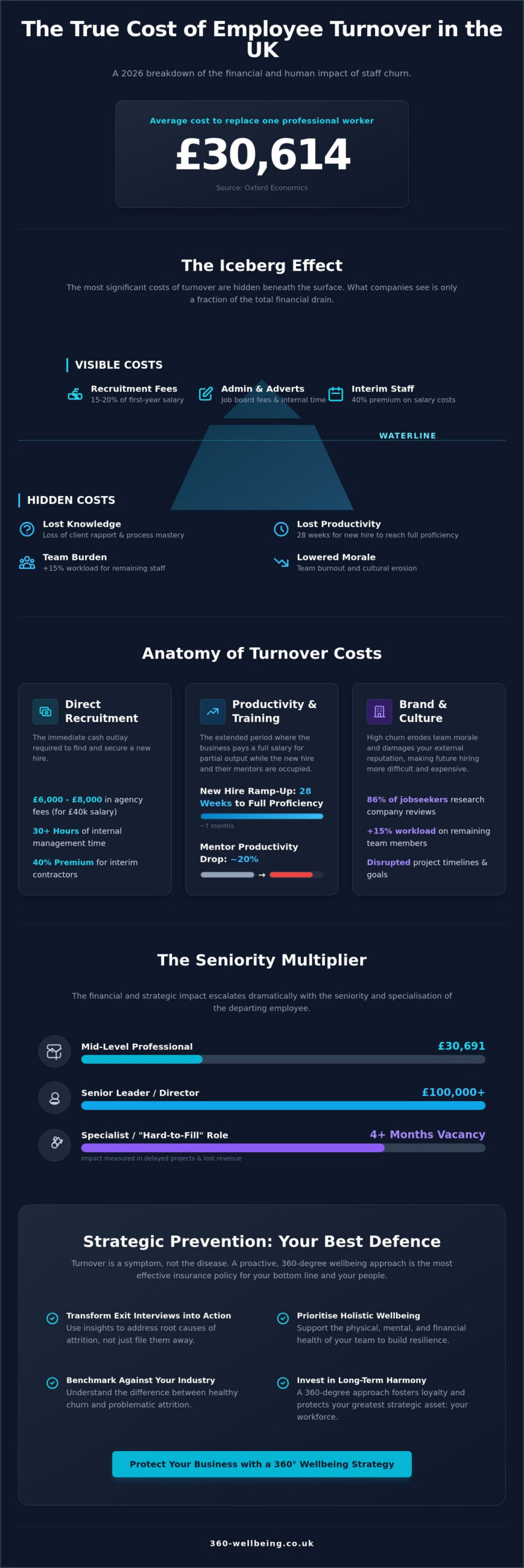
Current benchmarks for 2026 suggest the financial burden is heavier than ever. Research from Oxford Economics and updated industry data indicate that replacing a mid-level employee earning £35,000 now costs an employer roughly £30,691. This figure accounts for the time it takes for a new starter to reach optimum productivity, which typically spans 28 weeks. We view these figures not just as financial losses, but as a call to build more resilient, supportive environments where people choose to stay.
The “Iceberg Effect” remains the most accurate way to visualise these expenses. While a business might focus on the visible tip, such as job board fees, the vast majority of the cost of employee turnover uk remains submerged. These hidden costs include the lost institutional knowledge and the lowered morale of remaining staff who must pick up the slack. In 2026, the UK’s tight labour market and the high value placed on specialised skills make retention a strategic asset rather than a HR metric.
The Visible Costs: Recruitment and Admin
Direct expenses are the easiest to track but they still bite deep into annual budgets. Most UK recruitment agencies now charge between 15% and 20% of a candidate’s first-year salary. For a role paying £40,000, that’s an immediate £8,000 outlay. Beyond fees, your internal resources are stretched. HR teams and department managers often spend upwards of 30 hours on a single hire, covering CV screening and multi-stage interviewing. If you need interim contractors to fill the gap, day rates in 2026 often command a 40% premium over standard salary costs.
The Impact of Seniority on Turnover Costs
As you move up the organisational chart, the financial stakes rise dramatically. Replacing a senior leader or a director can cost an organisation upwards of £100,000 when you factor in executive search fees and the “ripple effect” on company-wide strategy. Specialist technical roles in sectors like green energy or AI also carry a premium. These “hard-to-fill” positions often remain vacant for over four months, leading to delayed projects and lost revenue. A tailored approach to executive wellbeing is essential here, as the departure of a high-level decision-maker often triggers further exits within their immediate team.
The ‘Hidden’ Costs: Beyond the Recruitment Agency Invoice
Recruitment invoices provide a clear figure, but the true cost of employee turnover uk businesses face is often submerged beneath the surface. When a valued team member exits, they take more than just their physical presence. They carry away years of institutional knowledge, client rapport, and internal process mastery. This knowledge drain forces remaining staff to bridge the gap, often leading to a 15% increase in workload for those left behind, according to recent UK workplace studies. The ripple effect of a single resignation can disrupt project timelines for months, creating a hidden deficit that rarely appears on a standard profit and loss statement.
Lost Productivity and the Training Gap
The “ramp-up” period is a significant financial burden that many leaders underestimate. Research from Oxford Economics indicates it takes an average of 28 weeks for a new hire to reach full proficiency. During these seven months, the business effectively pays a full salary for partial output. Existing staff also see their own productivity drop by approximately 20% as they pause their primary duties to provide essential mentorship. Onboarding friction is defined as the structural and social hurdles that prevent a new hire from integrating smoothly, acting as a primary driver of early-stage turnover. This friction creates a cycle where the investment in training is lost before it can yield a return, further inflating the cost of employee turnover uk companies must absorb.
Cultural Erosion and Employer Branding
High churn rates leave a visible scar on your employer brand. In an era where 86% of UK jobseekers research company reviews before applying, a series of negative Glassdoor ratings can increase your cost per hire by up to 10% due to the “risk premium” candidates demand. The psychological impact on the employees who stay is equally taxing. When a department experiences high turnover, the remaining team members often struggle with a sense of instability and increased stress. This can lead to a “wellbeing contagion,” where burnout spreads through a team like a virus, eventually triggering a second wave of resignations. Proactive mental health support isn’t just a benefit; it’s a strategic necessity to maintain organisational resilience during periods of change. Building a comprehensive wellness strategy helps stabilise these cultural shifts before they impact your bottom line.
The cumulative effect of these factors creates a fragile workplace environment. When employees see their colleagues leaving, their own commitment begins to waver. This creates a self-perpetuating loop of disengagement that is far more expensive than any agency fee.
Benchmarking Turnover: Industry Rates and ROI Analysis
Understanding where your business sits within the national landscape is the first step toward managing the cost of employee turnover uk. According to 2024 CIPD Labour Market Outlook data, the median turnover rate in the UK remains approximately 35%. However, a single figure rarely tells the whole story. Your strategy shouldn’t aim for a 0% turnover rate. Total stagnation prevents fresh ideas and stops you from addressing underperformance. We view healthy churn as a natural cycle of growth that allows for organizational evolution without compromising stability.
The tipping point occurs when turnover exceeds your sector’s benchmark by more than 10%, or when you lose “institutional memory” faster than you can replace it. When your remaining team starts covering double workloads, morale drops. This triggers a secondary wave of resignations. Preventing this cycle requires a shift from reactive hiring to proactive retention. Investing £10,000 in a tailored wellbeing programme can effectively safeguard against £100,000 in projected turnover losses by addressing the root causes of why people leave.
High-Turnover Industries vs. High-Stability Sectors
- Hospitality and Retail: These sectors often face churn rates exceeding 50% or 60%. Success here depends on building resilient onboarding systems that minimize the time it takes for entry-level staff to become productive.
- Professional Services: While turnover is lower, usually around 15%, the financial impact is far greater. Losing a senior consultant doesn’t just cost a recruitment fee; it risks client relationships and billable hours.
- Public Sector: With a turnover rate of roughly 18%, the challenge is often “quiet quitting” or burnout driven by budget constraints. Retention here relies on providing mental health support and a sense of purpose.
The ROI of Proactive Wellbeing Interventions
Proactive care acts as a safety net for your workforce. When employees have 24/7 access to a virtual GP, they address minor health concerns before they escalate into long-term sickness or forced resignations. Data shows that 40% of employees feel more loyal to companies that provide comprehensive health benefits. An Employee Assistance Programme (EAP) provides the clinical expertise needed to manage stress, which is currently the leading cause of long-term absence in the UK.
The financial logic is clear and compelling. Providing a comprehensive wellbeing subscription for an entire team typically costs less per month than the administration fees for a single new hire’s background checks. By choosing a 360-degree approach to health, you aren’t just buying a service; you’re protecting your most valuable strategic asset. This transition from a “fix it when it breaks” mentality to a culture of resilience is what separates thriving UK businesses from those caught in a permanent cycle of recruitment.
Strategic Prevention: How to Reduce Turnover Costs
Reducing the cost of employee turnover uk isn’t about finding faster ways to hire. It’s about creating a workplace where people don’t want to leave in the first place. High churn rates usually signal underlying issues that a simple pay rise won’t fix. To protect your bottom line, you need a methodical approach to retention that prioritises the human element of your business.
- Step 1: Conduct honest exit interviews. Move beyond generic surveys to identify the real reasons for departure. If 40% of your leavers cite a lack of growth, that’s a clear directive for your L&D budget.
- Step 2: Implement a holistic benefits package. Modern employees expect more than just a pension. They need support that covers physical health, mental clarity, and financial stability.
- Step 3: Train managers in empathetic leadership. A 2024 study by the CIPD found that poor management is a top reason for stress. Training leaders to spot burnout early can prevent a resignation before it happens.
- Step 4: Use data from wellbeing platforms. Use anonymised data to see which departments are struggling. High engagement with mental health resources in one team might suggest a local management issue.
- Step 5: Foster proactive resilience. Don’t wait for a crisis to offer support. Continuous access to health resources builds a culture where staff feel valued and secure.
Addressing the Root Causes: Health and Finance
Financial anxiety is a quiet killer of productivity and loyalty. A 2024 report indicated that 57% of UK workers feel stressed about their finances, often leading them to hunt for slightly higher-paying roles even if they like their current company. Providing financial support for employees helps settle this “financial noise,” allowing them to focus on their roles. Similarly, health issues shouldn’t lead to a resignation. By offering 24/7 Virtual GP access, you ensure that minor ailments are treated quickly. This prevents small health concerns from spiralling into the long-term absences that often precede a permanent departure.
Building a Culture of Recognition and Support
Longevity is built on more than just “perks” like office snacks or gym discounts. True retention comes from fundamental security. Providing access to life coaching and mental health therapy shows a deep commitment to an individual’s long-term success. It’s about moving away from a transactional relationship to a partnership. When you create a 360-degree feedback loop between staff and leadership, you ensure that every voice is heard. This transparency builds trust, which is the strongest shield against the rising cost of employee turnover uk. When people feel their health and legal security are protected, they stay.
Are you ready to transform your retention strategy and protect your workforce? Discover how our tailored wellbeing solutions can support your team.
Proactive Wellbeing: The 360-Degree Solution to Turnover
Managing the cost of employee turnover uk businesses face requires moving beyond the traditional exit interview. By the time a resignation lands on your desk, the financial damage is already done. We position 360 Wellbeing as a strategic insurance policy for your human capital. Instead of losing £11,000 or more every time a mid-level professional leaves, you invest in a framework that keeps them engaged and healthy. This represents a fundamental shift from reactive hiring to a proactive, people-first culture where employees feel protected before they ever reach a breaking point.
For small and medium enterprises, managing various health schemes is often a logistical nightmare that drains internal resources. Our unified platform removes this friction by consolidating essential services into one accessible hub. This simplicity doesn’t just benefit your HR team; it builds deep-rooted psychological safety. When a staff member knows that legal counsel, financial guidance, and medical support are just a click away, their commitment to the organisation deepens. They aren’t just employees; they’re part of an ecosystem that prioritises their total health.
Comprehensive Support for a Modern Workforce
Our Virtual GP and Mental Health therapy services act as core retention tools, providing immediate care that the NHS, currently facing record waiting lists, often cannot provide instantly. Loyalty is also built through “hidden” benefits that address the pressures of modern life. Financial stress is a major driver of disengagement. By offering debt advice and will writing, you demonstrate that you care about your team’s life outside the office. Additionally, 360 Rewards provides tangible daily value. By saving employees money on their weekly shop or leisure activities, you effectively increase their take-home pay without the heavy tax burden of a standard salary increase.
Next Steps for UK Employers
The first step toward stability is understanding the leak in your budget. We invite you to audit your current cost of employee turnover uk metrics to see exactly how much churn is hurting your 2026 growth projections. Once you have the data, we can provide a consultation to build a tailored wellbeing strategy that fits your specific team profile. Resilience isn’t built overnight, but it starts with a single decision to put your people first. Don’t wait for your best talent to look elsewhere. Protect your team and your bottom line with 360 Wellbeing today.
Turning Retention into Your Strategic Advantage for 2026
Managing the cost of employee turnover uk businesses face in 2026 requires looking far beyond recruitment agency invoices. Research from Oxford Economics indicates it takes approximately 28 weeks for a new hire to reach peak productivity, while the CIPD estimates the average cost of replacing a single professional exceeds £11,000. By shifting from reactive hiring to a proactive support model, you protect both your bottom line and your people’s morale. A healthy workforce isn’t just a corporate benefit; it’s a fundamental right that drives long-term resilience and workplace harmony. Small businesses and sole traders nationwide already trust us to provide 24/7 access to UK-registered GPs alongside comprehensive mental health and life coaching sessions. This 360-degree perspective ensures your team feels valued and supported well before burnout occurs. When you invest in a unified narrative of wellness, you’re not just saving on exit costs; you’re building a culture where people genuinely choose to stay. Let’s work together to make your team’s vitality a permanent part of your success story.
Book a demo to see how 360 Wellbeing can improve your retention
Frequently Asked Questions
What is the average cost of employee turnover in the UK for 2026?
The average cost of employee turnover uk businesses face is projected to reach approximately £33,500 per worker by 2026. This figure accounts for the 4.2% annual inflation in recruitment costs and the increasing loss of productivity during the 28 week period it typically takes for a new hire to reach full proficiency. It’s a significant financial burden that encompasses everything from agency fees to the hidden drain on internal resources.
How do you calculate the true cost of losing an employee?
You calculate the true cost by combining direct expenses like recruitment fees and training with indirect impacts such as lost output. Start with the “Rule of Thirds” where the cost is roughly 33% of the employee’s annual salary for entry level roles, rising to 200% for specialists. You must include the 15% to 20% of annual salary typically spent on headhunter fees plus the 40 hours of management time spent interviewing.
What are the main causes of high staff turnover in UK businesses?
The primary drivers of turnover in the UK are a lack of career development and poor work life balance, which accounted for 41% of resignations in 2024. Many employees also cite a disconnect with company culture or a lack of mental health support as a reason to leave. When people don’t feel a sense of 360 degree care from their employer, they’re 3.5 times more likely to seek a role elsewhere.
Can an Employee Assistance Programme (EAP) actually reduce turnover?
A comprehensive Employee Assistance Programme (EAP) can reduce staff turnover by up to 16% by providing proactive support for mental and financial health. These programmes offer a 360 degree safety net that helps employees manage stress before it leads to burnout or resignation. By investing in these tailored wellbeing tools, you’re building a resilient workforce that feels valued and supported in their daily lives.
What is considered a “healthy” staff turnover rate?
A healthy staff turnover rate typically falls between 10% and 15% for most UK industries. While keeping every employee sounds ideal, a small amount of “functional turnover” allows for fresh perspectives and new skills to enter your business. If your rate exceeds 20%, it’s often a signal that your cost of employee turnover uk is becoming a strategic risk rather than a manageable business expense.
How much does it cost to replace a senior manager in the UK?
Replacing a senior manager in the UK often costs upwards of £105,000 when you factor in their higher salary and specialized knowledge. This total includes the average 30% executive search fee and the six to nine months of reduced productivity while the new leader integrates. The loss of strategic momentum during this transition period can also impact the wider team’s morale and output.
Is it cheaper to increase salary or improve employee benefits for retention?
Improving employee benefits is often more cost effective than salary increases alone, as 60% of UK workers value a comprehensive benefits package over a small pay rise. While salary is a baseline requirement, tailored benefits like flexible working or health insurance create long term loyalty and resilience. It’s about providing a total wellness package that supports their life outside of work, making the role harder to leave.
What role does mental health play in staff attrition rates?
Mental health is a critical factor in attrition, with 52% of UK employees stating they’ve left a job due to poor workplace wellbeing. When stress and burnout go unaddressed, productivity drops by 20% before the employee finally resigns. Taking a proactive approach to mental health isn’t just a compassionate choice; it’s a strategic necessity that protects your bottom line and keeps your best talent.