
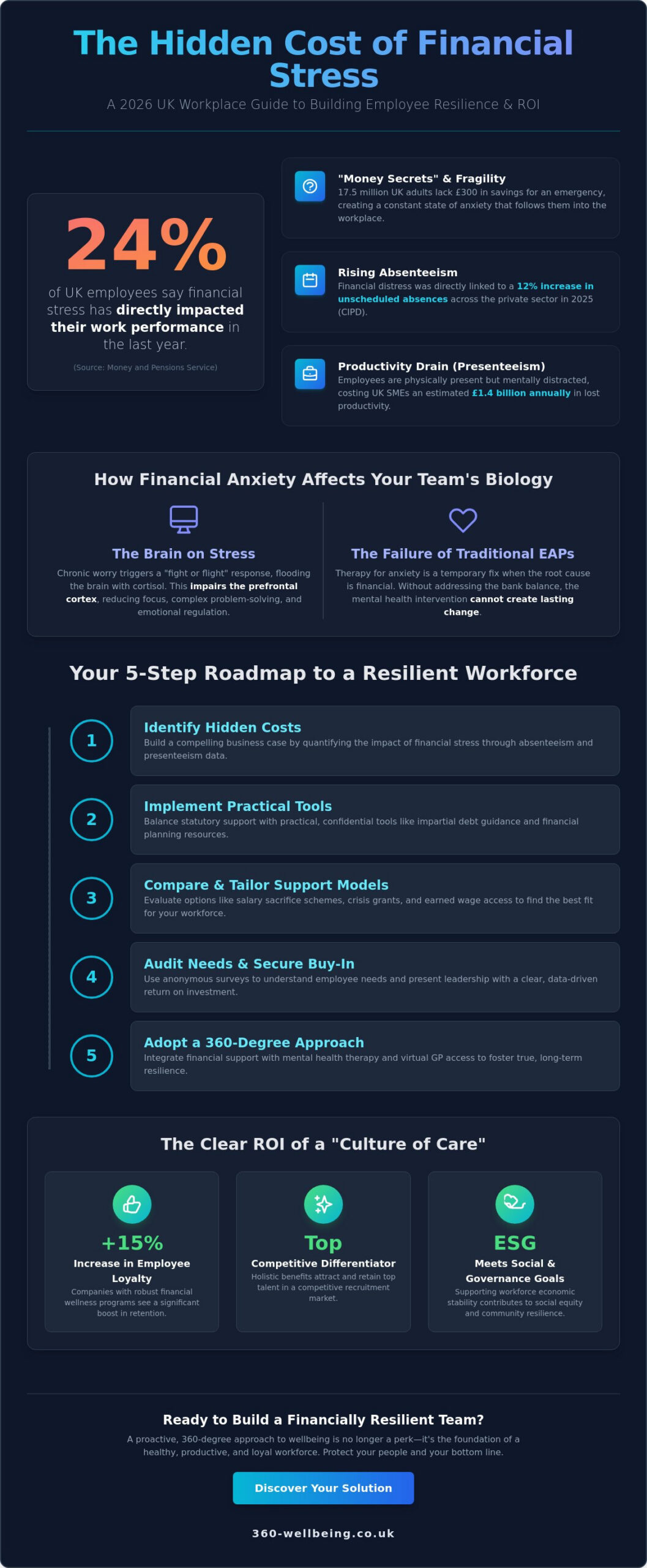
Did you know that 24% of UK employees admit that financial stress has directly impacted their performance at work during the last 12 months, according to data from the Money and Pensions Service? As a leader, you’ve likely noticed the quiet toll this takes through increased absenteeism or a dip in daily focus. It’s a heavy burden for your team to carry alone, and it often leads to talented people leaving for a slightly higher salary elsewhere. We believe that providing robust financial support for employees uk is no longer just a perk; it’s a fundamental pillar of a healthy, proactive workplace culture.
You want to protect your people while ensuring your business remains competitive and sustainable. This 2026 guide is designed to help you implement a comprehensive financial wellbeing strategy that reduces staff stress and provides genuine security for your workforce. We’ll walk you through choosing the right benefit providers and measuring the clear ROI of your wellbeing spend to ensure your team stays resilient, focused, and truly valued.
Key Takeaways
- Identify the hidden costs of financial stress, such as absenteeism and presenteeism, to build a compelling business case for a proactive wellbeing strategy.
- Discover how to implement effective financial support for employees uk by balancing statutory grants with practical tools like impartial debt guidance.
- Compare different support models, including salary sacrifice schemes and crisis grants, to determine which tailored approach best serves your unique workforce.
- Follow a clear, five-step roadmap to audit your staff’s needs and secure leadership buy-in through a proven return on investment.
- Learn why a 360-degree approach—integrating mental health therapy and virtual GP access—is essential for fostering long-term resilience and workplace harmony.
The Link Between Financial Stress and Workplace Performance
In 2026, financial wellbeing in the UK has evolved beyond the simple ability to pay monthly bills. It now represents a state of security where employees feel in control of their daily finances, possess the capacity to absorb a financial shock, and are on track to meet future goals. Providing effective financial support for employees uk is no longer a peripheral benefit; it’s a core pillar of operational resilience. Recent data from the Money and Pensions Service indicates that 24% of UK workers struggle with “money secrets,” while 17.5 million adults in the UK lack the savings to cover a £300 emergency. This persistent anxiety serves as a primary driver for workplace mental health issues, frequently manifesting as burnout or severe anxiety before the underlying financial cause is even identified.
Modern employers are shifting from reactive crisis management toward proactive wellness models. This transition involves understanding financial literacy as a foundational skill that empowers staff to manage their income effectively. By addressing the root causes of money worries, businesses can reduce the heavy burden of absenteeism. In 2025, the CIPD reported that financial distress was responsible for a 12% increase in unscheduled absences across the private sector, highlighting that a “hands-off” approach to employee finances is no longer sustainable for the bottom line.
How Financial Anxiety Affects the Brain and Body
Chronic financial stress triggers a constant “fight or flight” response, flooding the system with cortisol and adrenaline. This physiological state impairs the prefrontal cortex, which is the area of the brain responsible for complex problem solving and emotional regulation. Financial presenteeism occurs when an employee is physically at their desk but mentally consumed by debt or bills, costing UK SMEs approximately £1.4 billion annually in lost productivity. Traditional Employee Assistance Programmes (EAPs) often fall short because they offer therapy for the symptom while ignoring the financial root of the stress. Without addressing the bank balance, the mental health intervention remains a temporary fix.
The Business Case for Investing in Financial Support
Investing in a comprehensive financial support for employees uk strategy builds a “culture of care” that directly improves retention. According to 2025 industry reports, companies with robust financial wellness programs saw a 15% increase in employee loyalty. These initiatives also serve as a competitive differentiator in a tight recruitment market where candidates prioritize holistic benefits. Beyond the immediate team, financial wellness is essential for meeting Social (S) criteria within ESG goals. By supporting the economic stability of the workforce, businesses contribute to broader social equity and community resilience, proving that what is good for the employee is fundamentally good for the brand.
Core Pillars of Financial Support for Employees in the UK
Effective financial support for employees uk requires a holistic strategy that looks beyond the monthly salary. It’s about creating a safety net that catches people before they fall into crisis. By 2026, the most resilient UK businesses are those integrating statutory grants with private wellbeing tools to provide a 360-degree shield against economic volatility. This approach balances immediate relief with long-term security, ensuring your team feels valued and protected.
Government-Backed Support: Access to Work
Access to Work is a vital DWP grant that helps people stay in employment if they have a physical or mental health condition. In the 2023/24 financial year, this scheme supported 49,820 individuals, providing funds for specialist equipment, travel costs, or support workers. Employers play a proactive role by helping staff navigate the application process. It’s a partnership between the state and the workplace that ensures talent isn’t lost due to manageable health barriers, whether they require physical adaptations or mental health coaching.
Debt Advice and Crisis Prevention
Financial stress is a quiet productivity killer. Data from StepChange Debt Charity shows that debt-related anxiety affects 1 in 6 UK workers. Providing confidential access to professional debt counsellors allows employees to address issues early before they escalate into legal action or severe mental health decline. It’s vital to offer this support through third-party partners to maintain professional boundaries. Employees often feel hesitant to discuss money with HR, so an anonymous helpline acts as a crucial bridge to stability. This early intervention protects the individual’s dignity and the company’s operational rhythm.
Legal Security as Financial Wellbeing
Legal disputes are expensive and emotionally draining. According to The Law Society, 54% of UK adults don’t have a valid will, leaving their families financially vulnerable in the event of a tragedy. Offering complimentary will-writing services is a high-value benefit that provides long-term peace of mind. Beyond this, providing legal helplines for housing, family, or consumer disputes reduces the mental load your team carries. When an employee knows they have access to expert advice for a landlord dispute or a contract issue, they can remain focused on their professional goals.
Stretching the monthly salary is just as important as the figure on the payslip. Discount marketplaces allow staff to save on daily essentials, from groceries to fuel. These small wins accumulate, often saving a typical UK household over £1,000 annually. This type of integrated financial wellbeing ensures that support is felt every single day, not just during a crisis. By providing these core pillars, you move from being just a paymaster to becoming a true partner in your employees’ success.
Comparing Financial Support Models: What Works for Your Business?
Choosing the right framework for financial support for employees uk requires a balance between immediate relief and long-term resilience. By 2026, the landscape has shifted from reactive emergency fixes to integrated ecosystems. Your business must weigh the simplicity of one-off crisis grants against the sustained impact of recurring wellbeing subscriptions. While a £500 emergency grant provides a temporary safety net, data from recent 2025 workplace surveys indicates that 68% of employees feel more secure with ongoing, predictable benefits rather than sporadic interventions.
The choice between internal HR-led support and outsourced expert platforms often comes down to capacity and specialized knowledge. Internal teams understand your culture deeply, but they often lack the clinical or financial regulatory expertise to provide high-level advice. Outsourced platforms provide a layer of anonymity that encourages employees to seek help earlier, before a financial concern turns into a mental health crisis. Evaluating the cost-per-employee involves looking beyond the subscription fee. You should measure the reduction in “presenteeism,” which costs UK businesses an average of £1,500 per employee annually according to recent industry benchmarks.
Salary Sacrifice and Financial Education
Salary sacrifice schemes remain a cornerstone of financial support for employees uk. Common examples include enhanced pension contributions, Cycle to Work initiatives, and technology schemes. These models reduce National Insurance contributions for both the employer and the employee, making them highly cost-effective. You might also consider employee loans or salary advances. These tools offer a lifeline during high-inflation periods, but they can lead to debt cycles if they aren’t paired with robust financial coaching.
Education isn’t a standalone cure. A 2024 study showed that while 74% of UK workers value financial literacy workshops, the impact doubles when those workers have direct access to automated savings tools or debt consolidation platforms. Knowledge is most powerful when it’s immediately actionable within the same ecosystem.
The Rise of All-in-One Wellbeing Platforms
Modern digital platforms have replaced fragmented systems by consolidating health, legal, and financial support into a single interface. This is vital for the 43% of the UK workforce currently operating in remote or hybrid roles. These platforms offer 24/7 access, ensuring support is available exactly when a crisis hits, not just during HR office hours.
- Reduced Admin: Managing a bespoke internal support system can cost up to 15% more in man-hours compared to a subscription-based model.
- Data Insights: Platforms provide anonymised trends, helping you see if debt or childcare costs are the primary stressors in your workforce.
- Scalability: Digital tools grow with your business, providing the same level of care to ten employees or ten thousand.
A proactive platform that reduces absenteeism by even 1.5 days per year usually pays for itself. It transforms financial support from a high-maintenance “perk” into a seamless, strategic asset that protects your most valuable resource: your people.
How to Build a Financial Wellbeing Strategy in 5 Steps
Building a resilient workforce requires more than just a competitive salary; it demands a proactive, 360-degree approach to financial support for employees uk. A structured strategy ensures that your investment reaches the people who need it most while protecting your bottom line. Follow these five steps to create a meaningful impact.
- Step 1: Audit workforce needs. Don’t assume you know what your staff needs. Use anonymous surveys to gather data on their primary stressors, whether that’s debt management or saving for a first home.
- Step 2: Secure leadership buy-in. Use concrete data to make your case. Deloitte’s 2024 Mental Health Report found that UK employers receive an average return of £4.70 for every £1 spent on wellbeing interventions.
- Step 3: Select an integrated platform. Choose a solution that connects financial tools with physical and mental health resources. Financial stress doesn’t exist in a vacuum; it often impacts sleep and anxiety levels.
- Step 4: Launch with empathy. Introduce the strategy as a partnership. Focus on reducing the stigma surrounding money talk by framing financial health as a fundamental right.
- Step 5: Measure and evolve. Track engagement rates and sentiment every quarter. If a specific tool isn’t being used, ask why and adjust your offering to match current economic shifts.
Identifying Employee Pain Points
Understanding the unique pressures on your team is vital for success. A 22-year-old graduate might struggle with student loan repayments or the high cost of rental deposits in 2026. Conversely, a staff member in their late 50s might be more concerned with pension gaps or the costs of private social care for elderly parents. By using segmented data, you can match benefits to real-world challenges like childcare vouchers or emergency hardship loans, ensuring your financial support for employees uk is relevant and valued.
Communicating Benefits Effectively
Money is a sensitive subject. To encourage uptake, you must make support feel safe and accessible. Appointing “wellbeing champions” from different departments helps humanise the strategy; these individuals can signpost colleagues to tools without the formality of an HR meeting. Ensure all resources are mobile-first. This is essential for non-desk-based staff, such as those in retail or manufacturing, who need to access support during their commute or break times. Clear, jargon-free communication builds the trust necessary for a healthy workplace culture.
Ready to empower your workforce with a tailored strategy? Explore our comprehensive wellbeing tools to start your journey today.
A 360-Degree Approach to Financial and Health Wellness
True resilience in the workplace isn’t built through isolated benefits. It’s the result of a joined-up strategy where physical health, mental clarity, and financial stability work in harmony. At 360 Wellbeing, we’ve seen how debt and anxiety form a circular trap; financial worries often lead to poor sleep and reduced focus, which in turn impacts career progression. Our platform breaks this cycle by integrating professional debt advice directly with mental health therapy. This ensures that when an employee reaches out because they’re struggling, they receive a solution that addresses both the empty bank balance and the heavy mind.
Access to our 24/7 Virtual GPs plays a surprising role in reducing financial stress. For many UK workers, taking time off for a medical appointment means lost income or the stress of childcare arrangements. By providing instant digital access to clinicians, we help staff manage their health without the “hidden costs” of traditional primary care. For UK SMEs, choosing a holistic platform is the most cost-effective path. Instead of managing five different providers, a single unified system reduces administrative overhead and ensures no employee falls through the gaps. Effective financial support for employees uk requires this high-level view to be truly sustainable.
Beyond the Paycheck: The 360 Wellbeing Platform
The 360 Rewards marketplace is designed to make the daily cost of living more manageable. By offering significant discounts on groceries, fuel, and utilities, the platform effectively increases an employee’s disposable income without requiring a direct salary hike. It’s a proactive way to support staff during fluctuating inflation cycles. Beyond the checkout, we provide deep-level security through our debt helplines and complimentary will-writing services. While a professional will can cost between £150 and £300 elsewhere, we provide it as a standard part of our care package, offering families long-term peace of mind and protection against future legal costs.
Starting Your Journey to a Healthier Workforce
We believe that providing financial support for employees uk shouldn’t be a complex administrative burden for the employer. Our onboarding process is built for speed and simplicity, allowing you to register your entire team in minutes. Whether you are a sole trader looking for personal protection or a large organisation managing hundreds of staff, the platform scales to meet your specific needs. You can tailor the features to suit your industry’s unique pressures, ensuring your team feels seen, heard, and supported.
Empowering Your Workforce for a Resilient 2026
Investing in your team’s financial health is a strategic decision that directly boosts productivity and long-term retention. By 2026, the most successful UK businesses will be those that treat financial stability as a core pillar of workplace performance. You’ve seen how a 360-degree approach bridges the gap between physical health and fiscal security. Implementing robust financial support for employees uk isn’t just about perks; it’s about building a culture where people feel safe and empowered to do their best work every day.
We’re ready to partner with you to deliver this transformation. Our platform provides your staff with immediate access to 24/7 UK-registered Virtual GPs and complimentary will-writing services to manage life’s essential legalities. Your team can also maximize their take-home pay through thousands of retail discounts via 360 Rewards. These tangible benefits provide the reassurance your employees need to stay focused and motivated.
Secure your team’s future with our comprehensive financial support platform
Let’s work together to create a workplace where everyone has the opportunity to thrive and succeed.
Frequently Asked Questions
What is the most effective type of financial support for employees?
The most effective financial support for employees uk is a holistic strategy that combines immediate relief with long term education. Research from the CIPD in 2023 indicates that 27% of workers find money worries impact their performance. Providing a mix of salary sacrifice schemes, emergency hardship funds, and financial coaching ensures you meet both urgent needs and future goals. This 360-degree approach builds resilience and shows your team you’re invested in their total wellness.
Can an employer give financial advice to staff in the UK?
You can’t provide specific financial advice unless your business is regulated by the Financial Conduct Authority (FCA). Under the Financial Services and Markets Act 2000, offering recommendations on specific investments or pension transfers is a regulated activity. However, you can certainly provide financial guidance. This involves sharing general information, such as explaining how tax-free childcare works or providing educational workshops that help staff make their own informed decisions.
How much does a financial wellbeing platform typically cost?
Pricing for a financial wellbeing platform typically ranges between £1 and £5 per employee per month depending on the level of support provided. A 2024 industry benchmark suggests that most providers offer tiered subscriptions based on the size of your workforce and the range of features included. These features often cover debt management tools, savings accounts, and educational webinars. Investing this small monthly amount per head helps prevent the much higher costs associated with stress-related absenteeism.
Is financial support for employees taxable as a benefit in kind?
Most forms of financial support for employees uk are considered a benefit in kind and are subject to Income Tax and National Insurance. However, specific exemptions exist under HMRC rules. For example, you can provide up to £500 of pensions advice per employee each tax year without it being a taxable benefit. It’s vital to check the latest P11D requirements to ensure your support package remains compliant while maximizing the value for your staff.
What is the difference between an EAP and a financial wellbeing platform?
An Employee Assistance Programme (EAP) is primarily a reactive service designed for crisis intervention, whereas a financial wellbeing platform is a proactive tool for long-term growth. While an EAP might offer a one-off consultation for debt stress, a platform provides ongoing resources like budgeting apps and savings trackers. Using both creates a comprehensive safety net. It ensures staff have help when they’re struggling and the tools to thrive when they aren’t.
How can I support employees who are struggling with debt?
Supporting employees with debt starts with providing a safe, non-judgmental environment and clear signposting to professional help. You can offer access to debt counselling services or partner with organisations like StepChange, which helped over 600,000 people in 2023. Some employers also implement low-interest salary advances or debt consolidation loans. These practical steps reduce the mental burden of debt, allowing your team to regain focus and confidence in their professional roles.
Does offering financial support actually improve productivity?
Yes, providing financial support directly improves productivity by reducing presenteeism, where staff are at work but distracted by personal worries. A 2022 survey by Aegon found that one in four workers lose sleep due to financial stress, which inevitably lowers cognitive function and output. When you remove these distractions through robust support, you see higher engagement levels. Your team spends less time worrying about bills and more time contributing to your business goals.
How do I measure the ROI of my employee benefits package?
You can measure the return on investment by tracking key metrics such as staff turnover rates, sickness absence, and annual engagement scores. According to a 2023 report by the Reward and Employee Benefits Association (REBA), companies with defined wellbeing strategies see a measurable drop in recruitment costs. Compare your healthcare spend and absence data before and after implementing your financial support package. This data provides a clear picture of how your investment translates into a healthier bottom line.