
The most useful questions to ask a corporate virtual GP provider cover which health concerns can be assessed remotely, how employees access care, and what happens after a consultation. Ask about consultation options, follow-up, GP credentials, privacy, prescriptions and pharmacy collection so you can understand how the service may fit employees’ needs.
Employees need care that feels straightforward and personal, not just easy to access. A virtual GP can help with many routine physical symptoms and mental health concerns, while urgent or emergency symptoms require the appropriate level of care. Understanding what the service can support helps employees make informed choices.
This guide explains what to ask about access and consultation methods, how follow-up and referrals may work, and what to understand about doctors’ qualifications and medical information. It also covers prescriptions and pharmacy collection, giving you a clear picture of the care journey before deciding whether a service suits your workplace.
Key Takeaways
- Clarify how employees access the service, what consultation options are available and which health concerns can be discussed remotely.
- Ask how follow-up works, including when a GP may recommend further assessment or refer someone for specialist care.
- Understand the doctors’ credentials, how health information is protected and whether relevant medical records can be shared with an employee’s own GP.
- Find out how prescriptions are handled, including any limits and how employees can collect prescribed medication from a pharmacy.
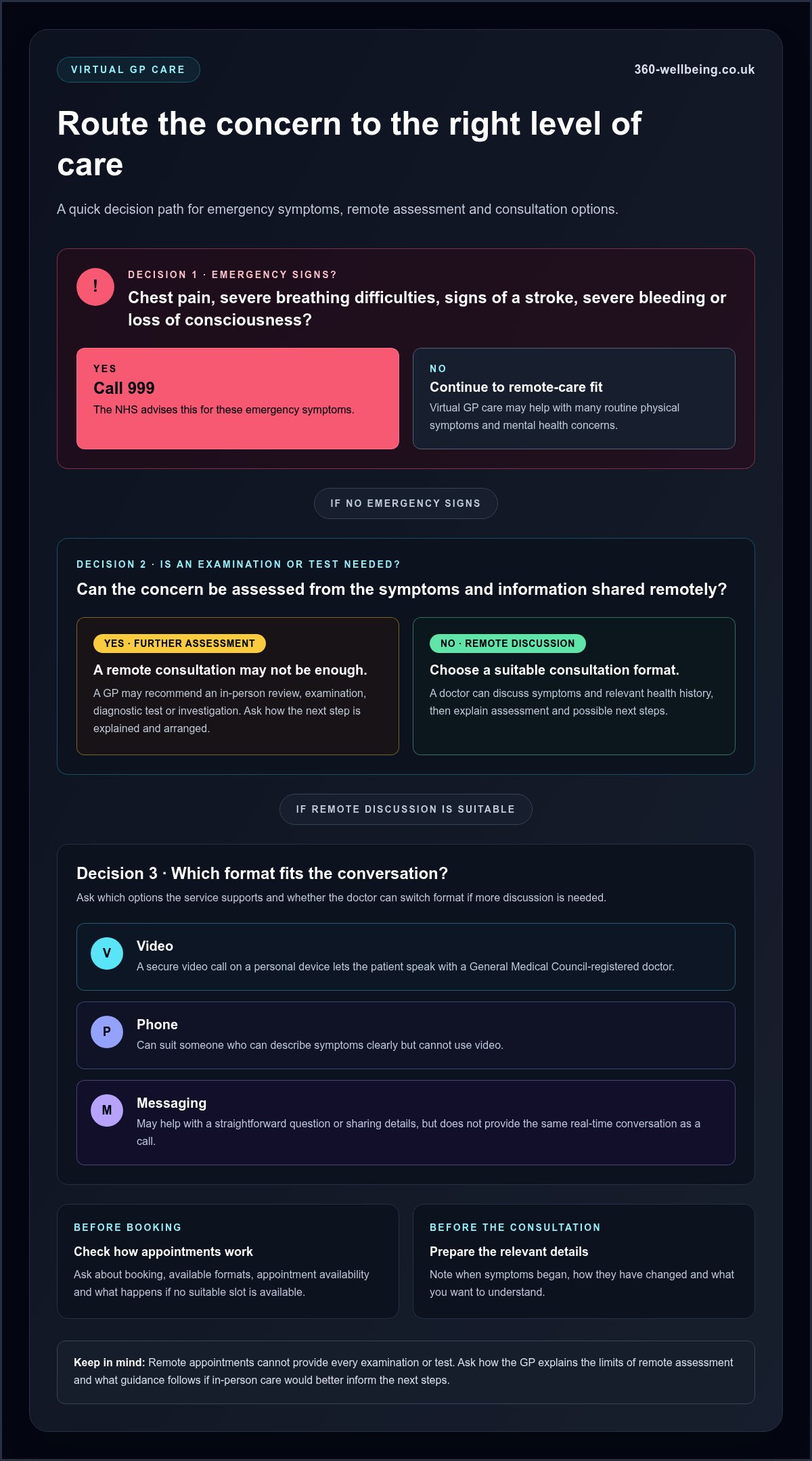
- Keep virtual GP care in perspective: according to the NHS, chest pain, severe breathing difficulties, signs of a stroke, severe bleeding or loss of consciousness require a call to 999.
Virtual GP access through employee benefits and insurance policies
Employee benefits platforms and insurance policies can give staff access to virtual GP consultations. The access route, appointment options and support for tests vary, so compare how each service works in practice.
Benefit and Policy Access Routes
A workplace benefit or insurance policy can include access to a virtual GP service, often through an app or online platform. Some UK private health insurance policies include access to a virtual GP app 24/7 as a standard perk, while some additional services can be used without making an insurance claim. Ask how eligible employees register, whether dependants can use the service, and whether a consultation affects policy claims or benefits.
These details affect how easily employees can use a service and what support it provides. Ask whether staff need an insurance policy, an employer invitation or a separate account to book. Some virtual GP services include access for employees’ children, but eligibility depends on the service’s rules. Clear information helps employees understand how to get clinical advice when they need it.
Consultation Access and Availability
A virtual GP consultation lets an employee speak with a doctor remotely, typically using a digital device. Some UK services operate 24/7, while others offer appointments at set times. Some providers can arrange a video consultation on the same day or within 24 hours, and some platforms offer same-day appointments depending on demand. Ask whether phone, video or messaging is available, and how employees book outside normal working hours.
Availability affects whether an employee can fit an appointment around work, caring responsibilities or changing symptoms. Ask how the service presents appointment options and what happens if no suitable slot is available. The answer shows how employees can reach a doctor without assuming every service follows the same appointment schedule.
Ask separately about diagnostic tests and screenings. A remote consultation lets the doctor hear about symptoms and assess the information shared, but examination or testing may still be needed. Ask how the GP explains the next step and whether the employee receives guidance on arranging further assessment. This clarifies the difference between online clinical advice and an in-person test.
Digital access also matters. Ask what device and connection an employee needs for a video appointment, and whether a phone consultation is an alternative. For NHS GP surgeries, secure online forms are available for contacting the surgery; from 1 October 2025, all GP practices in the UK must provide online tools during core hours. Patients who struggle with a form or prefer not to use one can call or visit their surgery. That contrast helps employers consider access for staff with different digital needs.
Consultation methods, including video, phone and messaging
Video, phone and messaging each shape how a patient explains symptoms and receives advice. Ask how booking works, what a private GP consultation involves, and when remote care is appropriate for an employee’s concern.
A virtual GP consultation allows a patient to speak with a General Medical Council-registered doctor through a secure video call on a personal device. Phone appointments can suit someone who can describe symptoms clearly but cannot use video. Messaging may help with a straightforward question or sharing details, though a written exchange doesn’t provide the same real-time conversation as a call. Ask which formats the service supports and whether the doctor can move to another format if more discussion is needed.
Booking usually involves entering the service’s platform, selecting an appointment and providing a brief reason for seeking advice. Before the consultation, employees can note when symptoms began, how they have changed and what they want to understand. During a private GP consultation, the doctor asks about symptoms and relevant health history, then discusses assessment and possible next steps. A private GP may perform a basic physical examination depending on symptoms, so ask how the service handles cases where remote assessment alone is insufficient.
Remote appointments can help employees discuss physical symptoms or mental health concerns with a doctor, including sensitive matters in a private setting. However, a video or phone consultation cannot provide every examination or test. Ask how the GP explains the limits of remote assessment and what guidance follows if an in-person review or investigation would better inform care.
Keep NHS treatment pathways distinct from a private virtual GP appointment. In the UK, the waiting time for non-urgent, consultant-led treatment is around 18 weeks from the day an appointment is booked through the NHS e-Referral Service. A private consultation is a separate appointment, not a change to that NHS pathway. Ask whether a consultation includes a charge, how any charge is explained before booking, and whether the doctor can discuss routes for further assessment.
For a workplace, compare the practical details: appointment booking, available consultation formats, how employees receive advice afterwards, and what happens when a concern needs in-person assessment. These questions can clarify whether the service meets different communication needs without assuming one format suits every employee. If you’re reviewing workplace support, explore virtual GP support for employees as one part of a broader wellbeing approach.
Follow-up care and specialist referrals
A useful virtual GP consultation should leave the patient clear about what happens next. Ask how the doctor explains the care plan, when follow-up is appropriate and how to access further assessment. Someone whose symptoms persist after initial advice, for example, needs to know whether to book another appointment, contact their own GP surgery or seek urgent help.
During a consultation, the doctor assesses the symptoms and decides whether further investigation or specialist treatment is needed. A virtual GP may issue a referral letter if the doctor determines that specialist care or investigation is appropriate. Ask what the referral covers, who receives it and what information the patient should take to the next appointment. This helps the patient understand how the referral fits into their wider care.
Continuity matters when care moves between a virtual service, a GP surgery and a specialist. Ask how the patient can share the consultation outcome with their usual GP and whether a follow-up consultation is available after further assessment. A patient can also ask their GP whether further assessment or a specialist consultation would support continuity of care. Clear handovers help connect symptoms, advice and next steps.
Online forms from a GP surgery offer another route for ongoing questions. Patients can use a form to report symptoms, ask a question or follow up on an issue, for themselves or someone they care for. For example, a carer could describe a relative’s changing symptoms and explain what advice they need. Ask how the virtual service guides employees who need to return to their own GP practice after a consultation.
Remote care has limits. A video or phone appointment cannot replace emergency services when someone needs immediate help. According to the NHS, people experiencing chest pain, severe breathing difficulties, signs of a stroke, severe bleeding or loss of consciousness are advised to call 999. For other urgent medical help, people can use NHS 111 online or call 111 if they cannot get help online.
In-person assessment may be important when symptoms require a physical examination, tests or direct observation. Ask how the doctor explains this and what the patient should do next. A referral for investigation is different from emergency care, so the patient needs clear guidance on which route applies. Ask how the service supports follow-up if the original concern changes or worsens.
Before choosing a workplace service, consider whether its follow-up process explains referrals, ongoing symptoms and urgent-care boundaries in plain language. A clear process helps employees make informed decisions about their wellbeing and understand when a virtual GP is no longer the right point of care.
GP qualifications, confidentiality and sharing medical records
Ask who provides clinical advice, how employee health information is protected and what happens to medical records. These details help employees make informed choices about discussing symptoms and treatment.
GP Credentials and Confidentiality
A virtual GP consultation should be with a doctor registered with the General Medical Council. Ask how the service identifies its doctors and what clinical support employees can expect during an appointment. UK providers must comply with UK GDPR and strict data protection laws when handling patient information, according to the Information Commissioner’s Office. Employees should understand who can access their health information and how it is handled.
Medical Records and Symptom Notes
A clear symptom timeline and relevant records can help a doctor understand the concern. Before an appointment, note when symptoms began, how they changed and any triggers, then gather relevant medical records and test results. For example, an employee discussing recurring headaches can describe when they occur and share relevant results. Ask whether the virtual GP can share information with the employee’s own GP to support continuity between consultations.
Employer Usage Data and Reports
Ask how the service handles employers’ access to usage data and the content of reports. Find out whether reports identify individual employees or show grouped usage, what information they include, and whether consultation notes or medical records are shared. Clear answers help employees understand the boundary between workplace reporting and personal medical advice.
Tell the doctor about current medicines and alternative treatments, including what has already been tried and whether symptoms have changed. This context helps the doctor consider the employee’s medical history alongside the concern. Ask how the doctor explains medication advice, possible next steps and the reasons for any proposed treatment, so the employee can make an informed decision.
A virtual GP may issue medication on a private prescription if needed after a consultation. Services generally don’t prescribe controlled drugs, strong painkillers or certain psychiatric medicines; gabapentin is an example of a controlled drug that virtual GPs typically don’t prescribe. Ask how repeat prescriptions are handled, what medicines fall outside the service’s prescribing scope, and whether a prescription can be sent to a chosen pharmacy.
For pharmacy collection or delivery, ask what prescription format is used, how the pharmacy receives it and what the employee needs to show when collecting medicine. These details help someone plan how to access prescribed treatment. Ask whether the GP communicates medication advice to the employee’s usual practice, especially when treatment changes or a repeat prescription is part of ongoing care.
Online prescriptions and pharmacy collection
A virtual GP may issue a private prescription after a consultation when medication is appropriate. Ask how prescriptions are sent, collected or delivered, and how repeat requests are assessed.
Prescription Delivery Options
Prescription delivery describes how a prescription reaches a pharmacy or patient after a GP appointment. Ask whether the service sends it electronically or uses another collection arrangement, and what details the employee needs to provide. For delivery, clarify who handles the medicine, where it can be sent and how the patient learns when it is ready. These steps help employees plan around work and other responsibilities.
Separate the prescription process from the medicine supply itself. A doctor may issue a private prescription, but the pharmacy handles dispensing and collection. Ask how the employee chooses a pharmacy, what identification or prescription details are needed, and how the service communicates any delay. This is especially useful if the employee needs to coordinate collection with a workday or caring commitments.
Repeat Prescription Requests
A repeat prescription request is a request for further medicine previously prescribed to the patient. Ask whether a new GP appointment is needed, what medical information the doctor reviews and how the patient receives the outcome. The doctor may need to assess current symptoms, treatment and medication history before issuing further medicine. This helps employees understand the process before an existing supply runs low.
An employee taking ongoing medication can ask how to submit a repeat request and whether the doctor needs an update about changes or side effects. A repeat request is not simply a transfer of an earlier prescription: the doctor considers the available information before deciding whether medication is appropriate.
Prescribing has limits. Virtual GP services generally don’t prescribe controlled drugs, strong painkillers or certain psychiatric medicines. Gabapentin is an example of a controlled drug that virtual GPs typically don’t prescribe. Ask which categories are excluded and what advice the doctor can provide if an employee’s current treatment involves one of these medicines.
A prescription and a referral serve different purposes. A prescription relates to medication, while a virtual GP may issue a referral letter if the doctor determines that specialist treatment or investigation is needed. Ask how the doctor explains each next step and whether a follow-up consultation is needed to discuss the plan. This distinction can prevent confusion after an appointment.
For an urgent concern, ask how the service directs employees to the appropriate care rather than relying on a prescription request alone. If you’re reviewing workplace access to GP appointments, explore virtual GP support as part of employee wellbeing.
360 Wellbeing: 24/7 Virtual GP
360 Wellbeing offers 24/7 Virtual GP access as part of workplace wellbeing support. It can be a natural option for organisations seeking employees’ access to GP support alongside other forms of care.
Its wider offerings include Mental Health Support and Physiotherapy, helping employers consider physical and mental wellbeing together. 360 Rewards also supports a broader employee benefits approach. These services complement virtual GP access, while each addresses a different aspect of employee wellbeing.
For employers reviewing the questions in this guide, consider how virtual GP access could fit alongside the support your workforce needs. To explore whether 360 Wellbeing suits your organisation, visit 360-wellbeing.co.uk.
Build a more considered approach to workplace wellbeing
Choosing a corporate virtual GP service is an opportunity to make health support a practical part of working life. Questions to ask a corporate virtual GP provider can help you focus on the experience you want employees to have, from seeking clinical guidance to feeling supported in their wider wellbeing.
360 Wellbeing brings together 24/7 Virtual GP access, Mental Health Support and 360 Rewards, giving organisations options to consider within a broader employee benefits approach. The right next step is to explore how these offerings could align with your workforce and existing wellbeing priorities.
Contact 360 Wellbeing to discuss your options and take a thoughtful next step towards a healthier, more supported workplace.
Frequently Asked Questions
What kind of conditions can a Virtual GP help with?
A virtual GP can discuss routine physical symptoms, changes in an ongoing concern and mental health worries. Employees can explain what they are experiencing and ask for clinical guidance, such as whether a symptom needs further assessment. Sharing when symptoms began and what makes them better or worse gives the doctor useful context. Virtual care is not suitable for emergencies, so urgent or severe concerns need the appropriate urgent-care route.
What services are included in a corporate virtual GP service in the UK?
At its core, a corporate virtual GP service provides access to a doctor for remote consultations. Some workplace wellbeing platforms combine this with other support, such as Mental Health Support, Physiotherapy or employee benefits. For example, 360 Wellbeing offers 24/7 Virtual GP, Mental Health Support, Physiotherapy and 360 Rewards. Employers can consider which combination fits their workforce, including whether they want healthcare access alongside wider wellbeing and lifestyle support.
What questions should employers ask about virtual GP access hours and appointment availability?
Ask when employees can access the service, how they book and what appointment formats are available. Clarify how they find a suitable appointment and what happens if their preferred time is unavailable. Useful questions to ask a corporate virtual GP provider should also cover access for shift workers, remote staff and employees who need support outside their usual working pattern.
How quickly can employees get a virtual GP appointment?
Appointment timing depends on the service and demand. Some UK virtual GP services can arrange a video consultation on the same day or within 24 hours; some platforms offer appointments in the near future, usually within a few days. Ask how employees see available times and whether appointment options vary by consultation type. This helps set realistic expectations for routine care without treating a virtual appointment as emergency support.
Are virtual GP consultations available by phone, video, and online messaging?
Virtual GP consultations can use different formats, including video calls, phone conversations and online messaging. The available options depend on the service. Video lets the patient speak directly with a doctor, while messaging can help them share a question or symptom details. Ask which formats employees can choose and how the doctor continues the conversation if the information shared needs fuller discussion.
How are prescriptions, referrals, and follow-up care handled by corporate virtual GP providers?
After assessing a patient’s concern, a virtual GP may provide medical advice, issue a private prescription if appropriate or write a referral when specialist investigation or treatment is needed. Follow-up arrangements should make the next step clear, such as sharing the consultation outcome with the employee’s usual GP. Ask how employees receive their care plan and who they can contact with questions about the advice afterwards.
How do UK virtual GP providers protect employee health data and comply with GDPR?
UK providers must comply with UK GDPR and data protection laws when handling patient information, according to the Information Commissioner’s Office. Employers should understand how clinical records are kept separate from workplace reporting, who can access identifiable information, and what usage reports contain. Clear privacy information helps employees know how their consultation details are handled and where to find information about data access, retention and their privacy rights.
How do virtual GP services support employees with disabilities or limited digital access?
Accessibility depends on the service’s design and consultation options. Employers can ask whether employees can use phone consultations instead of video, whether the booking platform works with assistive technology and what support is available if someone cannot complete an online process. An employee with limited internet access, for example, may need a phone-based route. Clear access information helps staff identify an appropriate way to seek support.