An Employee Assistance Programme (EAP) and private therapy can complement each other. An EAP typically offers employer-funded, short-term support, while private therapy can be a separate option for ongoing care. To compare the cost of private therapy vs an EAP service, look beyond the per-session fee: employees generally pay nothing for EAP counselling, though the number of sessions is usually limited.
It’s natural to focus on what you’ll pay when weighing brief support against therapy you fund yourself. The right option also depends on the continuity you want, the support you need and what your workplace EAP includes.
This article explains how the options compare, how to combine them thoughtfully and what to consider alongside NHS and charity support. You’ll find a practical way to match the format to your needs and budget, without assuming one option must replace the other.
Key Takeaways
- EAP counselling is generally employer-funded and free to employees, but access is usually limited by a session cap.
- Compare private therapy’s per-session fees with the support your EAP includes to understand the potential out-of-pocket cost.
- You can use EAP support alongside private therapy; consider how each fits your needs and whether continuity matters to you.
- Choose a format by balancing budget, the type of support you’re seeking and how much flexibility you want.
EAP pricing – how much does an EAP service cost?
UK EAPs usually focus on short-term counselling for mental health concerns, often beginning with an assessment. They may also signpost employees to self-help or other support, and some include practical guidance such as financial or legal support. The exact services depend on the employer’s arrangement.
Employees generally pay no session fee for EAP counselling because it is employer-funded. Access is usually capped: EAPs typically offer between 3 and 8 therapy sessions per year. This can make an EAP a lower-cost starting point, but the available sessions may not suit someone seeking longer-term support. A referral can help direct the person towards the relevant service.
Private therapy fees vary across the UK. The cost depends on location, format, therapy type and the therapist’s fee. In-person sessions in London typically cost more than those in smaller towns, while online therapy may have a different fee structure. Compare the likely cost of the planned course of sessions, rather than judging by one appointment alone.
Therapy type also affects the fee. Counselling, cognitive behavioural therapy (CBT), psychotherapy and sessions with a clinical psychologist are distinct options with different typical costs. For example, a clinical psychology appointment generally costs more than a standard counselling session. Frequency matters too: weekly appointments add up faster than fortnightly ones.
| Option | Employee payment | Session access | Cost factors |
|---|---|---|---|
| EAP counselling | Usually no fee | Typically 3 to 8 sessions per year | Employer’s programme and referral |
| Private, in person | Paid per session | Set with the therapist | Location and therapy type |
| Private, online | Paid per session | Set with the therapist | Format and therapy type |
Before choosing, compare the EAP’s session limit with the likely length and format of private support. Read the programme’s confidentiality terms too, so you understand how information is handled.
Can I use both an EAP and private therapy?
Yes. Employees can use employer-funded EAP counselling alongside private therapy when both options suit their situation. An EAP assessment can provide a starting point, while private sessions may offer continuity if further support is needed.
Access times differ. Private therapists in the UK can typically offer an initial consultation within days or weeks. EAP access depends on its referral and booking process, so the time to a first appointment varies. In England, NHS Talking Therapies has an 18-week first-appointment target for 95% of people referred.
The funding differs: employees usually pay nothing for EAP counselling, while private therapy is charged per session. Online appointments avoid travel, whereas in-person sessions may suit someone who prefers meeting face to face. The fee and format determine the overall spend.
Employers usually arrange and pay for EAP provision through a workplace contract, rather than treating it as an individual therapy bill. Workforce size, service scope and how sessions are funded affect the employer’s overall cost. Employees should distinguish this programme cost from their own private therapy fees.
Tax relief on privately paid therapy isn’t automatic, so employees shouldn’t assume their fees qualify. Employer-funded EAP provision is paid for differently; the two costs shouldn’t be treated as equivalent for tax purposes.
When EAP sessions run out, employees can discuss their ongoing needs with the counsellor and consider privately funded care. For private therapy, the total depends on the fee and the number and frequency of further appointments.
For a practical next step, map the referral route, remaining EAP sessions and preferred format, then compare that plan with the private-session budget. Employers reviewing workplace wellbeing support can consider how EAP access fits their workforce’s needs.
Choosing a therapy format based on needs and budget
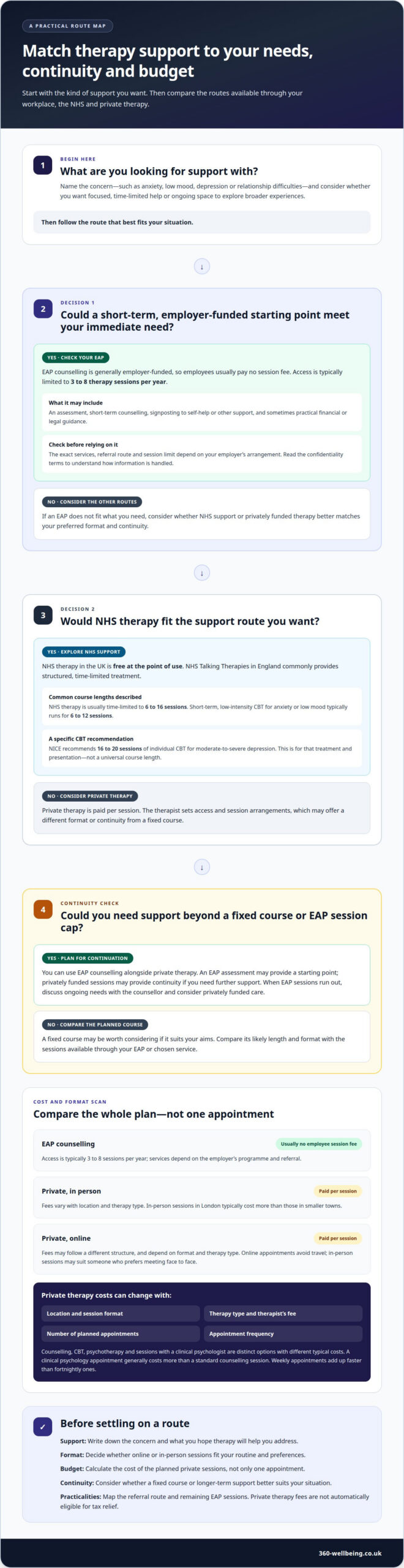
Start by identifying the concern you want support with, such as anxiety, low mood, depression, relationship difficulties or another mental health concern. Then consider whether you want focused, time-limited support or ongoing space to explore broader experiences. This distinction can help you narrow down the format before comparing costs and commitment.
NHS therapy in the UK is free at the point of use. NHS Talking Therapies in England commonly provides structured treatment, while private therapy offers a paid route that can suit someone seeking a different format or more flexible continuity. Short-term, low-intensity CBT for anxiety or low mood typically runs for 6 to 12 sessions; NHS therapy is usually time-limited to 6 to 16 sessions. The cost of private therapy vs an EAP service is another factor to weigh against the type and continuity of support you need.
Match the approach to the concern. NICE recommends 16 to 20 sessions of individual CBT for moderate-to-severe depression. That is a specific recommendation for this treatment and presentation, not a universal course length for every person. For a relationship concern, consider whether individual counselling fits your aims; discuss the focus and expected structure during an initial conversation. Comparing the cost of private therapy vs an EAP service can also help you decide which format fits your budget.
To compare options, write down:
- Support needed: name the concern and what you hope therapy will help you address.
- Format: decide whether online or in-person sessions fit your routine and preferences.
- Budget: calculate the cost of the planned private sessions, not only one appointment.
- Continuity: consider whether a fixed course or longer-term support better suits your situation.
When choosing a therapist, check their training and approach. In the UK, registration with a professional body can help indicate training, as anyone can legally call themselves a counsellor or psychotherapist. Look for a clear explanation of how they work with concerns such as anxiety or depression. Consider whether their approach suits your goals and whether the format fits around work, caring responsibilities and your budget.
Combining EAP and private-pay therapy
An EAP and private therapy can form a stepped plan: begin with workplace support, then decide whether further sessions would help. This may suit an employee who wants to start counselling promptly but expects their concerns to need longer-term attention. The two approaches should complement each other, rather than lead to repeated assessments without a clear purpose.
Before starting both, write down the main treatment goal and what each service will address. For example, an EAP counsellor might help someone clarify immediate priorities, while private therapy provides space to work on those goals over time. If trauma is part of the situation, effective therapy may require 15 to 20 sessions to begin addressing deeply ingrained patterns. That can make planning continuity important.
Use these steps to coordinate support:
- Define the roles: identify what you want from EAP sessions and what private therapy could add.
- Plan the transition: discuss next steps before EAP support ends, rather than waiting until the final appointment.
- Protect continuity: keep a personal note of goals and useful approaches, and share it with another therapist only if you choose.
Using two programmes at once may mean repeating conversations or encountering conflicting approaches. Set a clear focus: use one service for short-term coping strategies and the other for sustained work, rather than expecting both to provide identical treatment. To estimate private costs, multiply the therapist’s fee by the planned number of sessions. For instance, fortnightly appointments add up more slowly than weekly ones.
For employers, an EAP can provide an accessible starting point, while private therapy may be an option employees choose for continued support. Set out how employees access the programme and how they can plan next steps. To explore an EAP for your workplace, consider how counselling access could fit within your wider wellbeing approach.
360 Wellbeing: 24/7 Virtual GP
360 Wellbeing brings together a 24/7 Virtual GP and Mental Health Support, giving employees different routes to wellbeing support. Virtual GP access can help with health questions, while mental health support is relevant when someone is seeking emotional or psychological care. These services complement the choices discussed above; they don’t replace a therapy plan that suits the person’s needs.
For employers, 360 Rewards and Physiotherapy add further dimensions to a broader wellbeing approach. The right combination depends on the workforce and the support an organisation wants to make accessible. Employees can use the relevant offering as part of a considered plan for their wellbeing.
To explore how 360 Wellbeing could support your organisation, visit 360-wellbeing.co.uk.
Make your next step fit your wellbeing goals
The cost of private therapy vs an EAP service is only one part of the decision. The support you need and the continuity you want matter too. A useful next step is to identify the kind of support that feels appropriate, consider how it fits into work and daily life, and choose an option you can sustain.
For organisations looking at employee wellbeing more broadly, 360 Wellbeing brings together a 24/7 Virtual GP, Mental Health Support and 360 Rewards. These offerings can contribute to a more joined-up benefits approach, alongside the therapy options discussed in this article.
Explore how 360 Wellbeing could support your organisation by contacting 360 Wellbeing. A thoughtful next step can help make support feel more accessible and aligned with your needs.
Frequently Asked Questions
Is EAP counselling as good as therapy?
EAP counselling is therapy, usually intended to provide focused, short-term support. Its value depends on whether the approach and available support fit your needs, not simply on whether it comes through work. For example, someone seeking help with a specific workplace concern may find brief counselling useful, while someone with complex or ongoing concerns may prefer a longer-term plan. Discuss your goals at the first appointment.
Can You Combine Both?
Yes, you can use EAP counselling alongside private therapy. To make the combination useful, decide what you want from each: for example, use EAP sessions to address an immediate concern, then continue privately with broader goals. If you feel comfortable, tell each therapist about the support you’re receiving elsewhere. This can help avoid repeated assessments and keep the approaches aligned with your priorities.
What is the average cost of private therapy per session in the UK?
The fee varies by location and therapy type, so counselling and sessions with a clinical psychologist may cost different amounts. To estimate your budget, multiply the therapist’s fee by the number of appointments you expect to attend.
How much do online private therapy sessions cost in the UK?
Your total spend depends on the therapist’s fee and how often you book. Compare weekly appointments with a less frequent schedule over the same period. Online sessions can remove travel from your planning, but the therapy fee remains a key budget factor.
How many counselling sessions does a UK employee assistance programme (EAP) typically provide?
A UK EAP typically provides between 3 and 8 counselling sessions per year. Some programmes set the allowance for each presenting concern, so a new issue may be treated differently from continuing support for the same concern. Check the scheme’s session rules and whether the allowance resets annually. Knowing the limit helps you plan what support to use first.
Are EAP therapy sessions free for employees in the UK?
Usually, yes. EAP counselling is generally employer-funded, so employees pay no fee for the sessions included in the programme. However, not every therapy appointment is covered: support outside the EAP, such as private sessions after the allowance ends, must be paid for separately. Distinguish the employer-funded benefit from any personal treatment costs.