High EAP utilisation doesn’t automatically mean the programme is working, just as low utilisation doesn’t prove employees don’t need support. The most useful strategies to boost low EAP engagement make support easier to understand and access, then assess whether it helps employees, not just how many use it. A usage count shows activity, but not what’s getting in the way or whether the support meets people’s needs.
It’s understandable to look at utilisation first when reviewing an EAP. But employees may not know what’s available, feel unsure about confidentiality or think their concerns aren’t serious enough to seek help. This article explains how to build awareness with regular, relevant communication, reduce barriers to access and gather feedback to guide improvements. It also explores how to interpret utilisation alongside access, satisfaction and the issues employees raise, so you can make informed decisions about wellbeing support.
Key Takeaways
- Use anonymous employee feedback to uncover barriers to support, then show how you’re responding to what people say.
- Assess EAP use alongside access, employee satisfaction and the issues addressed, rather than treating utilisation as the only measure of value.
- Keep promotion going throughout the year across the channels employees use, and make clear what support is available and how to access it.
- Reduce friction with straightforward access options and guidance, so employees can find appropriate support when they need it.
1. Employer strategies for increasing EAP engagement
Low engagement can point to a gap between the support offered and employees’ experience of finding it. An employee may not understand which challenges the EAP can address or how to begin. Treat employee experience as an input, then assess engagement as an outcome. These strategies to boost low EAP engagement work best when they address the barriers employees actually describe.
In the UK, employers should explain how EAP confidentiality and personal data are handled. Tell employees what information is collected, who can access it and what is shared with the employer. Clarify how service-level feedback differs from personal details about an individual’s mental health support. Clear explanations help employees make informed decisions about seeking help.
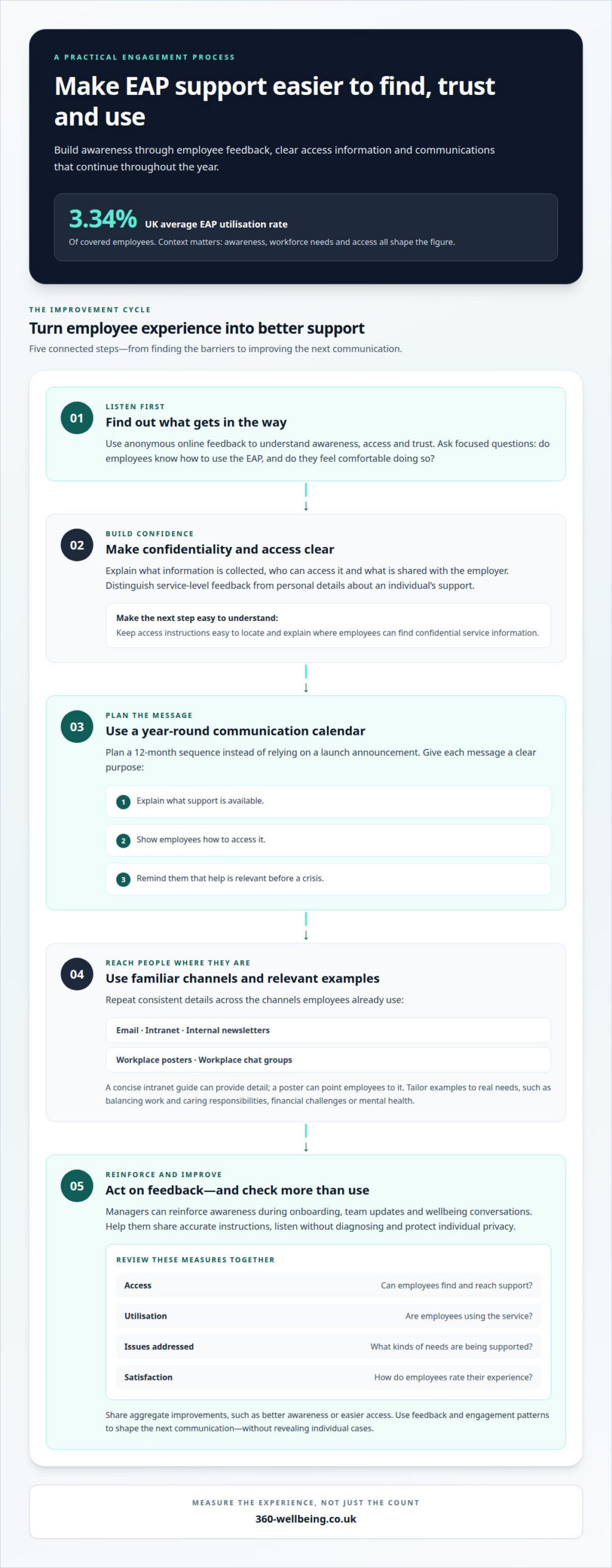
Start with anonymous online feedback about awareness, access and trust. Ask focused questions, such as whether workers know how to use the EAP and feel comfortable doing so. Then explain what action will follow. If employees say access instructions are hard to find, make them easier to locate and tell them what changed. Feedback without visible action can weaken confidence.
Tailor messages to employees’ real needs instead of sending every group the same examples. Parents may value information about balancing work and caring responsibilities; employees supporting dependants may need different signposting. Use examples that reflect varied challenges without assuming everyone has the same circumstances. This makes strategies to boost low EAP engagement more relevant across the workforce.
Managers and wellbeing champions can help make support familiar. Train managers to recognise signs of stress, listen without diagnosing and explain where employees can find the EAP. Champions can share practical guidance on accessing support while respecting privacy. Review feedback and engagement patterns regularly, then adjust communications or access information. This creates a continuous improvement cycle focused on employee experience, wellbeing and meaningful outcomes.
2. How can employers boost EAP utilisation?
Measure access, use and outcomes separately. Activation shows whether employees have registered or opened the service; utilisation shows whether they have used support. Neither measure alone reveals whether help was timely or useful. The UK average EAP utilisation rate is 3.34% of covered employees, but context matters: awareness, workforce needs and access all shape the figure.
When comparing EAP providers, assess how employees can access support, which issues it addresses and what anonymised reporting is available. Track access, issues addressed, satisfaction and utilisation together, then compare the measures over time. This gives the organisation a fuller picture than a single headline rate.
Managers can encourage EAP use by explaining the service and sharing access instructions, without asking who has used it or why. Keep individual conversations private and direct employees to the support route. Discuss overall trends only through anonymised reporting.
HR technology can bring these measures into one view. Pair service data with employee surveys, while keeping personal support records separate from workforce-level reporting. Gallup’s Q12 framework covers 12 elements linked to performance and can help assess wider employee engagement. It complements EAP measures rather than replacing them: an engagement survey and service-use data answer different questions.
Evaluate a campaign by recording when it starts, the communication channels used and its intended outcome. For example, after adding clear access instructions to induction, compare awareness and access measures with the previous period. Review satisfaction and anonymised feedback alongside utilisation. Share aggregate improvements, such as better awareness or easier access, without revealing individual cases. Use the findings to shape the next campaign and improve employee experience.
For organisations strengthening mental health support, an employee assistance programme can be part of a broader wellbeing approach.
3. Regular EAP communications and promotion
A launch announcement can introduce an employee assistance programme, but sustained awareness needs a longer plan. Build a 12-month communication calendar rather than relying on one campaign. Give each message a clear purpose, such as explaining available support, showing how to access it, or reminding employees that help is relevant before a crisis. A deliberate sequence keeps the programme visible without making every message feel like a repeat.
Use several channels so employees can find information in familiar places. Share access instructions by email, on the intranet, in internal newsletters, through posters and in workplace chat groups. Keep the key details consistent: what support covers, how employees can access it and where to find confidential service information. A concise intranet guide can provide detail, while a poster can direct employees to it.
Make communications relevant to different employee groups. A message for parents might cover balancing work and caring responsibilities, while another could address financial or mental health challenges. Choose examples that reflect the organisation’s workforce without assuming every employee has the same needs. Surveys can reveal which topics employees want explained, where they look for updates and what wording they find clear.
Managers can reinforce awareness during onboarding, team updates and wellbeing conversations. Give them a short briefing with accurate access instructions and language that encourages support without asking who has used the service. Review the communication calendar alongside employee feedback. If workers say they missed an email, try a different channel; if the purpose remains unclear, simplify the explanation. Consistent, year-round promotion helps employees remember the programme when a need arises.
4. Convenient access, including virtual and out-of-hours services
Access should fit around the realities of work, not depend on employees being free during office hours. Shift workers, remote teams and people with caring responsibilities may need different routes to support. EAPs are often available 24/7, and some are accessible to employees’ family members. Employers should explain which access options apply to their programme, so workers know what support they can use.
Digital routes can reduce effort when someone is ready to seek help. Clear directions, quick reference guides and single sign-on can make it easier to find the right service without searching through several workplace systems. A mobile app can also give employees a convenient way to reach wellbeing content. Some EAPs provide 24/7 access to content and counselling through apps, while a 24/7 hotline can offer another route for immediate assistance.
Make access instructions visible where employees already look. Add a direct link to the intranet, include the steps in onboarding materials and explain the route during team updates. For example, a worker who finds a wellbeing page after hours should be able to see whether support is available then, how to start and whether family access is included. Straightforward information can remove uncertainty before it becomes a barrier.
Leaders show that wellbeing belongs in workplace culture by making support easy to discuss and keeping personal use private. Promote access routes consistently, including in communications for remote and shift-based teams. Use anonymous feedback to identify practical barriers, such as unclear sign-in steps or difficulty finding the right contact route. Addressing these points can make support easier to reach and help employees seek assistance before challenges affect wellbeing or productivity.
For a more convenient route to health support, explore virtual GP access.
360 Wellbeing
360 Wellbeing brings together support that can help employers respond to varied employee wellbeing needs. Alongside an Employee Assistance Programme, its offering includes Mental Health Support, 24/7 Virtual GP, Physiotherapy and 360 Rewards. This broader range gives employees different routes to support, while helping organisations make wellbeing part of everyday working life.
If low engagement is prompting a review, consider whether employees can find support that feels relevant to their circumstances and easy to access. 360 Wellbeing can support organisations looking to strengthen their employee benefits and wellbeing provision across physical and mental health.
Contact 360 Wellbeing to discuss your organisation’s wellbeing needs.
Make your next wellbeing step count
A practical strategy to boost low EAP engagement starts with listening, then making support relevant to everyday working life. Choose one improvement employees will notice, such as clearer signposting or an easier route to help. Invite feedback, act on it and keep learning from employees’ experiences.
For organisations reviewing how wellbeing support fits together, 360 Wellbeing offers Mental Health Support, 24/7 Virtual GP and 360 Rewards. These options can sit alongside an EAP as part of a broader approach to employee wellbeing. The right combination depends on the needs your organisation is aiming to address and how employees can access support.
Contact 360 Wellbeing today to discuss your organisation’s wellbeing needs and potential next steps. A thoughtful, steady approach can help make support easier to understand and use, while building a workplace culture where wellbeing is part of how people are supported every day.
Frequently Asked Questions
Does high EAP utilisation mean it’s working?
Not by itself. High utilisation can indicate that employees know about the service and feel able to use it, but it doesn’t prove that support meets their needs. For example, a rise after a promotion campaign may reflect improved awareness, not a change in workplace wellbeing. Read usage alongside satisfaction and the issues addressed to understand what the figures may mean.
How can employers boost EAP utilisation?
Make the service easy to understand, relevant to employees’ needs and straightforward to access. For example, explain how employees can use support for stress or financial concerns, then demonstrate the process during induction. Employers can also connect the EAP with wellbeing activities, such as a mindfulness workshop, to show how support relates to everyday life.
What is the average EAP utilisation rate?
The average EAP utilisation rate in the UK is 3.34% of covered employees. Treat this as a comparison point, not a target that automatically defines success. Before interpreting your organisation’s figure, make sure you’re comparing the same kind of population and reporting period. A workforce with different needs or awareness may use support at a different rate.
What should you measure alongside EAP utilisation?
Include employee satisfaction, the types of issues addressed and how employees access support. These measures can help distinguish between a service people notice and one they find useful. A separate engagement survey can show whether employees feel supported more broadly. Gallup Q12, which covers 12 elements linked to performance, offers one framework for exploring workplace engagement alongside EAP data.
What’s the cost of low EAP utilisation, and low-impact usage?
Low utilisation can mean a support service isn’t reaching employees who might benefit, while high use alone doesn’t demonstrate value. Look at patterns in access, satisfaction and the issues addressed before deciding what the figures suggest. If use is low, explore awareness or access barriers. If use is high but satisfaction is poor, investigate whether the support fits employees’ needs.
Why does high utilisation matter, and where does it fall short?
High utilisation can show that employees are engaging with available support. But as a standalone measure, it doesn’t show who is being reached, whether the support is helpful or how employees feel afterwards. Consider whether different parts of the workforce can access the service, then use feedback and reported satisfaction to put the overall figure in context.