Private medical insurance isn’t the only way to support employees’ health. Alternatives for a small business include health cash plans, virtual GP access, wellbeing support and NHS care. The right fit depends on whether you want help with everyday healthcare costs, convenient GP support or broader wellbeing benefits without private medical cover. This guide compares alternatives to private medical insurance for small business, including how cash plans differ from NHS care.
It’s understandable to want a benefit that feels useful to employees while keeping business costs manageable. A cash plan can contribute towards everyday treatments, while the NHS remains the route for publicly funded healthcare; neither works in exactly the same way as insurance for private consultations, diagnostics and hospital treatment. You’ll learn what each option can and can’t do, what affects the cost, and when combining different forms of support may make sense. We’ll finish with a practical decision guide to help you weigh your priorities.
Key Takeaways
- Compare a cash plan’s eligible everyday healthcare costs with the private consultations and treatment you may want covered; they serve different needs.
- Look beyond a low monthly cash-plan cost by weighing its benefits and limits against what employees are likely to use.
- Factor NHS care into your decision, then consider whether added support could address the access or wellbeing needs that matter most to your team.
- Use the decision guide to match your budget and priorities with a single benefit or a combination of options.
Health cash plans for everyday healthcare costs
A health cash plan reimburses employees for eligible everyday healthcare costs, up to the plan’s limits. Private medical insurance (PMI), by contrast, typically covers private consultations, diagnostics, hospital treatment and surgery for acute conditions. A cash plan may suit small business owners looking for help with routine costs, rather than private acute-care cover.
Factors include employees’ ages, location and level of cover. More than 1.6 million UK employees have paid-for corporate cash plans.
UK tax and National Insurance treatment for employer-funded health benefits depends on the benefit and how the employer provides it. Consider payroll and tax treatment when setting up a scheme rather than assuming payments or reimbursements are all treated alike.
A limited company can pay for employees’ medical treatment, but paying through the company doesn’t automatically make it tax-free. The tax and National Insurance consequences depend on the treatment and arrangement, so factor them into the total cost.
Self-pay avoids a recurring premium, but employees pay for treatment themselves. Cash-plan reimbursements are limited by the plan’s terms, while self-pay bills can be substantial, so weigh both carefully against your business’s priorities.
| Option | Main use | Cost basis | Key limitation |
|---|---|---|---|
| Health cash plan | Eligible everyday costs | Monthly employee cost | Claims are subject to plan benefits |
| Group PMI | Private acute treatment | Monthly employee cost | Higher cost range |
| Self-pay | Chosen private treatment | Pay per treatment | Large bills can arise |
To set up a workplace scheme, identify the costs employees most need help with and set a business budget. Compare benefits, exclusions and claim rules, then decide how employees will access the support and explain the process clearly. Include payroll and tax considerations before launch.
Choose a cash plan for eligible routine costs, PMI for private acute treatment, or self-pay when you want to fund specific treatment directly.
Low-cost cash plans and their limitations
Price alone doesn’t show how much practical help employees will receive. Compare benefit limits, eligible treatments and claim rules before deciding.
A cash plan reimburses eligible costs up to its stated limits. For example, an employee might claim towards a routine treatment, then pay any amount above the plan’s limit themselves. A lower-cost option may suit a business focused on defined everyday expenses, but it won’t provide the same cover as PMI for private hospital treatment or surgery.
Read the benefit schedule as carefully as the monthly price. Check which treatments qualify, the maximum reimbursement, how often employees can claim and whether dependants are included. These details determine how useful the plan is for your team. A category that looks generous may offer limited value if its allowance is quickly used.
- Match benefits to likely needs: compare listed treatments with the everyday costs employees want help managing.
- Review claim limits: note the maximum payment and claim frequency for each eligible category.
- Check access conditions: understand who can claim and which expenses qualify before setting the budget.
For a small business, estimate the total recurring spend by multiplying the monthly employee rate by the number enrolled. Then compare that figure with the benefits employees could realistically claim. Don’t treat the plan as a fund for unpredictable major treatment: a cash plan’s reimbursements are limited by its terms, while self-pay bills can be substantial.
Cash plans also don’t solve every wellbeing need. A team seeking emotional or practical guidance may benefit from separate workplace wellbeing support, alongside reimbursement for eligible healthcare costs. That combination can address different needs without presenting a cash plan as full medical insurance.
Choose the lowest-cost plan only if its limits and eligible treatments match your priorities. If employees need cover for private consultations, diagnostics or hospital care, assess that need separately rather than assuming a cash plan provides it.
Relying on the NHS and waiting times
Relying on the NHS keeps publicly funded care as the main route for employees, but appointment timing can affect work planning. Waiting times for non-urgent care can vary. That target helps frame expectations, but it doesn’t mean every appointment will happen within that period.
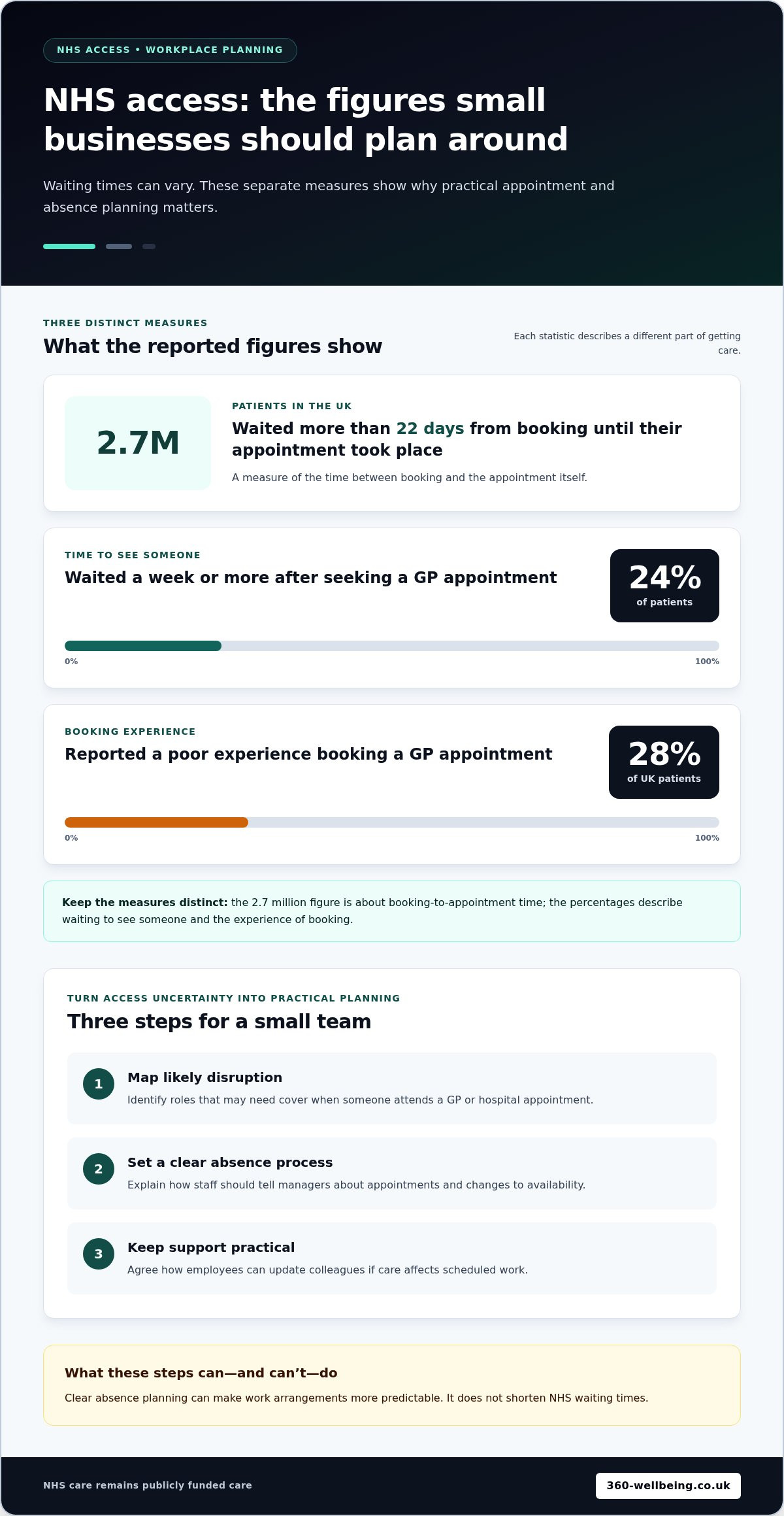
Waiting can begin before treatment, including while someone seeks a GP appointment. In the UK, 2.7 million patients waited more than 22 days from booking until their appointment took place. A separate measure found 24% of patients waited a week or more to see someone after seeking a GP appointment.
Access to primary care also shapes employees’ experience. The figures report that 28% of UK patients have a poor experience booking a GP appointment. For a small business, the practical question is how employees can manage work while seeking care, attending appointments and following treatment advice.
- Map likely disruption: note which roles need cover when an employee attends a GP or hospital appointment.
- Set a clear absence process: explain how staff should notify managers about appointments and changes to availability.
- Keep support practical: agree how employees can update colleagues if care affects scheduled work.
These steps won’t shorten NHS waiting times, but they can make absence planning more predictable. For example, a small team can identify essential tasks a colleague could cover during an appointment. Keep arrangements proportionate, protecting employees’ privacy while helping managers organise work responsibly.
Relying on the NHS may suit a business that prioritises public healthcare and can plan around appointment access. It may be less suitable as the only workplace health response if the team needs additional support or easier access to certain services. Compare NHS care with benefits that address specific needs, rather than assuming one option replaces another.
Use the 18-week target and the reported appointment waits as context, not a promise of an individual timeline. Decide how the business will handle appointments, absence updates and workload cover, then assess whether employees need any additional support alongside NHS care.
When alternatives to PMI may suit a business
Alternatives to private medical insurance for small business owners may suit a company prioritising targeted employee support over private treatment for acute conditions. Start by identifying the needs your team raises and the support your business can sustain. For example, an employer might provide wellbeing benefits while employees continue to use NHS services for treatment.
An Employee Assistance Programme (EAP) and PMI serve different purposes. An EAP offers workplace support, while PMI typically covers private consultations, diagnostics, hospital treatment and surgery for acute conditions. An EAP isn’t a like-for-like replacement for medical insurance; it may suit a business focused on employee wellbeing rather than private hospital access.
Consider employee needs, the scope of each benefit and how staff would use it. A team seeking emotional wellbeing support may prioritise an EAP. An employer looking to provide private treatment pathways should assess PMI separately. Some businesses combine options, giving each benefit a distinct purpose instead of expecting one scheme to cover every need.
- Set the priority: decide whether the main aim is private treatment, everyday healthcare costs or workplace wellbeing.
- Compare scope: list what each option supports, then identify gaps that matter to employees.
- Plan the budget: compare recurring scheme costs with direct self-pay and your intended level of support.
- Explain access: tell employees what the benefit is for and how they can use it.
For example, a small team with limited benefit spending might prioritise wellbeing support and use the NHS as its main treatment route. Another employer may value private acute-care cover more highly. Present alternatives accurately: an EAP or cash plan isn’t equivalent to PMI.
Use a simple decision guide: identify the need, choose the matching support, compare its scope, then explain the arrangement to staff. If an EAP aligns with your workplace priorities, explore workplace wellbeing support as part of your benefits planning.
360 Wellbeing: 24/7 Virtual GP
360 Wellbeing offers a 24/7 Virtual GP for businesses looking to add convenient GP access alongside NHS care. It isn’t private medical insurance, but it can form part of a broader employee wellbeing approach. The platform also includes Mental Health Support, Physiotherapy and 360 Rewards, allowing businesses to consider support across different aspects of employee wellbeing.
This may suit employers who want to complement existing healthcare arrangements with virtual GP access or practical wellbeing benefits. Consider which needs matter most to your team, then explore how these offerings could fit your employee benefits approach. Contact 360 Wellbeing to discuss your business’s wellbeing needs.
Build a benefits approach that can grow with your team
Your next step is to decide what employee health support should make easier at work. Consider the needs your team raises, what managers can explain clearly and how your approach could adapt as the business changes. Choosing alternatives to private medical insurance for a small business isn’t simply a cost decision; it’s a way to shape support around real priorities.
360 Wellbeing brings together a 24/7 Virtual GP, Mental Health Support and 360 Rewards. These can help employers consider practical access to health guidance, emotional wellbeing and employee benefits within one broader approach. The right mix depends on what you want the scheme to achieve and how it fits alongside existing healthcare arrangements.
Take the priorities you’ve identified and consider how they could translate into a thoughtful benefits plan. Contact 360 Wellbeing to discuss your business’s employee wellbeing needs and explore a considered next step for your team.
Frequently Asked Questions
What are the alternatives to private medical insurance for SMEs?
SMEs can consider health cash plans, employee assistance programmes, virtual GP access, wellbeing benefits, self-pay treatment or NHS care. These options address different needs, so compare what each helps employees access rather than treating them as interchangeable. For instance, an employer might combine NHS care with wellbeing support, while another prioritises reimbursement for eligible everyday healthcare expenses.
What alternatives to private medical insurance can UK small businesses offer employees?
Businesses can offer a mix of support, such as an Employee Assistance Programme, Mental Health Support, Physiotherapy, virtual GP access or a cash plan. The right combination depends on what the business wants employees to access. A team seeking help with emotional wellbeing, for example, could prioritise that support while continuing to use NHS services for healthcare.
Can small businesses offer virtual GP or digital health services instead of private medical insurance?
Yes. A small business can offer digital GP access, but it should explain that this is not the same as private medical insurance. For example, 360 Wellbeing’s Virtual GP service allows contact by phone, video or text, and its GPs can issue open referral letters for NHS or private treatment. Those letters don’t themselves pay for consultations or treatment.
What NHS services and waiting-time support can small-business employees use instead of private cover?
Employees can continue using NHS care, including their GP practice and NHS hospital services, rather than relying on employer-funded private cover. A business can make arrangements easier to manage by explaining its appointment and absence notification process. For example, an employee can let their manager know when an appointment affects availability while keeping personal medical details private.
What are the drawbacks and risks of replacing private medical insurance with cheaper health benefits?
The main risk is a mismatch between what employees expect and what a benefit actually provides. A wellbeing service or cash plan doesn’t automatically fund private consultations, diagnostics or hospital treatment. Before choosing, explain what the benefit covers, what it excludes and what employees need to arrange themselves. Clear communication helps staff understand how NHS care or separate treatment funding fits in.