
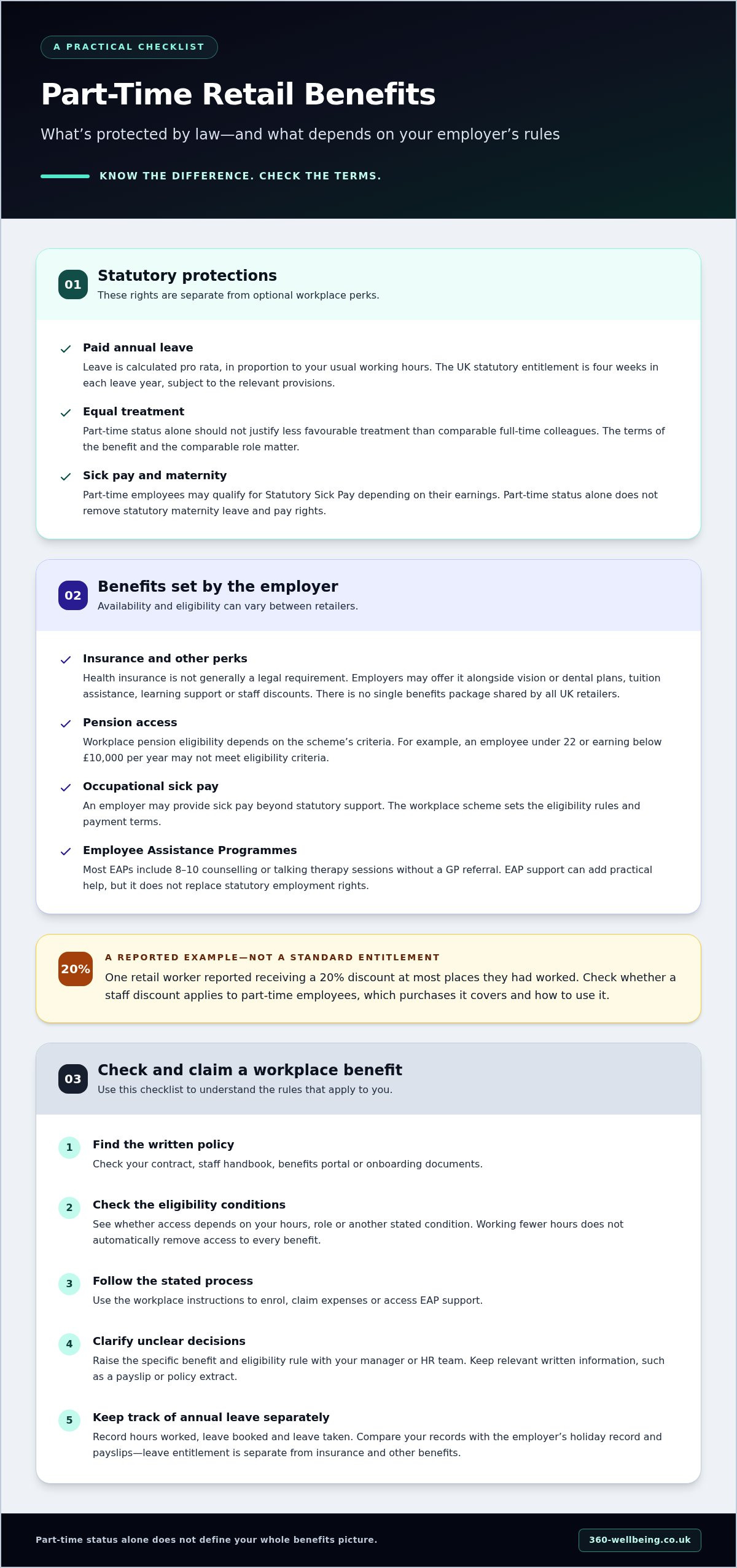
A benefits package for part-time retail staff in the UK may include health insurance, but employers aren’t generally required to provide it. Part-time workers should receive no less favourable treatment than comparable full-time colleagues without objective justification, and paid annual leave is calculated pro rata.
It’s reasonable to ask whether working fewer hours means fewer workplace protections or less support. The key distinction is that some entitlements are statutory, while other benefits depend on the employer’s package and eligibility rules.
This guide explains how health insurance and other benefits may apply, how paid annual leave and statutory protections work for part-time staff, and what equal treatment means in practice. It also outlines the wellbeing support employers can include in a benefits package.
Key Takeaways
- Health insurance isn’t generally a legal requirement, but part-time staff should understand how their employer’s benefits eligibility rules apply.
- Paid annual leave is calculated pro rata, so your usual working pattern affects your entitlement.
- According to the UK Government, a worker is entitled to four weeks’ annual leave in each leave year, subject to the relevant provisions.
- Part-time staff should receive no less favourable treatment than comparable full-time colleagues without objective justification.
- If you make a written request for reasons for less favourable treatment, the employer must respond within 21 days, according to the UK Government.
Do Part-Time Workers Receive Benefits Like Health Insurance?
Yes. Part-time retail employees can receive workplace benefits, but eligibility depends on the benefit and the employer’s rules. Health insurance isn’t generally a legal requirement, while statutory protections apply separately.
Employee Benefit Eligibility
Benefit eligibility means the conditions an employer sets for employees to access non-statutory workplace perks. It matters because working fewer hours doesn’t automatically remove access to every benefit. UK employers may offer part-time staff health insurance, vision or dental plans, and tuition assistance. Under the Equality Act 2010, part-time status alone shouldn’t justify less favourable treatment; the benefit’s terms and comparable full-time roles matter.
There’s no single benefits package shared by all UK retailers. Employers may offer insurance, learning support or staff discounts, but their policies determine eligibility. A written benefits guide should explain whether access depends on hours, role or another stated condition.
Sick Pay and Pension Access
Statutory Sick Pay (SSP) is pay for eligible employees who are off work sick. Part-time retail employees may qualify for Statutory Sick Pay, depending on their earnings. Meeting that condition means a part-time schedule alone doesn’t exclude them. Employers may also offer occupational sick pay, with eligibility and payment governed by the workplace scheme.
Workplace pensions use eligibility criteria, so part-time employees may not qualify automatically. For example, an employee under 22 or earning below £10,000 per year may not meet workplace pension eligibility criteria. Check the enrolment information and payslip to understand whether contributions are being made. A part-time worker who is eligible should be considered under the scheme’s rules.
Employee Assistance Programmes (EAPs) can add practical support beyond pay and insurance. Most EAPs include 8-10 counselling or talking therapy sessions without a GP referral. Mental Health Support through an EAP may help an employee address a concern while balancing shifts, home responsibilities and recovery. Support can contribute to workplace morale and focus, though it doesn’t replace statutory employment rights.
Discounts and other staff benefits are handled through each retailer’s policy. One retail worker reported receiving a 20% discount at most places they had worked; that’s an example, not a standard entitlement. Check whether the discount applies to part-time staff, what purchases it covers and how to use it. A clear policy helps employees understand the value of their benefits.
Checking and Claiming Workplace Benefits
To check or claim a benefit, review the workplace rules, confirm your eligibility and follow the application process. Start with your contract, staff handbook, benefits portal or onboarding documents. Check the rules against your role and hours, then follow the instructions to enrol, claim expenses or access an Employee Assistance Programme (EAP). Workplace materials should explain how to use confidential EAP support.
If the policy doesn’t explain a decision, raise the specific benefit and eligibility rule with your manager or HR team. Keep relevant written information, such as a payslip or policy extract, to make the issue clear. This can help distinguish the benefit’s conditions from statutory rights such as SSP.
Paid annual leave for part-time staff
Part-time employees build paid annual leave in proportion to their usual working hours. This gives retail staff a fair entitlement without requiring them to work the same number of shifts as full-time colleagues.
For a regular schedule, the calculation reflects the hours normally worked. Someone working shorter shifts across the week and someone working fewer, longer shifts may have different patterns, even if their weekly hours match. Entitlement follows usual hours, not simply the number of days on the rota.
Retail rotas can change, so keep a personal record of hours worked, leave booked and leave taken. Compare it with the employer’s holiday record and your payslips. Clock-in records and rota entries can help clarify the hours used in a calculation, particularly when a weekend shift or swap changes your usual pattern.
Ask how the workplace records leave when scheduled hours vary. The calculation should reflect your usual hours and applicable entitlement, rather than assuming every part-time employee has the same schedule. Clear records also help you plan rest, family commitments and expenses without losing track of paid time off.
Paid annual leave is separate from benefits such as health insurance. A benefits package may set out insurance eligibility, while the holiday policy explains how leave accrues and is booked. Keeping the terms distinct helps employees understand what supports time away from work and what applies during working periods. A clear leave process can also help staff balance work and personal responsibilities.
Part-time employees are entitled to statutory maternity leave and pay, like full-time employees. Part-time status alone doesn’t remove those statutory rights. Maternity leave and annual leave are separate entitlements, so understand how each is recorded and paid when planning time away. Workplace policies should explain the process and how to notify the employer.
Pay during annual leave matters when planning, particularly if your shifts or hours vary. Review payslips around leave periods and compare holiday pay with the workplace’s stated calculation method. If a figure seems inconsistent, note the dates and hours involved, then raise that specific calculation with your manager or payroll team. This helps resolve discrepancies without confusing holiday pay with insurance or other benefits.
Before booking a weekend break or longer time away, review your leave balance and the workplace booking process. Confirm how the requested time will be deducted from your entitlement, and keep the approval with your rota records. This helps part-time retail staff plan ahead and track their paid leave.
Statutory holiday entitlement
UK law requires paid annual leave for workers, including part-time retail staff. According to the UK Government, subject to paragraph (5), a worker is entitled to four weeks’ annual leave in each leave year.
Part-time employees’ paid leave is calculated pro rata, based on their usual working hours. Someone working fewer hours receives leave proportionate to their schedule, rather than the same number of hours as a full-time colleague. For many retail rotas, entitlement is measured in hours, which can make varying shift patterns easier to account for than counting whole days.
For leave years beginning on or after 1 April 2024, statutory holiday for irregular-hours and part-year workers in the UK generally accrues at 12.07% of hours worked in each pay period, according to the UK Government. This calculation links leave accrual to hours worked during each pay period. A retail employee with variable shifts can compare recorded hours and accrued leave across those periods.
If your rota varies between quieter and busier weeks, check that holiday accrual reflects eligible hours worked. Review the applicable leave year, pay-period records and the employer’s calculation method. This is especially useful when shifts are picked up, cancelled or changed, as these arrangements can affect recorded working hours.
Statutory holiday is paid time away from work, while additional contractual leave depends on the employer’s policy. Full-time workers must receive at least 28 days of paid annual leave, and part-time workers receive a pro-rata entitlement. The total can include bank holidays, depending on the employer’s arrangements. Review the contract and handbook to see how public holidays are treated and whether a scheduled shift uses annual leave.
Holiday entitlement sits alongside other legal protections; it doesn’t replace them. The statutory minimum wage applies to eligible workers, and eligible employees may qualify for SSP. Health insurance and extra paid leave are different: they may be offered as workplace benefits, but health insurance isn’t generally mandatory.
Leave arrangements should sit alongside fair access to training and career development. Part-time workers should receive the same treatment as equivalent full-time colleagues for training and development opportunities, unless different treatment has objective justification. Managers can improve access by considering shift patterns, scheduling sessions at workable times and sharing the same progression information with part-time staff.
Keep a simple record of hours worked, leave accrued, leave booked and pay received. From 6 April 2026, employers may need to keep detailed annual leave and holiday-pay records for at least six years. Workers can compare their records with payslips and rota information, then raise a specific discrepancy with a manager or payroll. Accurate records help resolve questions about changing hours and leave balances.
Equal treatment compared with full-time workers
Part-time retail staff should receive the same treatment as equivalent full-time colleagues, unless the employer has an objectively justified reason. This principle applies to workplace policies, opportunities and benefits, as well as pay.
The Part-time Workers (Prevention of Less Favourable Treatment) Regulations 2000 address this protection. The Employment Rights Act 1996 (UK) is also part of the UK employment-rights framework, according to the UK legislation register. Together, these rules help employees understand why a policy affects them and whether working fewer hours is the actual reason.
Compare your terms with those of a full-time worker doing the same or similar job. Some benefits can be adjusted pro rata to reflect hours worked, rather than provided identically. For example, if a full-time worker receives a £1,000 Christmas bonus and a comparable part-time colleague works half as many hours, the example pro-rata amount is £500. Different treatment needs a good reason, known as objective justification.
Areas to compare include:
- Pay rates, pension opportunities and access to benefits.
- Holiday entitlement, training and career development.
- Promotion opportunities, redundancy selection and career breaks.
Check health insurance eligibility carefully. UK law doesn’t make employer-provided health insurance universally mandatory, but part-time status alone shouldn’t automatically exclude an employee from a workplace benefit. Review the policy, including any hours-based rules, and compare how it applies to equivalent full-time roles. Different treatment requires objective justification.
Consider a policy’s practical effect as well as its wording. A training session scheduled only during a part-time employee’s non-working hours may limit access to development opportunities. An hours threshold in a benefits policy may also affect coverage. Ask how the rule relates to the role and whether a fair alternative arrangement is available.
If you believe treatment is less favourable, first raise the specific policy and example with your employer or trade union representative. You can make a written request for a statement explaining the reasons. According to the UK Government, an employer must respond within 21 days to a part-time worker’s written request for a statement of reasons for less favourable treatment.
Keep the relevant contract terms, rota, policy wording and any written response together. If the employer’s explanation doesn’t address the difference, a part-time worker may be able to take a case to an employment tribunal. Clear records help show how the policy affected your engagement, benefits or progression compared with a full-time colleague.
Attracting and retaining talent
Retail benefits can help employers attract applicants and give existing staff reasons to stay. For part-time workers, a clear offer combines fair statutory rights with practical support, predictable rotas and opportunities to progress.
Flexible work matters in a sector with changing shift patterns. In the UK, there’s no statutory weekly-hours threshold that automatically defines full-time work, although full-time workers usually work 35 hours or more a week. Employees have had a statutory right to request flexible working from their first day since 6 April 2024. A request can help someone balance retail shifts with study, caring or another job.
Discounts are another visible perk. One retail worker reported receiving a 20% discount at most places they had worked, but that example isn’t a universal retail entitlement. Employers can explain whether part-time staff qualify, which purchases are covered and how seasonal workers access the policy. Clear terms help applicants compare the practical value of a role without mistaking one employer’s offer for an industry standard.
Progression can support retention as well as recruitment. One retail worker’s promotion to shift lead within a year illustrates how a part-time role can develop into greater responsibility. Employers can clarify this pathway by sharing training opportunities, promotion criteria and application steps with all staff, including those working fewer hours.
Fairness matters when employers design enhanced benefits. Part-time staff should receive equal treatment to comparable full-time colleagues unless a difference has objective justification. A benefit may be adjusted pro rata to hours worked, but the eligibility rule should be clear and consistently applied. For example, explain how a bonus or paid leave entitlement relates to hours rather than excluding someone solely because they work part-time.
Retail employers can start a practical review with these questions:
- Are statutory rights and discretionary perks clearly distinguished in recruitment materials?
- Can staff understand eligibility, pro-rata calculations and seasonal arrangements?
- Do part-time employees see the same training and progression opportunities?
- Are rota and benefit policies applied consistently across comparable roles?
Pay remains part of the overall offer. The UK Government sets the main National Minimum Wage rate for workers aged 21 and over at £12.71 an hour from April 2026. Benefits don’t replace fair pay, but straightforward policies around discounts, flexibility and development can make the full employment offer easier to understand. Employers looking to strengthen workplace wellbeing can explore employee wellbeing support as part of that broader approach.
360 Wellbeing: 24/7 Virtual GP
360 Wellbeing brings together support that can complement a workplace benefits package for part-time retail staff. Its 24/7 Virtual GP offers access to a UK-registered GP, while Mental Health Support and Physiotherapy address other aspects of employee wellbeing. 360 Rewards adds a discount marketplace, giving employers another way to support staff beyond statutory entitlements.
For retail employers considering wellbeing support alongside pay, leave and fair treatment, these options offer a broader view of employee needs. They can help when building a benefits package that recognises physical, mental and everyday wellbeing.
Contact 360 Wellbeing to discuss support for your workplace.
Build a Benefits Approach That Grows With Your Team
A thoughtful benefits package for part-time retail staff can do more than meet policy requirements. Make support easy to understand, communicate it consistently across shifts and revisit whether it reflects your team’s needs.
That broader approach can include practical wellbeing alongside employment benefits. 360 Wellbeing offers a 24/7 Virtual GP, Mental Health Support and 360 Rewards, bringing health and everyday value into the conversation. These options can help employers consider support that reaches beyond the shop floor, while keeping statutory rights and employer-provided benefits clearly distinct.
Your next step can be a focused discussion about the support that fits your workplace and staff priorities. Contact 360 Wellbeing about staff benefits to explore the options. Clear communication and considered support can help create a workplace where part-time colleagues feel included and able to thrive.
Frequently Asked Questions
How can employee benefits support retail workers?
Employee benefits can support retail workers’ health, financial wellbeing and ability to balance work with life outside the shop. Wellbeing support, for example, can help someone address stress that may affect concentration during customer-facing shifts. Discounts can ease everyday spending, while flexible arrangements may help staff balance caring responsibilities or study. For employers, a thoughtful offer can contribute to a more supportive workplace and stronger staff engagement.
How do benefits differ for part-time, full-time, temporary and zero-hours retail staff?
Differences usually depend on employment terms, benefit rules and statutory eligibility, rather than the job label alone. Part-time entitlements may be adjusted pro rata; temporary workers’ rights depend on their employment status and applicable terms. Zero-hours arrangements can affect predictability, though eligible employees on zero-hours contracts must be offered guaranteed hours from 2027. Compare the written policy and contract to understand how each benefit applies to your arrangement.
What eligibility rules or minimum hours apply to retail staff benefits in the UK?
There’s no universal minimum-hours rule for every retail workplace benefit. Employers may set eligibility conditions for optional benefits, but part-time staff shouldn’t receive less favourable treatment without objective justification. Criteria can vary by benefit, so check the specific policy rather than assuming one hours threshold applies to everything. Compare the stated rule with your contract and role, and ask for an explanation if an eligibility decision seems inconsistent.