
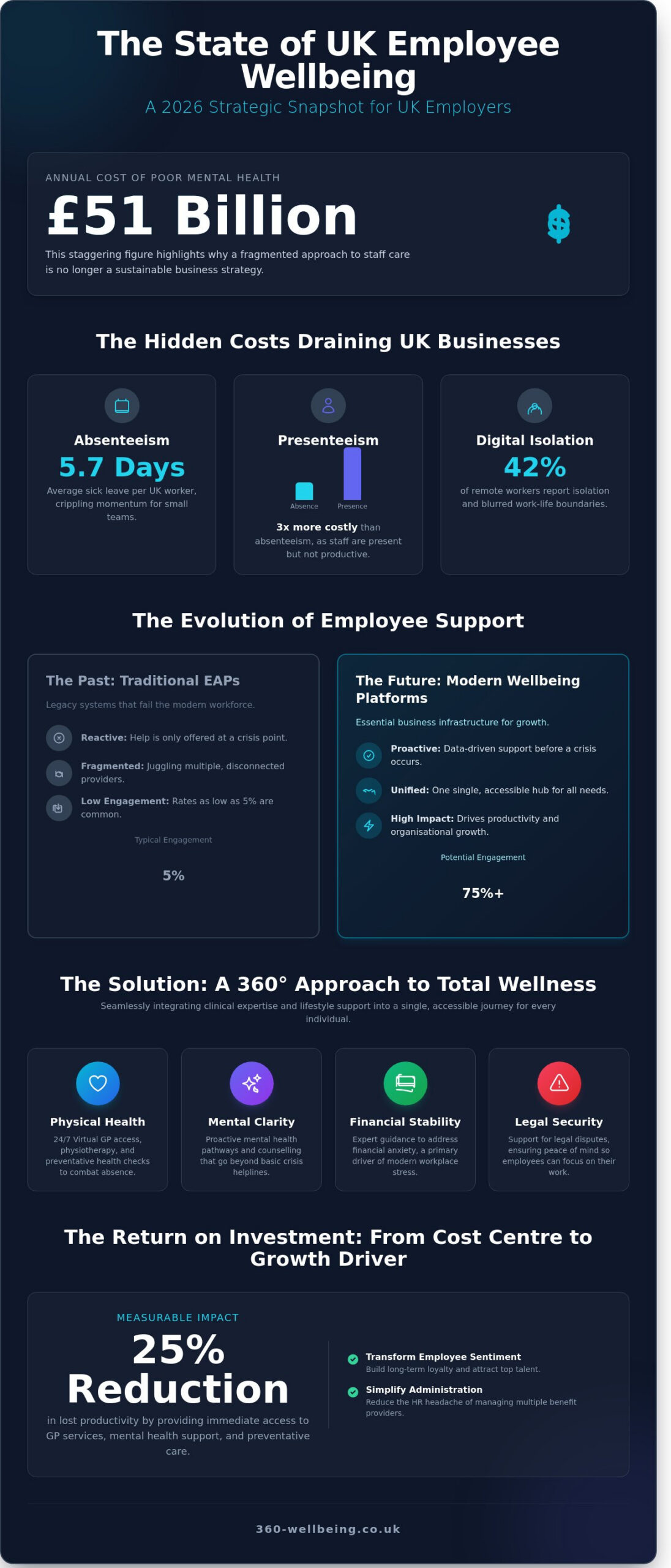
Did you know that poor mental health cost UK employers an estimated £51 billion in 2024? It’s a staggering figure that highlights why a fragmented approach to staff care is no longer sustainable for any forward-thinking business. You likely feel the weight of high turnover and the administrative headache of juggling multiple benefit providers. It’s exhausting for HR teams and confusing for the people you’re trying to support. Choosing the right employee wellbeing platform uk shouldn’t feel like another burden on your to-do list.
We agree that your team deserves more than a tick-box exercise; they need a proactive partner that looks at their health from every angle. This 2026 buyer’s guide promises to show you how to evaluate and select a platform that balances clinical excellence with financial wellness and mental health support. We’ll explore how a single, unified hub can slash presenteeism, simplify your admin, and transform employee sentiment into long-term loyalty through a truly 360-degree perspective on wellness.
Key Takeaways
- Understand how to select a modern employee wellbeing platform uk that functions as essential business infrastructure rather than just a collection of lifestyle perks.
- Identify the core clinical features your workforce needs, including 24/7 virtual GP access and proactive mental health pathways that move beyond basic helplines.
- Compare the cost-benefit of holistic service models against app-only solutions to find a sustainable balance between per-employee subscriptions and traditional PMI.
- Follow a structured five-step checklist to audit your current benefits gap and build a compelling business case for leadership based on reduced absenteeism.
- Discover how integrating expert-led, UK-registered clinical care can transform your wellbeing strategy into a proactive driver of long-term organisational growth.
The Evolution of the UK Employee Wellbeing Platform in 2026
By 2026, the employee wellbeing platform uk has moved far beyond the era of simple benefit portals. It now functions as a unified digital ecosystem that weaves health, lifestyle, and clinical support into the fabric of the working day. British businesses have realised that health is not a peripheral concern but a core component of operational resilience. This shift sees wellbeing technology moving from a “nice-to-have” luxury into essential business infrastructure, sitting alongside CRM and payroll systems as a non-negotiable tool for growth.
The UK landscape in 2026 presents unique challenges that traditional models fail to address. Hybrid work fatigue has become a documented clinical concern, with 42% of remote workers reporting feelings of digital isolation and blurred professional boundaries. Simultaneously, the persistent cost of living pressures mean that financial anxiety is a primary driver of workplace stress. These complex, overlapping issues require a sophisticated response. Workplace wellness strategies must now be proactive rather than reactive to remain effective.
Traditional Employee Assistance Programmes (EAPs) are no longer enough for the modern British workforce. These legacy systems often suffer from low engagement rates, sometimes as low as 5%, because they rely on employees reaching a crisis point before seeking help. In contrast, a modern employee wellbeing platform uk uses data-driven insights to offer support before a breakdown occurs. It creates a space where mental and physical health are managed with the same level of professional rigour as a financial audit.
Why “Perks” Alone Are No Longer Sufficient
In a high-stress economy, a 10% discount on coffee or a cycle-to-work scheme doesn’t solve the underlying causes of burnout. While these perks have their place, they don’t address the fundamental needs of a workforce facing 2026’s economic realities. Employees now prioritise “Total Wellness,” a concept that treats physical health, mental clarity, financial stability, and legal security as interconnected pillars. If an employee is worried about their mortgage or a legal dispute, their productivity will suffer regardless of how many gym discounts they have. 360-degree wellbeing is the seamless integration of clinical expertise and lifestyle support into a single, accessible journey for every individual.
The Impact of Absenteeism on UK SMEs
The financial cost of poor health is a significant burden for British employers. Projections for 2026 suggest that mental ill-health alone costs UK businesses approximately £56 billion annually. This figure includes the direct costs of sick days and the expensive process of staff turnover. For small and medium enterprises (SMEs), these losses are particularly damaging; the average UK worker now takes 5.7 days of sick leave per year, which can cripple a small team’s momentum.
The “Presenteeism Trap” is perhaps even more dangerous than total absence. This occurs when staff are logged in and physically present but are mentally or physically unable to perform at their best. Current data indicates that presenteeism costs the UK economy three times more than actual absenteeism. A dedicated wellbeing platform combats this by providing immediate access to GP services, mental health counselling, and preventative health checks. Implementing these tools can lead to a 25% reduction in lost productivity, ensuring that teams stay healthy, engaged, and genuinely present.
Core Features of a High-Impact Wellbeing Solution
Selecting an effective employee wellbeing platform uk requires looking beyond superficial perks to find clinical depth and genuine support. A high-impact solution serves as a digital front door to healthcare. It bridges the gap between traditional benefits and the immediate, daily needs of a modern workforce. By integrating physical, mental, and financial support into one ecosystem, companies create a safety net that catches issues before they escalate into long-term absence. This proactive approach ensures that health is treated as a strategic asset rather than a yearly box-ticking exercise.
The Clinical Pillar: Virtual GPs and Physiotherapy
Virtual GPs are the cornerstone of modern corporate health. Instead of waiting weeks for a local surgery appointment, employees can speak with a UK-registered doctor via video in under 30 minutes. This speed is vital for both the individual and the business. Data from 2023 indicates that the average UK worker loses 2.5 hours of productivity for every traditional GP visit. Digital access eliminates this friction, allowing staff to seek advice from their desk or home at any time of day or night.
Implementing these clinical tools aligns with UK government guidance on workplace health, which emphasises the importance of early intervention. Beyond general practice, digital physiotherapy provides targeted support for musculoskeletal (MSK) issues. In 2022, MSK conditions accounted for 24% of all working days lost in the UK. Remote workers often lack ergonomic setups; providing them with video-led clinical assessments ensures they stay mobile and pain-free without the need for travel to a physical clinic.
The Mental Health Pillar: Beyond the Crisis Line
Most businesses offer a basic Employee Assistance Programme (EAP), yet many of these “crisis lines” see usage rates as low as 5%. A comprehensive platform moves toward proactive care by offering structured therapy sessions and life coaching. This shift helps employees build resilience before a crisis occurs. If you want to see how these services can be integrated into your team, you can explore our tailored wellbeing solutions to see the impact of proactive care.
Confidentiality remains the primary driver of uptake in any mental health programme. When staff trust that their data is secure and their sessions are private, engagement levels can rise by 40% or more. High-impact platforms focus on the following to ensure a healthy culture:
- Direct Pathways: Moving from a simple helpline to direct bookings with qualified therapists.
- Life Coaching: Focusing on goal setting and personal development to prevent burnout.
- Anonymised Reporting: Providing employers with high-level trends without compromising individual privacy.
Financial stress impacts 1 in 4 UK employees, often manifesting as physical illness or mental fatigue. Leading platforms address this by offering debt advice and complimentary will writing. These are not just “extra” features; they provide tangible relief from the pressures of the cost-of-living crisis. To maintain daily morale, a curated discount marketplace adds a layer of lifestyle support. Saving an average of £500 a year on groceries or travel makes a real difference to a household budget. Balancing these serious clinical needs with practical lifestyle rewards creates a 360-degree approach to health that feels both scientifically grounded and deeply personal.
Comparing Platform Models: What UK Employers Need to Know
Choosing the right employee wellbeing platform uk organisations rely on involves more than just a software download. You’re deciding between a digital-only tool and a comprehensive support ecosystem. Most providers fall into two camps. There’s the “App-Only” model, which offers digital self-help tools, and the “Holistic Service” model, which combines technology with human-led clinical intervention. While apps are convenient, they often fail to address complex crises. A holistic model ensures that when a digital nudge isn’t enough, a real person is ready to step in and offer professional guidance.
SaaS vs. Traditional Insurance
Many SMEs are moving away from traditional Private Medical Insurance (PMI) because the costs have become unsustainable. In 2024, some corporate PMI premiums rose by 12% to 18%, making them restrictive for growing teams. SaaS-based platforms offer a breath of fresh air. They provide a predictable monthly fee, often ranging from £3 to £10 per employee. This flexibility is vital for businesses with fluctuating headcounts. 360 Wellbeing bridges this gap specifically for sole traders and small firms, offering the same level of care once reserved for global corporations without the heavy insurance price tag.
Proactive care is the foundation of a healthy workforce. According to UK guidance on workplace health, investing in prevention reduces long-term sickness absence, which currently costs the UK economy billions annually. By choosing a subscription model over reactive insurance, you’re prioritising vitality before a crisis occurs. It’s about keeping people well, rather than just treating them once they’re broken.
The biggest hurdle for any employee wellbeing platform uk provider is engagement. If your team doesn’t use the tool, the ROI is zero. Research shows that “off-the-shelf” apps often see engagement rates drop below 15% after the first quarter. High adoption requires a human touch. This is why UK-based support and dedicated account management are non-negotiable. Having a partner who understands the specific nuances of the UK labour market and NHS structure ensures the platform remains relevant. They help you tailor communications, making the platform feel like a genuine benefit rather than just another login to remember.
The “Hidden” Pillars: Financial and Legal Support
Wellbeing isn’t just about physical fitness or mindfulness. In 2026, financial resilience has become a primary driver of mental health. Debt advice isn’t just a “nice to have” feature; it’s a critical clinical intervention. When an employee is distracted by creditors, their productivity can drop by 25%. Providing access to Financial Support & Debt Advice directly through your platform offers immediate relief and long-term stability.
Legal peace of mind is another often-overlooked pillar. Offering services like will writing might seem outside the scope of traditional wellness, but it removes a massive emotional burden. It shows your team that you care about their family’s future, not just their output during office hours. This 360-degree approach transforms a simple app into a life-changing resource, fostering deep loyalty and workplace harmony. By addressing these hidden stressors, you create a culture of resilience that benefits the individual and the business alike.
A 5-Step Checklist for Implementing Your Platform
Selecting the right employee wellbeing platform uk is a significant milestone, but the true value emerges during a structured rollout. Success depends on moving beyond a simple software launch to create a deeply integrated support system. We recommend a methodical five-step approach to ensure your investment translates into tangible health outcomes and cultural shifts.
- Audit your “Benefits Gap”: Before the launch, identify exactly where your current support falls short. Statistics from the HSE 2023 report show that 51% of all work-related ill health is due to stress, depression, or anxiety. If your current benefits only focus on physical health, you have a clear psychological support gap that needs closing.
- Secure leadership buy-in: Executives often view wellbeing as a cost centre. You must reframe it as a strategic asset. Presenting the 2022 Deloitte data, which highlights an average return of £5.30 for every £1 spent on mental health interventions, provides the financial justification needed for long-term commitment.
- Appoint “Wellbeing Champions”: Peer-to-peer advocacy is more effective than top-down mandates. Recruit a diverse group of employees, ideally representing 15% of your total headcount, to act as internal advocates. These individuals provide a human face to the digital platform, guiding colleagues through its features.
- Integrate into onboarding: Make the platform a “Day 1” priority. When new hires see wellbeing tools included in their initial induction, it sets a clear expectation that their health is a fundamental right within your organisation.
- Review data monthly: Use usage analytics to refine your strategy. If engagement with sleep tools spikes in November, you might consider running a targeted webinar on rest and recovery. This proactive adjustment ensures the platform remains relevant to the evolving needs of your team.
Securing Leadership and Stakeholder Buy-in
To gain genuine executive support, align your employee wellbeing platform uk with ISO 45003 standards. This international standard focuses on managing psychosocial risks in the workplace. By framing the platform as a tool for compliance and psychological safety, you move the conversation from “perks” to “governance.” Use specific internal metrics, such as a 12% reduction in short-term absenteeism, to demonstrate how a proactive health strategy protects the company’s bottom line while fulfilling its duty of care.
Driving Engagement Through Culture
A platform only works if people feel safe using it. We suggest launching with a dedicated “Wellbeing Week” featuring live demonstrations and workshops. Managers play a pivotal role here; when a leader openly discusses using a meditation tool or booking a clinical consultation, it destigmatises seeking help. You can further embed this into your culture by using 360 Rewards. This creates a positive feedback loop where employees are recognised not just for their output, but for their commitment to maintaining a healthy, balanced lifestyle. This holistic approach ensures that your team feels seen, heard, and valued.
Ready to transform your workplace culture with a tailored health strategy? Book a consultation with our clinical experts to begin your journey toward a more resilient workforce.
Why 360 Wellbeing is the Strategic Choice for UK Growth
Choosing the right employee wellbeing platform uk is a decision that impacts every level of your organisation, from the boardroom to the front line. 360 Wellbeing offers a distinct advantage by blending clinical rigour with a deeply human touch. Our Oxford-founded heritage, established in 2011, provides a foundation of medical excellence that digital-only providers often lack. We don’t just provide software; we provide access to a network of 100% UK-registered clinical staff who understand the specific pressures of the British working environment.
For HR teams, the administrative burden of managing multiple health vendors is a significant drain on productivity. Research from 2023 indicates that 76% of HR leaders feel overwhelmed by fragmented benefit systems. Our all-in-one subscription model eliminates this complexity. By consolidating mental health support, physical therapy, and GP access into a single ecosystem, we allow your team to focus on culture rather than paperwork. It’s a shift from reactive problem-solving to a proactive strategy that fosters long-term vitality. This approach has been shown to reduce sickness absence by up to 20% in participating organisations, creating a direct impact on your bottom line.
We pride ourselves on being more than a service provider. We are an expert caregiver for your business. This means we take the time to understand your unique challenges, whether you’re dealing with a remote workforce or a high-pressure manufacturing site. Our commitment to quality is reflected in our recruitment; we only employ practitioners who are fully vetted and registered with UK professional bodies. This ensures that every piece of advice and every treatment plan is scientifically grounded and safe.
- Expert-led care delivered by professionals who live and work in the UK.
- A unified subscription that reduces overheads and simplifies reporting.
- Direct access to clinical hubs for face-to-face or digital consultations.
- Proactive health screenings that identify risks before they become crises.
The 360-Degree Perspective: A Unified Narrative
Physical, mental, and social health don’t exist in silos. A back injury often leads to stress; chronic stress can manifest as physical pain. Our approach treats these as an interconnected whole. With physical centres in Farnborough and Northampton, we serve as regional hubs of expertise that bridge the gap between digital convenience and hands-on care. These locations allow us to offer a level of continuity that purely virtual platforms cannot. You can book a demo today to see how this integrated narrative supports your specific business goals through a tailored quote.
Supporting the Modern British Workforce
The UK economy relies on the agility of sole traders and SMEs, which make up 99.9% of the business population. We’ve designed our employee wellbeing platform uk to be accessible for businesses of all sizes, ensuring that smaller teams receive the same expert caregiver attention as large corporations. We act as your dedicated health partner, looking out for your staff’s interests with a compassionate, forward-thinking approach. Don’t wait for burnout to impact your bottom line. Enquire about our employee wellbeing platform today to secure your team’s future and move toward a more resilient, vibrant workplace.
Future-Proofing Your People Strategy for 2026
Building a resilient workforce requires moving beyond reactive fixes toward a proactive, holistic health model. By 2026, the most successful organisations will prioritise integrated support that treats mental, physical, and social health as a single, unified narrative. Selecting the right employee wellbeing platform uk ensures your team has the tools they need to thrive, whether that’s immediate medical advice or long-term financial peace of mind.
360 Wellbeing provides a comprehensive safety net that’s already trusted by businesses across Oxford, Farnborough, and Northampton. Your staff gain 24/7 access to 100% UK-registered GPs, alongside a complimentary Will Writing service that provides essential security for every family. We’ve designed our platform to be a steady, compassionate partner in your growth; we turn workplace wellness into a tangible strategic asset rather than a hidden cost.
It’s time to create a culture where vitality and workplace harmony are the standard. Book a demo of the 360 Wellbeing Platform today to see how we can support your team’s journey. We’re here to help you build a healthier, more empowered future for everyone in your organisation.
Frequently Asked Questions
Is an employee wellbeing platform tax-deductible for UK businesses?
Yes, investing in an employee wellbeing platform uk is typically 100% tax-deductible as a legitimate business expense. Under HMRC’s Section 210 of ITEPA 2003, welfare counselling and preventative health measures often qualify as non-taxable benefits. This means you don’t pay National Insurance or Benefit-in-Kind (BiK) on these costs. It’s a cost-effective way to support your team while reducing your overall Corporation Tax liability.
How does a virtual GP service work for my employees?
Our virtual GP service provides your employees with 24/7 access to GMC-registered doctors via a secure video link or phone call. Most staff can book an appointment within 4 hours, which is much faster than the average 2024 NHS wait time for non-urgent care. Doctors can issue private prescriptions, provide fit notes, and make referrals to specialists. This immediate support helps your team manage health issues before they escalate into long-term absence.
Can a small business with fewer than 10 staff use 360 Wellbeing?
Yes, 360 Wellbeing is designed to be inclusive, so businesses with as few as 2 employees can access our full suite of tools. We don’t believe that size should limit your ability to protect your staff’s health. Small teams often face higher risks from a single person being on sick leave, so our platform provides the same clinical-grade support that a firm with 500 staff would receive. You’ll get a tailored setup that fits your specific budget.
What is the difference between an EAP and a wellbeing platform?
A traditional Employee Assistance Programme (EAP) is often a reactive tool focused on crisis management and short-term counselling. In contrast, an employee wellbeing platform uk offers a proactive, 360-degree approach that integrates physical fitness, mental resilience, and lifestyle coaching. While an EAP might only be used by 5% of staff during a crisis, our comprehensive platform typically sees engagement rates of over 60% because it supports daily healthy habits and long-term vitality.
How do you measure the ROI of a wellbeing programme?
You can measure the ROI of your programme by tracking key metrics like reduced sickness absence, lower staff turnover, and increased productivity. According to Deloitte’s 2024 Mental Health and Employers report, UK businesses see an average return of £4.70 for every £1 invested in wellbeing. We provide anonymised data dashboards that show you exactly how many staff are using the services. This allows you to see the tangible impact on your bottom line and team morale.
Are the mental health sessions on the platform confidential?
Every mental health session on our platform is 100% confidential and adheres to strict BACP ethical frameworks. We don’t share any individual clinical data or personal conversation details with you as the employer. You’ll only receive high-level, anonymised usage reports once your team size exceeds 10 people to ensure total privacy. This creates a safe space where employees feel comfortable seeking help for stress, anxiety, or personal challenges without fear of judgement.
Does the platform include support for financial stress and debt?
Our platform includes a dedicated financial wellbeing hub that offers practical support for debt management and household budgeting. Employees can access one-on-one sessions with financial experts and use interactive tools to plan for the future. Since 47% of UK workers reported financial stress in 2024, we provide specific resources to tackle the cost-of-living crisis. This holistic support reduces the mental burden of money worries, allowing your team to stay focused and resilient at work.
How long does it take to roll out the platform to a medium-sized team?
We can typically roll out the platform to a medium-sized team of 50 to 150 employees within 14 to 21 days. The process starts with a 7-day technical configuration followed by a structured communication campaign to ensure your staff understand how to use the tools. We provide all the digital assets and onboarding materials you need to launch effectively. This streamlined approach means your team can start benefiting from professional health support in less than a month.