Could you speak to an Employee Assistance Programme (EAP) without your employer finding out what you discussed? It’s a reasonable question, and central to eap confidentiality in the workplace uk. Confidentiality matters, but it doesn’t mean every detail is always private or that every provider handles information in the same way.
If you’re concerned that asking for support could affect your job or future prospects, it helps to know what information may be shared. Employers might receive general service-use information, while details from a support conversation are handled differently. There can also be limited exceptions, such as a serious risk of harm or a legal requirement to disclose information. The boundaries depend on the provider’s terms and the circumstances.
This guide explains what an EAP may keep confidential, what employers might see and when information could be shared. You’ll also find practical questions to ask a provider and ways employers can explain the service clearly, so employees can make informed choices with realistic expectations.
Key Takeaways
- Learn which details may be kept private and how appointment administration differs from a support conversation.
- Understand how eap confidentiality in the workplace uk can vary with provider terms, reporting arrangements and circumstances.
- Know what to check before using an EAP, including how the provider explains exceptional disclosures and handles personal information.
- Use a practical checklist to help employers explain privacy clearly without promising complete anonymity.
- Compare privacy arrangements across services in a broader benefits platform, rather than assuming one set of terms applies to everything.
What does EAP confidentiality in the UK workplace actually mean?
EAP confidentiality means protecting information shared when an employee seeks support, subject to the provider’s terms, professional duties and applicable data protection requirements. It doesn’t guarantee absolute secrecy in every situation, or mean an employer will never receive any information connected with using the service.
An EAP may provide counselling or other assistance. The broad purpose of an Employee Assistance Program is to support employees with personal or work-related concerns. However, the service label alone doesn’t explain how a particular provider handles information. In the UK, personal data must be handled in line with requirements including the UK GDPR and the Data Protection Act 2018. The provider’s privacy notice and service terms explain how these apply to its service.
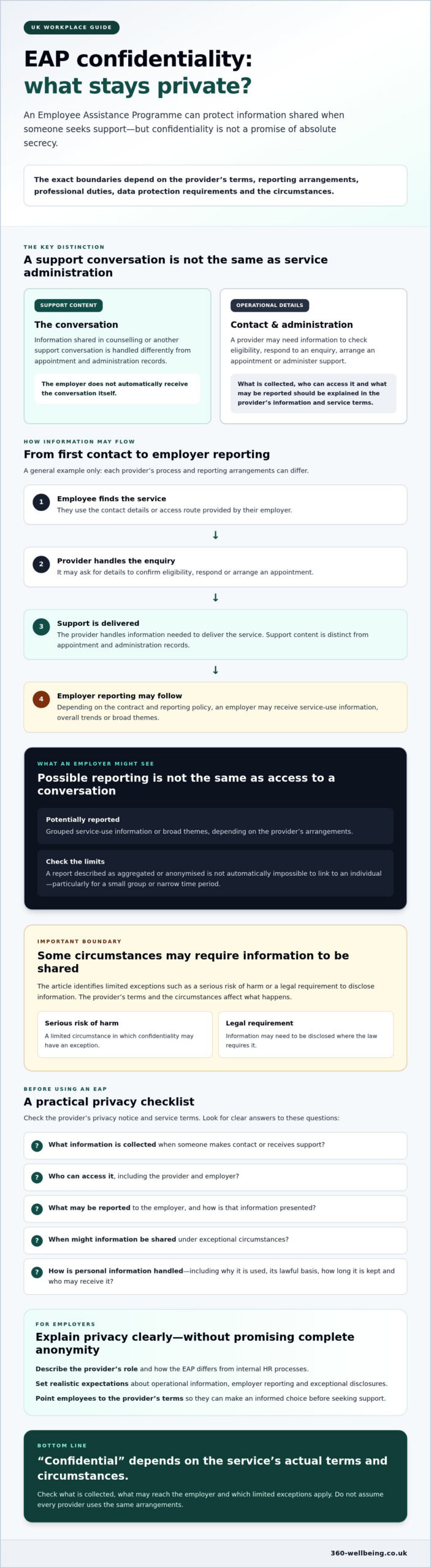
It’s useful to distinguish the content of a support conversation from operational information. A provider may need some details to confirm eligibility, arrange contact or administer support. That doesn’t automatically mean the employer receives the conversation itself. The provider’s documentation and the employer’s agreement should explain what information is collected, who can access it and what may be reported.
What does confidential EAP support mean for an employee?
Knowing how personal information is handled can make it easier to seek support without worrying about workplace judgement. A conversation with an EAP provider is separate from an employer’s general responsibility to support staff wellbeing, but the exact privacy boundaries depend on the service and circumstances. Before using an EAP, check its privacy notice and terms. Look for what information may be shared, with whom and in which situations.
Is an EAP the same as an internal HR service?
Usually, an EAP is arranged through a provider, while HR handles internal workplace matters. Arrangements differ, so don’t assume every EAP operates independently in the same way or that HR can never receive identifiable information. The contract and privacy information should clarify the provider’s role, the employer’s responsibilities and any information-sharing arrangements.
For employees, this distinction matters: seeking help from an EAP isn’t automatically the same as raising a concern with HR. For employers, clear explanations help staff understand where the support service ends and internal processes begin. In practice, eap confidentiality in the workplace uk depends on the specific arrangements, not just a general assurance that the service is “confidential”.
How does EAP information flow between employees, providers, and employers?
Follow the information from an employee’s first enquiry through to any employer reporting. The process varies by provider, so use this as a general example, not a guarantee about a particular service.
- Finding the service: An employee uses the contact details or access route provided by their employer.
- Making contact: The provider may ask for details to confirm eligibility, respond to an enquiry or arrange an appointment.
- Receiving support: The provider handles information needed to deliver the service. The content of a counselling or support conversation is distinct from appointment and administration records.
- Employer reporting: Depending on the contract and reporting policy, the employer may receive service-use information, such as overall trends. Check what is shared and how it is presented.
Contact details and appointment records can identify someone, while reports may combine information from multiple users. But a report described as aggregated or anonymised isn’t automatically impossible to link to an individual, especially if it covers a small group or a narrow time period.
What information might be collected when someone contacts an EAP?
Depending on the service, information could include contact details, eligibility information, appointment arrangements and records of service use. If an employee shares counselling or health details, that information may be special category data under UK GDPR, which receives additional protection. The provider’s privacy notice should explain why information is used, its lawful basis, how long it is kept and who may receive it. If you’re unsure, check these details before using the service.
What might an employer receive about EAP use?
Some providers give employers grouped usage information or broad themes to help them understand workforce needs. Others may use different reporting arrangements. The contract and reporting policy should clarify whether reports contain identifiable information, how small groups are handled and what safeguards apply. Don’t assume a report is anonymous simply because it combines data.
UK GDPR and the Data Protection Act 2018 provide the framework for handling personal data, including information about health. For an industry perspective on standards and good practice, consult the EAPA UK professional guidelines. Employers reviewing an EAP should ask the provider to explain the information flow in plain language: what is collected, who can access it and what appears in reports. These details are central to understanding eap confidentiality in the workplace uk.
If you’re comparing employee support options, you can explore 360 Wellbeing’s EAP support and ask how privacy arrangements apply to each service.
Can an employer find out who used an EAP? Understand the limits
Possibly, but there isn’t one rule for every EAP. Whether an employer can identify someone depends on the provider’s policy, the contract, how reporting is designed and the circumstances. Routine reports may show broad patterns, while administration or an exceptional situation may involve identifiable information.
For example, an employer might receive an overall summary of service use, while the provider needs an employee’s details to confirm eligibility or arrange an appointment. These are different kinds of information. The UK government guidance on EAP describes confidentiality arrangements for the Civil Service, including that line managers won’t be told someone used the service without permission. Treat this as an example of a specific scheme, not a guarantee about every provider.
Confidentiality sets boundaries around information, but it doesn’t guarantee that nothing will ever be shared. Ask the provider to explain its arrangements rather than relying on a general assurance.
| Situation | What may happen | What to check |
|---|---|---|
| Routine aggregate reporting | The employer may receive grouped usage figures or general themes, depending on the reporting policy. | How data is grouped and whether small numbers could make someone identifiable. |
| Identifiable administration | The provider may use personal details to check eligibility, arrange support or manage the service. Whether the employer receives any of these details depends on the arrangement. | Who can access records and what information, if any, is shared with the employer. |
| Exceptional disclosure | Information may be shared in limited circumstances, such as a serious risk of harm or where disclosure is required by law. | The provider’s policy, decision process and who may be contacted. |
When could confidentiality have limits?
A serious safety concern may prompt a provider to take steps under its policies and professional duties. A legal requirement could also apply in particular circumstances. This doesn’t mean every expression of distress is automatically reported to an employer. The provider should explain its thresholds, how it assesses concerns and what it may do. For a specific situation, confirm the relevant rules with the provider or a legal adviser.
How should employees check what is shared?
Before sharing sensitive details, ask who can access your records, what the employer receives, how long information is retained and whether consent is sought before sharing. Read the privacy notice, service terms and complaints procedure. The Information Commissioner’s Office (ICO) provides UK data protection guidance, including information about personal data rights. Clear answers can help you decide whether and how to use the service.
How can UK employers explain EAP confidentiality and build trust?
Trust grows when employees know what to expect before they need support. Employers should review the arrangements with their provider, then explain them in plain language. Avoid broad promises such as “your use is completely anonymous” unless the provider has confirmed that this accurately describes the service and its limits.
What should employers ask an EAP provider before choosing a service?
Use this checklist to make the privacy arrangements specific and straightforward to verify:
- Clarify responsibilities. Ask who acts as controller or processor for each data activity, and confirm the roles and responsibilities are reflected in the contract.
- Map the information. Find out what data is collected, who can access it, why it is used and how long it is retained.
- Review employer reporting. Ask what reports the employer receives, request a sample and check how small-group data is handled to reduce the risk of identification.
- Understand escalation procedures. Ask how the provider responds to safety concerns, what information might be shared and how decisions are communicated.
- Check complaints arrangements. Find out how employees can raise concerns about information handling and where to find the provider’s privacy notice.
Apply the same care across a wider benefits offer. An EAP, mental health support, a Virtual GP and other services may have different providers, purposes or privacy terms. Don’t assume one explanation covers every service.
How can managers reassure staff without overpromising?
Give employees written access instructions and a direct route to the provider’s privacy information. Share these during onboarding and repeat them in regular wellbeing communications, so staff can find the details when they need them. Managers should be trained not to ask employees to disclose what they discussed in a private EAP conversation. If someone chooses to share a concern with a manager, listen supportively and respect their choice about what to disclose.
A plain-language explanation could say: “The EAP is provided to give you access to support. The provider’s privacy notice explains what information it collects and who may receive it. Some limited sharing may apply in particular circumstances, so please read the provider’s terms or contact them with questions.” This is more useful than a blanket assurance and sets realistic expectations around eap confidentiality in the workplace uk.
Make it easy for staff to ask questions without feeling pressured to use the service. Employers reviewing their options can explore 360 Wellbeing’s EAP support and ask how its privacy arrangements work.
Choosing an EAP: make confidentiality clear before employees need support
Privacy should be part of choosing an EAP, not a detail left until an employee is ready to use it. Compare providers by how they explain information handling, how staff access support and what employers receive. Asking specific questions helps set realistic expectations and makes the service easier to understand.
- Privacy terms: Check the provider’s privacy notice and contract. Confirm what information is collected, how it is used, who can access it and how long it is retained.
- Access routes and service scope: Understand how employees reach the EAP and what support it covers. Make sure staff can find clear instructions without having to ask a manager for personal help.
- Reporting: Request sample employer reports and ask how small-group data is treated. Check whether reports contain aggregate trends or could reveal someone in a small team.
- Exceptions and communications: Ask how the provider handles safety concerns and complaints. Agree how privacy information and access details will be shared with employees and kept current.
This framework is especially useful when support sits within a broader benefits platform. Services may involve different providers, purposes and information flows, so don’t assume the EAP’s confidentiality terms automatically apply to every other benefit.
How does an EAP fit into broader employee wellbeing support?
Mental health, physical health and practical support can all contribute to a more complete employee offer. 360 Wellbeing provides an Employee Assistance Programme alongside mental health support, a 24/7 Virtual GP, life coaching, physiotherapy, financial support and legal support. Each service may have different privacy arrangements, so employers should check the specific terms for each one before describing it to staff.
What should employers do next?
Start by reviewing the provider’s contract and privacy information. Then prepare a short employee-facing summary explaining how to access the service, what is known about information sharing and where to read the full terms. Avoid promising complete anonymity. Give staff accurate information and a route to ask questions instead.
Understanding eap confidentiality in the workplace uk starts with clear, service-specific answers. Employers can explore 360 Wellbeing’s employee support options and ask how privacy and reporting arrangements work across the services they’re considering.
Make clear privacy part of everyday wellbeing support
Confidence in an EAP comes from knowing what information is handled, what an employer may receive and where the boundaries lie. eap confidentiality in the workplace uk depends on the provider’s terms, reporting arrangements and circumstances. Employees and employers should check the details rather than rely on a broad promise of anonymity.
Before introducing a service, review its privacy information and contract, then explain access and any limits in plain language. If support sits within a wider benefits platform, check the confidentiality arrangements for each service separately. Clear expectations help employees make informed choices and feel more comfortable seeking support.
360 Wellbeing offers an Employee Assistance Programme alongside mental health support and a 24/7 Virtual GP for organisations across the UK. To explore the employee support options and ask how privacy arrangements apply, explore 360 Wellbeing’s employee support options.
Thoughtful, transparent communication can make support easier to access and contribute to a healthier, more supportive workplace.
Frequently Asked Questions
Is EAP confidential in the workplace?
An EAP is generally designed to offer private support, but confidentiality isn’t one universal promise. The provider’s terms, professional duties, data protection practices and circumstances all affect what may be shared. Before discussing sensitive details, read the privacy notice and ask what information an employer could receive, including any exceptions. Clear answers can help you decide how to use the service with realistic expectations.
Can my employer see that I used an EAP?
It depends on the provider’s processes and the agreement with your employer. Some providers may report grouped information about service use, while limited identifiable details could be needed for administration or eligibility. Don’t assume every use is identifiable, but don’t assume it’s always anonymous either. Check the provider’s privacy notice and ask how individual users are protected, what the employer receives and whether small-group reports could identify someone.
What information does an EAP share with an employer?
There’s no single answer for every EAP. An employer may receive service-level or aggregate reporting, while identifiable information could be handled for specific administrative purposes or circumstances described in the provider’s terms. Ask for a sample report and check who can access information, how long it’s retained and what safeguards apply. Health or counselling information may receive additional protection under UK data protection rules.
When can an EAP break confidentiality?
An EAP may have to consider sharing information if there’s a serious safety concern, a relevant professional duty or a legal requirement. The threshold and response depend on the facts, the provider’s policies and applicable rules. This doesn’t mean every disclosure of distress is automatically passed to an employer. Ask the provider what could be disclosed, to whom, and whether you’d normally be told before information is shared.
Are EAP counselling records covered by UK GDPR?
Personal information handled by an EAP is subject to applicable data protection law, including UK GDPR and the Data Protection Act 2018. Health information may be special category data, which has additional requirements. The details, including the lawful basis for processing, responsibilities, retention period and safeguards, depend on the arrangement. Read the provider’s privacy notice for specifics, and seek current specialist advice if you need guidance on a particular situation.
Can I use an EAP without telling my manager?
You can usually contact an EAP through the access route your employer provides, but whether your use could be identified depends on the provider’s arrangements. Don’t assume your manager will automatically be told, or that no one could know. Before sharing sensitive details, review the privacy notice and ask the provider who can access your information, what the employer receives and whether any exceptions apply.
How can employers reassure staff about EAP confidentiality?
Explain the provider’s actual privacy terms rather than promising the service is “completely anonymous.” Tell staff what the employer may receive, what the provider keeps private and where exceptions are explained. Share access instructions during onboarding and in regular communications, and train managers not to ask for details of counselling conversations. Make it easy for employees to ask questions, and update communications if service or reporting arrangements change.