
The most visible EAP isn’t automatically the right fit for a remote team. Evaluating EAP providers for remote teams means comparing how easily employees can access support, whether it addresses isolation, workload and caring pressures, and how well it works across locations and time zones. Prioritise practical access and continuity of care, not just a long list of services.
It’s natural to want one programme that supports people wherever they work and feels relevant to their everyday challenges. Remote employees need support that is easy to access and broad enough to meet different personal and work-related needs.
This guide explains what to compare, from virtual access and the range of support available to employee engagement and ongoing care. You’ll also find a practical way to weigh different EAP models and decide which features matter most to your team.
Key Takeaways
- Compare EAPs by how easily remote employees can reach support, including across different working hours and locations.
- Look beyond availability: consider how the programme encourages employees to use its support and how engagement is reviewed.
- Assess whether support can address isolation, workload strain and caring responsibilities as connected parts of wellbeing.
- Use a consistent set of criteria to compare global access, service breadth and continuity of care before choosing a programme.
What is the best EAP provider for remote teams in 2026?
There’s no single best employee assistance programme for every distributed workforce. A practical way of evaluating EAP providers for remote teams is to compare access, care pathways and inclusion against your employees’ needs.
Digital access across locations and time zones
A digital-first EAP gives remote employees online routes to support across locations. Digital options may give remote employees another way to access support across locations. Compare access speed and available channels, too: traditional EAPs can involve an average 48-day wait for appointments. An employee working outside standard hours needs a convenient way to find support.
Therapist matching and access to care
Therapist matching connects an employee with therapy suited to their needs. Compare how each programme explains the route from first contact to sessions, including virtual access and continuity of care. A broader pathway may address a wider range of challenges than a service focused on one appointment type. Cultural fit and employee preferences also affect whether support feels accessible.
Typical UK cost per employee
There isn’t one typical UK EAP cost that suits every arrangement. Cost depends on workforce size, included support, access channels, session structure and implementation. A lower headline price may reflect a narrower service, so compare what employees can use, not just the quoted amount. Consider whether the services fit your team’s needs.
Employer risks and limitations
Limited access hours can make support harder to reach across time zones. A narrow service may not suit varied needs, and poor cultural fit can reduce engagement. Compare confidentiality information, care pathways and continuity against your workforce’s requirements. A service that looks comprehensive may still be difficult to access in practice.
| Option | Access | Care pathway | Best suited to |
|---|---|---|---|
| Digital-first | Online channels | Virtual support | Distributed teams |
| Phone-led | Telephone | Call-based support | Call-preferring employees |
| Blended | Digital and phone | Multiple formats | Mixed preferences |
| Global network | Multiple locations | Local fit and continuity | Cross-border teams |
When evaluating EAP providers for remote teams, choose the model that fits employees’ needs and working patterns.
Why do remote employees need a different type of EAP?
Remote work can make pressure less visible to leaders, so engagement and wellbeing need deliberate attention. Compare how an EAP builds trust, encourages use and responds to challenges beyond crisis support.
Utilisation and employee engagement
Utilisation measures how often employees use an EAP; engagement also reflects whether they understand its support and feel able to access it. Traditional EAPs often report utilisation rates of 2% to 5%, so low use deserves investigation, not assumption. Clear introductions, repeated signposting and guided explanations can help remote employees recognise when support may be useful.
Confidentiality and employee trust
Confidentiality shapes whether employees feel safe seeking help. Explain plainly what information remains private and what employers receive as programme-level reporting. Keep individual conversations separate from performance discussions, and use consistent wording in HR messages, onboarding and team briefings. Clear communication helps distinguish a trusted support route from an employer monitoring tool.
Usage statistics and employee feedback
Use usage trends alongside employee feedback to understand access, not to judge individual wellbeing. Review whether employees know how to begin, which channels they use and where they encounter friction. Pair those patterns with anonymous feedback and practical examples, such as difficulty finding the EAP link in an HR portal. A single utilisation figure can’t explain why people did or didn’t engage.
Remote employee wellbeing challenges
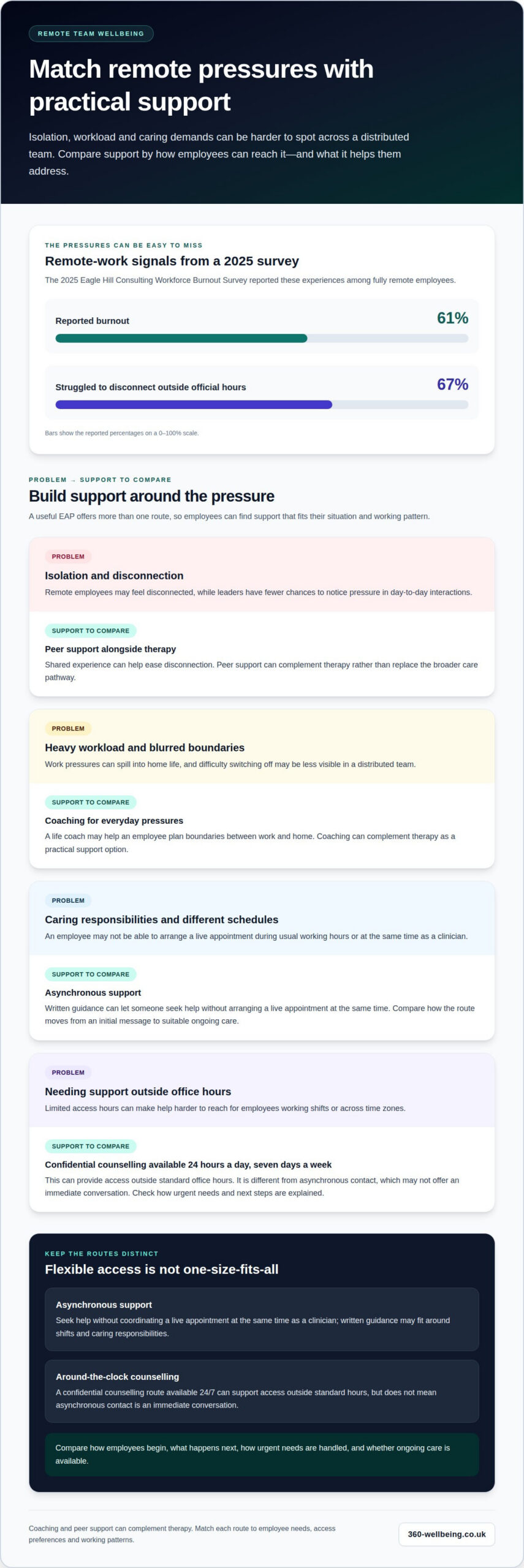
The 2025 Eagle Hill Consulting Workforce Burnout Survey found that 61% of fully remote employees reported burnout, while 67% struggled to disconnect outside official hours. These pressures can be less visible in distributed teams. Integrate signposting into existing tools through onboarding, HR systems, team communications and wellbeing benefit pages, while keeping private support separate from performance records. A clear employee assistance programme can give staff a recognisable route to help.
Support for isolation, workload and caring pressures
Remote work can make isolation, heavy workloads and caring demands harder to spot. Compare support options by how employees can access them and whether they address practical pressures alongside mental health.
Asynchronous support across time zones
Asynchronous support lets an employee seek help without arranging a live appointment at the same time as a clinician. For example, written guidance may suit someone managing caring responsibilities during usual working hours. Unlike scheduled therapy, this approach offers flexibility around shifts and time zones. Compare how employees move from an initial message to suitable ongoing care.
Flexible and around-the-clock support
Flexible access gives employees more choice about when to seek help. A confidential counselling route available 24 hours a day, seven days a week can support staff outside standard office hours. This differs from asynchronous contact, which may not provide an immediate conversation. Check how the programme distinguishes routine support from urgent needs and explains the next step.
Coaching and peer support can complement therapy by helping employees address everyday pressures. A life coach, for instance, may help someone plan boundaries between work and home, while peer support can ease disconnection through shared experience. Compare these options with clinical mental health support: they serve different needs and shouldn’t be treated as substitutes for therapy.
Crisis and critical incident support should be clearly explained, including how employees can reach help after a distressing event. Ask how the programme communicates its response pathway and what support follows an initial conversation. In a distributed workforce, managers also need training to signpost employees without trying to provide clinical care themselves.
Finally, assess whether the programme supports proactive wellbeing as well as moments of crisis. A remote employee facing workload strain may need a timely way to discuss stress, while someone with caring pressures may value practical guidance. Compare access, counselling and coaching together to see whether the support reflects the varied challenges across your workforce.
Comparing EAP services for global teams
Compare global EAP services by access, clinical support, cultural fit and outcome reporting. For a UK workplace, map employee locations, working hours and languages before weighing provider models.
Start with a baseline, then measure the same indicators over time. The figures can show reach and patterns, but they don’t explain an individual employee’s experience. Combine service data with employee feedback to understand what helps, where access breaks down and whether support matches workforce needs.
- Access: Compare routes to support across locations, time zones and working patterns.
- Clinical care: Review how employees reach therapy and continue care when needs change.
- Broader support: Compare coaching and practical guidance with clinical services for stress or burnout.
- Reporting: Look for consistent usage trends, feedback and outcome measures across locations.
Global networks, UK-focused programmes and digital-first models can differ in how they organise access and support. Compare each against the same employee scenarios, such as a remote worker facing burnout outside UK office hours or a new starter seeking coaching. This shows whether a provider’s model fits your workforce, rather than simply offering a wide catalogue of EAP services.
Measurement matters too. In the UK, 31% of organisations have never evaluated EAP quality or impact, and 9% of employers measure return on investment. The GHQ-12 is a standardised tool for quantifying mental health and wellbeing outcomes. Organisations can review reporting quarterly and conduct an annual in-depth evaluation. Use a consistent baseline and method so changes can be compared meaningfully.
Choose a modern EAP by matching its access model, clinical care and reporting approach to your locations and employee needs. If coaching is part of your comparison, explore life coaching support as one element of a wider wellbeing approach.
360 Wellbeing
360 Wellbeing brings employee support together through an Employee Assistance Programme and a broader benefits platform. For organisations comparing EAP options, it offers a way to consider mental health alongside physical health and everyday wellbeing, rather than treating each need in isolation.
Its offerings include Mental Health Support, a 24/7 Virtual GP, Physiotherapy and 360 Rewards. This combination may suit employers looking to provide employees with access to support across different aspects of wellbeing. Consider how these services align with your workforce’s needs and the criteria you’ve used to compare providers.
If you’d like to discuss how 360 Wellbeing could support your organisation, contact the team.
Make wellbeing part of how your team works
An EAP works best when it feels like a normal part of working life, not a last resort. Leaders can help create that culture by speaking openly about wellbeing, making space for regular conversations and showing that seeking support is a positive step. For a distributed workforce, these small signals can shape whether employees feel recognised and comfortable accessing help.
Treat evaluating EAP providers for remote teams as the start of an ongoing approach, not a one-off procurement exercise. As roles, locations and working patterns change, revisit how the programme fits your people and supports your wider wellbeing priorities. Regular attention helps keep support relevant and accessible.
If you’re ready to explore a thoughtful approach for your organisation, speak with 360 Wellbeing. A considered next step can help build a healthier, more connected remote workplace.
Frequently Asked Questions
What should you evaluate your EAP for?
Evaluate whether the programme fits your employees’ working patterns and support needs. For example, consider how a night-shift employee or a new remote starter would find the right help. Compare access routes, care options, inclusion and communication, then identify how the provider reports overall usage. These criteria help distinguish a service that looks comprehensive on paper from one employees can practically use.
Why should you evaluate your employee assistance programme?
Regular evaluation helps you see whether the programme still fits your workforce and where employees encounter barriers. Few enquiries could reflect limited awareness, inconvenient access or a mismatch between support and need. Use employee feedback alongside service trends to identify possible improvements. This gives leaders a clearer basis for decisions than anecdotal comments or a provider’s service description alone.
How often should you review your EAP service?
Review your EAP at least annually, and bring the review forward when your workforce or working arrangements change substantially. For example, a team expanding into new countries may need different access arrangements or clearer guidance for employees. Consider employee feedback, usage patterns and whether the programme still aligns with your wellbeing priorities. A scheduled review helps keep the service relevant instead of treating selection as a one-off task.
Is an EAP confidential for remote staff?
EAP conversations are intended to provide private support, but employees should understand the provider’s confidentiality terms before using the service. Explain what information stays between the employee and support professional, what anonymised or aggregated reporting may go to the employer, and any limits to confidentiality. Make this guidance available in remote onboarding materials, for example, so staff can read it privately before deciding whether to seek help.
What is a good EAP utilisation rate for remote teams?
A healthy EAP utilisation rate typically falls between 10% and 15%. Treat this as a reference point, not a standalone verdict on programme quality. Before comparing results, understand how the provider defines utilisation and the period measured. Then consider whether employees know how to access support and whether feedback points to practical barriers. A rate alone cannot show whether individual employees received suitable help.
What services should an EAP provider offer remote teams?
A useful EAP can combine mental health support with practical services that reflect employees’ varied needs. Depending on the programme, this might include counselling, virtual GP access, coaching, physiotherapy, or financial and legal guidance. Consider how employees reach each service, how support fits different working hours and whether options suit a distributed workforce. The right mix depends on your team’s needs, not a fixed checklist.