Did you know that 43% of UK remote workers reported feeling “professionally invisible” compared to their office-based colleagues in a 2025 workplace study? It’s a sobering figure for any leader trying to understand how to build psychological safety in a hybrid team while maintaining a cohesive culture across different postcodes. You probably already feel the pressure of managing digital exhaustion while worrying if proximity bias is quietly stalling the careers of your best off-site talent. It’s a delicate balance to strike, and it’s one that requires a deliberate, human-centered strategy.
This guide provides a clear path to fostering a culture of trust and holistic wellbeing that empowers your workforce to innovate without the paralyzing fear of making mistakes. We’ll move beyond basic check-ins to explore a comprehensive 360-degree framework tailored for the modern UK landscape. By following these steps, you will learn to lower staff turnover and transform workplace stress into a proactive, resilient energy that drives honest feedback and lasting growth for your entire organization.
Key Takeaways
- Discover how to build psychological safety in a hybrid team by identifying the subtle social cues and communication gaps that can hinder remote collaboration.
- Learn to dismantle proximity bias and the inclusion gap to ensure every team member feels empowered to share ideas, regardless of their physical location.
- Implement actionable frameworks, such as “Virtual First” meeting protocols and Team Charters, to create a consistent and reliable environment for all staff.
- Protect your workforce from digital exhaustion by establishing clear boundaries and a “Right to Disconnect” that fosters long-term mental resilience.
- Explore the vital link between holistic wellbeing and workplace trust, including how instant access to medical support provides the security employees need to thrive.
What is Psychological Safety in a Hybrid Team Context?
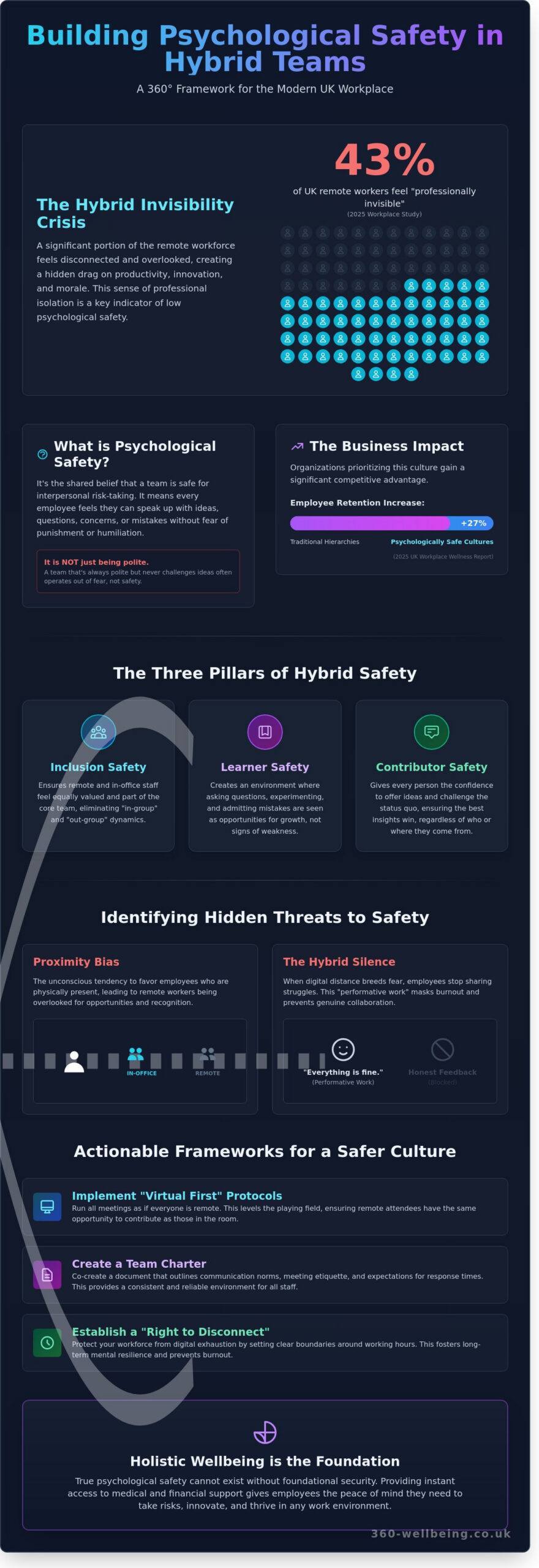
In the 2026 UK workplace, Psychological safety has evolved from a leadership “soft skill” into a vital strategic asset. It’s the shared belief that a team environment is safe for interpersonal risk-taking. In a hybrid world, this means every employee feels they won’t be punished or humiliated for speaking up with ideas, questions, concerns, or mistakes. According to a 2025 UK workplace wellness report, organisations that prioritised this culture saw a 27% increase in employee retention compared to those relying on traditional, rigid hierarchies. As talent pools become more mobile, this sense of safety serves as a primary competitive advantage for businesses seeking to protect their most valuable resource: their people.
Understanding how to build psychological safety in a hybrid team requires a proactive shift in perspective. Hybrid work naturally reduces the social cues we rely on to build trust. We no longer have the “watercooler” moments or the spontaneous desk-side chats that once smoothed over misunderstandings. Without these physical touchpoints, digital distance can breed anxiety. It’s vital to distinguish between “politeness” and true safety. A team that’s always polite but never challenges an idea is often one where fear is simmering just beneath the surface. True psychological safety is the ability to disagree openly and constructively, regardless of whether you’re in the London office or working from a home hub in Edinburgh.
The Three Pillars of Hybrid Safety
Creating a resilient hybrid culture rests on three foundational pillars that bridge the gap between physical and digital spaces. First, inclusion safety ensures that remote staff feel like valued members of the “in-group” rather than secondary participants. Second, learner safety creates a digital environment where admitting a mistake on a shared channel is met with support rather than judgment. Finally, contributor safety gives every person the confidence to offer ideas in a blended setting. This ensures the loudest voice in the physical boardroom doesn’t drown out the quiet insight appearing on a screen. When these pillars are strong, the team operates with a 360-degree view of success.
The Risk of the Hybrid Silence
Silence in a hybrid team is rarely a sign of agreement; it’s often a red flag for fear. When digital distance grows, staff may fall into the trap of “performative work,” where they spend more energy looking busy or perfect than being authentically productive. They fear that showing any sign of struggle will lead to being overlooked for promotions or viewed as less committed than their in-office colleagues. This silence masks brewing resentment and can lead to significant mental health struggles. By learning how to build psychological safety in a hybrid team, leaders can dismantle this performative barrier. They can foster a supportive atmosphere where people feel empowered to show their vulnerabilities, knowing they’re part of a partnership that values their total wellness.
Identifying the Hybrid Inclusion Gap and Proximity Bias
Proximity bias is a quiet but persistent threat to UK businesses in 2026. It’s the unconscious habit of favouring people who are physically present in the office over those working remotely. In a hybrid setup, this often creates a visible “In-Group” and an invisible “Out-Group.” When leaders focus their attention on the colleagues they see at the coffee machine, they inadvertently signal to remote workers that their contributions carry less weight. This erosion of trust is one of the biggest hurdles when leaders consider how to build psychological safety in a hybrid team.
This bias doesn’t just hurt morale; it damages long-term diversity and inclusion. Data from 2025 suggests that employees from underrepresented groups often choose remote work to manage personal responsibilities or avoid office microaggressions. If the “office group” consistently receives the best projects or faster promotions, you’re building a structural barrier to equity. Taking a behavioural science perspective on creating psychological safety helps leaders identify these patterns. By understanding how our brains naturally categorise “us” versus “them,” managers can take proactive steps to bridge the inclusion gap.
Spotting the Signs of Low Psychological Safety
Low safety in a hybrid team rarely looks like an open argument. Instead, it manifests as a quiet withdrawal. Look for these red flags:
- Silence in digital channels: A lack of dissenting voices or creative suggestions in Slack or Teams often means people don’t feel safe to “interrupt” the status quo.
- The “Blame Game”: When a hybrid project misses a milestone, the office-based team might point fingers at the remote staff, or vice versa, rather than solving the problem together.
- Persistent disengagement: High rates of “camera-off” meetings or increased absenteeism often signal that an employee feels disconnected from the team’s core mission.
The ROI of a Safe Hybrid Culture
A safe culture is a high-performing one. When every team member feels secure enough to admit a mistake or flag a risk early, project delays drop significantly. This environment also helps managers provide better financial support for their staff by reducing the stress-related errors that lead to costly rework. Research shows that psychologically safe teams resolve complex problems 2.5 times faster than those operating in a culture of fear. By prioritising safety, you’re building long-term organisational resilience that protects both your people and your bottom line.
If you’re noticing these gaps in your own team, exploring tailored wellbeing solutions can provide the framework your leaders need to foster a truly inclusive environment.
5 Practical Steps to Build Safety in Your Hybrid Team
Creating a culture where people feel safe to speak up requires more than just good intentions; it demands a structured, proactive framework. To understand how to build psychological safety in a hybrid team, leaders must bridge the gap between physical and digital presence. Start by establishing a Team Charter that clearly defines digital communication etiquette and core hours. This prevents the always-on culture that contributed to a 20% increase in employee burnout reported in early 2025. By setting boundaries, you give your team the resilience to switch off without guilt.
Leaders should also normalise the Professional Mess by sharing their own hybrid challenges, such as a tech glitch during a board meeting or a lapse in judgment. This vulnerability mirrors NHS Employers’ top tips for fostering openness, showing that perfection isn’t the goal. You can further strengthen these bonds by implementing the following steps:
- Adopt a Virtual First protocol for all team-wide meetings to ensure everyone has an equal seat at the table.
- Schedule structured check-ins that focus on the person, not just the task, for at least 10 minutes.
- Create dedicated Social Syncs to rebuild the informal connections that a 2024 study found had dropped by 30% in remote environments.
Reimagining the Hybrid Meeting
The fairest rule for any collaborative session is “one person remote, everyone remote.” If a single team member joins via video, every person in the office should also log in from their own laptop. This prevents side conversations in the room from excluding those at home. To invite quiet voices into the conversation, use anonymous digital polls. Tools like Mentimeter allow individuals to share honest feedback without the fear of being put on the spot. This provides a practical roadmap for how to build psychological safety in a hybrid team by ensuring every perspective is captured.
The Art of the 1-on-1 in a Blended World
Effective 1-on-1s must move from status updates to comprehensive wellbeing conversations. Leaders should ask tailored questions like, “What is one thing I could do to make your remote work easier?” or “Which part of our current workflow feels most draining?” It’s vital to ensure equal frequency of these meetings for both office and home-based staff. Recent data from 2025 suggests that remote workers are 15% less likely to receive spontaneous feedback, so scheduling these touchpoints with clinical precision is essential for long-term workplace harmony.
Setting Digital Boundaries and Protecting Mental Health
The “always-on” culture of the mid-2020s has created a specific type of digital exhaustion that erodes trust. When employees feel they must respond to a Slack message at 8:00 PM to prove their productivity, psychological safety vanishes. Leaders in 2026 are now adopting a “Right to Disconnect” policy, mirroring successful models in Europe. This isn’t just a perk; it’s a foundational element of a comprehensive wellbeing strategy. By 2025, 63% of UK employees stated that clear boundaries around contactable hours were their top priority for mental health. Understanding how to build psychological safety in a hybrid team requires a shift from monitoring presence to valuing output.
Establishing “Deep Work” blocks is another proactive step. These are scheduled periods where notifications are silenced, allowing for cognitive flow without the constant ping of notification fatigue. 2023 research by Microsoft indicated that heavy users of communication apps spend 57% of their time on meetings and chat, leaving little room for meaningful tasks. Knowing how to build psychological safety in a hybrid team means giving your staff permission to go offline to get their best work done.
Combating Zoom Fatigue and Digital Burnout
Cognitive load increases significantly when we’re forced to process constant on-camera social cues. Stanford University researchers identified “mirror anxiety” as a primary driver of exhaustion back in 2021, and the problem has only intensified. Encouraging camera-optional meetings allows team members to focus on the conversation rather than their own reflection. It’s also vital to encourage movement. A 2024 study showed that 10-minute movement breaks between calls increase cognitive flexibility by 15%. Leaders must also watch for digital red flags. If a typically engaged employee becomes silent or their communication tone shifts to being overly clipped, it’s often a sign they need professional support.
The Role of Life Coaching in Hybrid Resilience
The home office often creates a work-life blur that’s difficult to navigate alone. Life coaching provides a tailored space for employees to build the personal resilience needed for high-pressure hybrid roles. It moves the conversation from crisis management to proactive growth. Data from 2025 suggests that employees with access to professional coaching are 31% more likely to handle candid feedback constructively. This proactive approach ensures mental health is treated as a strategic asset, not a problem to be solved after burnout occurs. By investing in coaching, you empower your team to set their own boundaries and maintain vitality.
Discover how our comprehensive wellbeing solutions can help your leaders set healthy boundaries and foster a resilient hybrid culture.
Integrating Holistic Support: Why Health and Financial Security are Prerequisites
An employee cannot contribute their best ideas if they’re preoccupied with a looming debt or a persistent health concern. True psychological safety isn’t just about the freedom to speak; it’s about the freedom from basic survival anxiety. According to the 2024 CIPD Health and Wellbeing at Work report, 76% of UK respondents reported stress-related absence in their organisations. When leaders consider how to build psychological safety in a hybrid team, they must look beyond the screen to the individual behind the keyboard. If a team member is worried about their physical or financial resilience, their capacity for vulnerability and innovation disappears.
Making wellbeing a visible, 360-degree pillar of your culture means acknowledging that personal lives and professional performance are inextricably linked. By providing proactive support, you remove the “threat response” that often hinders collaboration in high-pressure hybrid environments. This creates a stable foundation where staff feel valued as people, not just as units of productivity.
Virtual Health as a Workplace Equaliser
Hybrid working creates a physical divide that shouldn’t extend to healthcare access. Providing 24/7 access to UK-registered GPs ensures that a remote developer in Cornwall has the same medical reassurance as a manager in London. This accessibility is a powerful tool for reducing digital presenteeism. A 2025 industry survey found that 46% of remote workers feel they need to be “always on” even when unwell. When you offer instant, high-quality medical support, you give them permission to recover.
This “doctor at hand” service acts as a tangible demonstration of care. It levels the playing field, ensuring that health advice isn’t dependent on an employee’s proximity to a physical office or their ability to secure a local appointment during work hours. It’s a proactive way to maintain team health and prevent minor issues from escalating into long-term sickness.
Building the Safety Net with 360 Wellbeing
A unified platform simplifies the delivery of mental, physical, and financial benefits, removing the friction that often prevents staff from seeking help. When an Employee Assistance Programme (EAP) is integrated into daily workflows, it acts as a reliable safety net for difficult personal situations, from bereavement to legal worries. This comprehensive care is a vital component in learning how to build psychological safety in a hybrid team. It proves that the business is a partner in their long-term success rather than just a temporary employer.
Having a structured path for support creates a sense of order and safety. When employees know that help is available for their mind, body, and finances, their confidence in the organisation grows. This resilience allows them to take the creative risks necessary for hybrid teams to thrive in 2026 and beyond. A culture of safety isn’t built through words alone; it’s built through the consistent, practical support you provide every day.
Ready to transform your culture and protect your people? Book a demo to see how our platform supports hybrid team safety.
Cultivating a Resilient Future for Your Hybrid Workforce
Creating a culture where every voice feels heard isn’t just a leadership trend; it’s a strategic necessity for UK businesses navigating the 2026 landscape. You’ve learned that bridging the hybrid inclusion gap starts with intentional digital boundaries and a commitment to closing the proximity bias that often sidelines remote talent. When leaders master how to build psychological safety in a hybrid team, they can see a 27% reduction in staff turnover according to Gallup research. True safety isn’t just about open dialogue. It’s built on a foundation of physical and mental security that allows employees to bring their full selves to work, regardless of their postcode.
At 360 Wellbeing, we help you turn these strategies into a living reality. We’re proud to be trusted by UK SMEs to build proactive cultures through our comprehensive support systems. By providing 24/7 access to UK-registered Virtual GPs and robust Mental Health and EAP support, we ensure your team feels valued every hour of the day. It’s time to move beyond survival and toward a vision of total vitality. Empower your hybrid workforce with 360 Wellbeing’s holistic support platform and watch your team thrive in this new era of work. You’ve got the tools to lead with compassion, and we’re here to support every step of that journey.
Frequently Asked Questions
What is the first step to building psychological safety in a hybrid team?
The first step is for leaders to model vulnerability by openly admitting their own mistakes or knowledge gaps. When a manager says, “I’m not sure, what do you think?”, it grants permission for the 67% of employees who typically fear speaking up to share their own ideas. This proactive approach sets a standard where learning is valued over perfection, creating a secure foundation for the entire team.
How can I tell if my remote employees feel psychologically safe?
You can measure safety by tracking the frequency of dissenting opinions and the speed at which mistakes are reported. In a safe environment, remote workers won’t wait for a monthly review to flag a 15% drop in project metrics; they’ll share it immediately in a group chat. If your video calls are met with silence or 100% agreement, it’s a clear signal that the underlying trust needs urgent attention.
Does psychological safety mean I cannot hold my hybrid team accountability?
Psychological safety and accountability are not opposites; they’re complementary forces that drive high performance. In fact, safety allows for more rigorous accountability because team members can discuss failures without fear of retribution. When you know how to build psychological safety in a hybrid team, you create a culture where 90% of staff feel comfortable taking ownership of their specific KPIs while knowing the team will support their recovery if a strategy fails.
How does proximity bias affect team trust and safety?
Proximity bias erodes safety by creating an unintentional hierarchy where those in the office receive 25% more spontaneous feedback than remote colleagues. This “out of sight, out of mind” mentality makes remote workers feel their contributions are invisible. To counter this, leaders must adopt a “digital first” communication policy, ensuring every decision is documented in shared spaces so no one feels excluded from the inner circle.
Can an Employee Assistance Programme (EAP) help build psychological safety?
An EAP acts as a vital structural support that reinforces a 360-degree perspective on employee wellbeing. By providing confidential access to 24/7 counselling and financial advice, you demonstrate a tailored commitment to your staff’s life outside of work. This comprehensive care reduces the 38% of workplace stress that stems from personal anxieties, allowing employees to show up more fully and authentically within their professional roles.
What are the best digital tools for facilitating team feedback?
Effective feedback in 2026 relies on tools that level the playing field, such as Mentimeter for anonymous real time polling or Miro for asynchronous brainstorming. Using these platforms ensures that the 50% of your team who are introverted or working across different time zones have an equal voice. These digital spaces provide a structured way to capture diverse insights, making the feedback process feel both inclusive and methodical rather than chaotic.
Is psychological safety more important in hybrid teams than in-office ones?
It’s arguably more critical in hybrid settings because you lose the 80% of non-verbal cues that build rapport in person. Without these physical signals, misunderstandings can escalate quickly, leading to a 35% decrease in team cohesion if not managed proactively. Mastering how to build psychological safety in a hybrid team is the only way to bridge this “empathy gap” and ensure that geographical distance doesn’t become emotional distance.
How do I handle a team member who is resistant to open communication?
Start by scheduling a private 15 minute check-in to understand the root of their hesitation without judgment. Resistance often stems from past negative experiences where speaking up led to criticism. By using a calm and compassionate approach, you can explain that their perspective is a strategic asset to the team. Gradually inviting their input on low-stakes topics helps rebuild their resilience and integrates them into the wider culture of openness.