
What if the most daunting meeting in your diary wasn’t a source of anxiety, but the catalyst for your team’s greatest breakthrough? Most managers feel a genuine knot in their stomach when learning how to have a difficult conversation with an employee about performance, often fearing that a single misstep could damage morale or lead to the stress of an Employment Tribunal. It’s a delicate balance to strike, especially when you care deeply about your team’s mental health and the overall harmony of your workplace.
This 2026 guide explores a holistic approach, shifting your perspective towards a panoramic viewpoint that treats performance management as a diagnostic partnership. We’ll show you how to master this essential skill with a structured method that prioritises both accountability and employee wellbeing. You’ll gain a clear action plan that transforms these sensitive moments into opportunities for growth, ensuring your team remains durable and supported through every professional challenge.
Key Takeaways
- Master a structured 5-step framework designed to reduce immediate anxiety and ensure every meeting remains focused on positive, professional outcomes.
- Learn how to have a difficult conversation with an employee about performance by distinguishing between skill gaps, motivation issues, and underlying health or wellbeing concerns.
- Discover how to prepare effectively with objective evidence and the right environment to maintain a panoramic view of the employee’s unique situation.
- Understand how to leverage proactive benefits like the Employee Assistance Programme (EAP) and Life Coaching to support team members through their recovery plan.
- Explore the vital role of the 48-hour follow-up in bridging the gap between the initial meeting and sustained, long-term performance improvement.
Why Performance Conversations Feel Difficult (and Why They Matter)
Feeling a sense of trepidation before a performance review doesn’t make you a weak manager; it makes you a human one. For many leaders in the UK, the anxiety surrounding these meetings stems from a place of genuine care for their team’s morale and a fear of causing unnecessary distress. However, understanding how to have a difficult conversation with an employee about performance is one of the most compassionate things you can do for your staff. When you address issues early, you prevent the slow erosion of confidence that occurs when an individual senses they’re failing but doesn’t know how to fix it.
The cost of silence is often far higher than the discomfort of the meeting itself. Avoiding these conversations leads to a ripple effect across the entire organisation, often resulting in team burnout and a sharp decline in collective productivity. In 2026, the professional landscape has shifted away from traditional, top-down discipline. Modern employees value transparency and expect a holistic approach to management that prioritises their growth and mental health over rigid targets. Reframing the narrative from a “confrontation” to a “supportive partnership” allows you to build a culture of trust and long-term durability.
The Emotional Weight of Leadership
Delivering tough feedback carries a significant emotional load for managers. It requires high levels of emotional intelligence to stay present and supportive while being clear about where improvements are needed. By adopting a calm, methodical approach, you create a safe environment that reduces defensive reactions. This steady rhythm allows the employee to process the information without feeling attacked, turning a potentially volatile situation into a professional consultation. Your goal is to act as an expert caregiver, guiding them toward success rather than just pointing out their flaws.
Performance as a Symptom, Not a Deficit
We encourage leaders to adopt a panoramic viewpoint when assessing staff output. Often, a dip in performance is merely a symptom of an underlying challenge rather than a lack of capability. It might be a physical health issue, a mental health struggle, or even financial stress weighing them down. When you look at the whole person, you can identify whether the barrier is a temporary hurdle or a deeper need for support. Integrating physical, mental, and social health into your assessment ensures that your feedback is scientifically grounded and deeply personal, helping the employee regain their professional vitality and balance.
Preparing for the Meeting: Data, Mindset, and Environment
Success in performance management is rarely decided during the meeting; it’s won in the hours of preparation beforehand. When you’re learning how to have a difficult conversation with an employee about performance, your mindset must shift from that of an accuser to an expert caregiver. This perspective allows you to approach the situation with the foresight needed to ensure the employee feels supported rather than cornered. Preparation replaces the coldness of traditional discipline with a sense of safety and order.
The Evidence-Based Approach
Use objective performance data to ground the discussion in reality. Vague generalisations like “you’ve been underperforming lately” trigger immediate defensiveness and anxiety. Instead, gather specific metrics or documented instances from the previous quarter. Try to write a single, neutral sentence that defines the performance gap without being harsh. For instance, “The last three project reports were submitted 48 hours past the agreed deadline.” This clarity provides a sturdy foundation for growth. We recommend “positive sandwiching,” where you frame the performance gap between genuine acknowledgments of their strengths. It ensures the individual feels their total value to the team is still recognised.
Creating a Safe Space for Dialogue
The environment you choose speaks volumes about your intent. A neutral, quiet room or even a private digital space, similar to a secure virtual GP consultation, can significantly lower tension. Timing is equally critical. Avoid Friday afternoons or the day immediately before a bank holiday. Delivering tough news at the end of the week gives the employee the weekend to spiral without a chance for immediate follow-up. Ensure they have at least 24 hours’ notice for the meeting so they don’t feel ambushed. This transparency is an essential human entitlement in the modern UK workplace.
Anticipate emotional reactions. Whether it’s tears, anger, or stony silence, your role is to maintain professional composure and a steady, methodical rhythm. If an employee becomes overwhelmed, it’s often a sign that personal stressors are impacting their professional durability. Having a safety net in place, such as an Employee Assistance Programme (EAP), allows you to pivot the conversation from a critique to a supportive plan for recovery. This foresight transforms a difficult encounter into a methodical path forward for both of you.
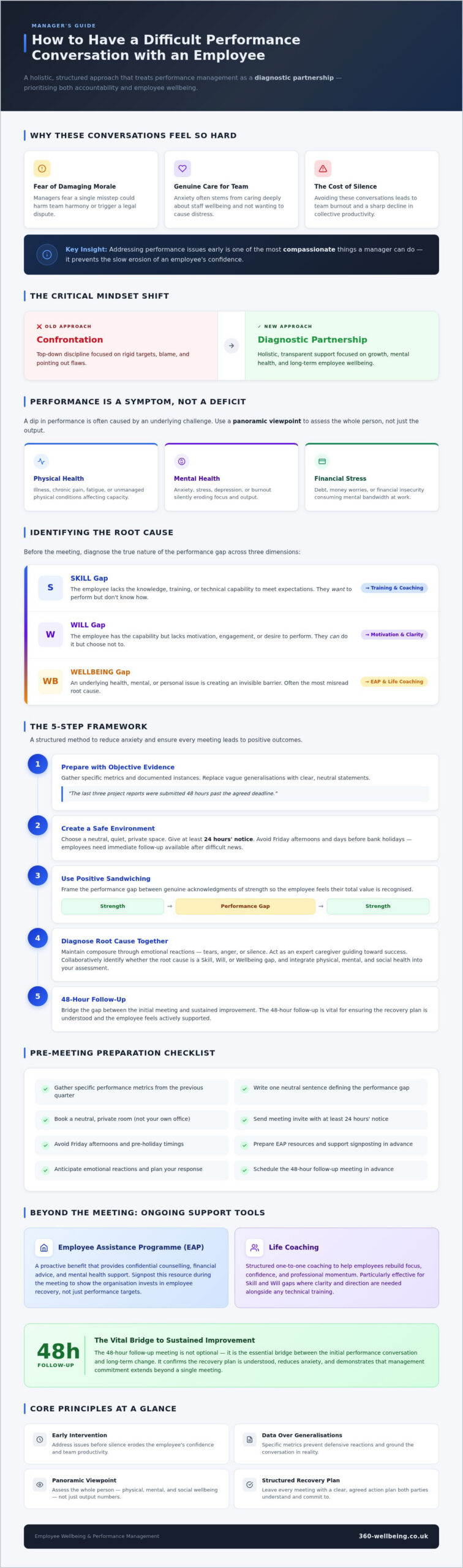
A 5-Step Framework for a Productive Performance Conversation
Approaching a performance review without a clear structure often leads to a circular discussion that leaves both parties feeling drained. By following a methodical framework, you can maintain your professional authority while acting as a supportive partner in your employee’s success. This process ensures that you cover all necessary points without the meeting feeling like a cold, disciplinary hearing. Learning how to have a difficult conversation with an employee about performance effectively means mastering the balance between clarity and compassion.
Opening the Conversation with Empathy
The first few minutes of the meeting set the tone for everything that follows. Start with a “soft start” to lower the individual’s heart rate and reduce defensive barriers. Instead of saying “Your work isn’t good enough,” try using “I” statements such as, “I’ve noticed a shift in your recent project delivery, and I’d like to understand what’s changed.” This approach focuses on your observations rather than making an accusation. After stating your observation, utilise the “diagnostic pause.” Stop talking and give the employee at least ten seconds of silence. This space invites them to fill the gap with their own perspective, often revealing underlying issues you hadn’t considered.
- Step 1: State the purpose clearly. Be kind but direct about why you’re meeting to reduce immediate anxiety.
- Step 2: Present the facts. Outline the specific performance gap and explain how it impacts the wider team and the business objectives.
- Step 3: Listen deeply. Give them the floor to explain their side without interruption; this is where you identify if the issue is skill, will, or wellbeing.
- Step 4: Problem-solve together. Ask, “What do you need from me to get back on track?” to identify practical barriers.
- Step 5: Agree on the path forward. Close the meeting by setting a clear, time-bound action plan with specific follow-up dates.
Collaborative Goal Setting
Once you’ve identified the challenges, shift the focus toward a positive vision of workplace harmony. Move from discussing what went wrong to defining how you’ll get it right together. Create SMART goals (Specific, Measurable, Achievable, Relevant, Time-bound) that feel like a roadmap for growth rather than a list of demands. Link these targets to the employee’s long-term professional development. If a skill gap is identified, this is the perfect moment to suggest integrated tools like Life Coaching or specialised training to help them regain their professional durability and confidence.
Identifying the Root Cause: Is it Skill, Will, or Wellbeing?
Understanding the root cause of an issue is the difference between a temporary fix and a permanent solution. When you’re learning how to have a difficult conversation with an employee about performance, you must determine if you’re looking at a gap in skill, a lack of will, or an overlooked wellbeing concern. A skill gap is often the most straightforward to resolve; it simply requires targeted training or integrated Life Coaching to build the necessary professional durability. Conversely, a will gap suggests a misalignment in motivation or culture fit, which requires a deeper look at career goals and team harmony.
The wellbeing gap is perhaps the most critical yet frequently ignored factor in modern management. In the UK, performance issues are often deeply intertwined with mental or physical health challenges. Legally, managers must also consider whether a performance dip is linked to a protected disability under the Equality Act, which necessitates reasonable adjustments rather than disciplinary action. By viewing the individual through a panoramic lens, you can differentiate between a lack of effort and a lack of capacity due to external pressures.
Spotting the Signs of Workplace Stress
Workplace stress often manifests in physical ways before it ever appears in a performance report. You might notice an employee appearing unusually fatigued, irritable, or struggling to maintain focus during meetings. Asking about wellbeing requires a delicate touch; focus on the observable change in their behaviour rather than making assumptions. Referencing the role of a Mental Health Champion within your team can provide a bridge to support, making the conversation feel like a professional necessity rather than an intrusion.
The Role of Health in Professional Vitality
Physical ailments can be invisible performance blockers that drain an individual’s energy. Conditions like chronic sciatica or the symptoms of menopause can severely impact focus and professional vitality. Instead of issuing a generic warning, provide a bridge to clinical support. Access to 24/7 medical advice through a Virtual GP ensures that minor health issues are addressed before they escalate into long-term absences. This proactive approach treats health as an essential human entitlement, ensuring your staff remains resilient and capable.
To ensure your team has the support they need to thrive, consider how our Mental Health Support services can act as a vital safety net for your management strategy.
Beyond the Meeting: Ongoing Support and the Role of Benefits
The success of your meeting isn’t measured by the words spoken in the room, but by the progress made in the weeks that follow. Once you’ve navigated how to have a difficult conversation with an employee about performance, the focus must shift toward a consistent rhythm of support. A vital component of this is the 48-hour follow-up. This short, methodical check-in ensures the employee has processed the feedback and fully understands the agreed action plan. It’s a moment of reassurance that reinforces your role as a partner in their success rather than a judge of their past mistakes.
Building a culture where these sensitive discussions are rare requires a panoramic approach to workplace harmony. When support is constant, performance issues are often identified and resolved before they require a formal meeting. By utilising the 360 Wellbeing platform as a proactive tool, you provide your team with the foresight needed to manage their own health and professional durability. This safety net reduces the likelihood of performance dips caused by burnout or untreated health conditions, fostering a sense of completeness and balance within the team.
Integrating Wellbeing into Performance Plans
Modern performance recovery plans should treat wellbeing as a professional necessity rather than a luxury. If a team member is struggling with focus, encouraging them to use an Employee Assistance Programme (EAP) or integrated Life Coaching can provide the clarity they need to move forward. External distractions often play a significant role in professional output. For example, providing access to Financial Support & Debt Advice can remove the heavy weight of personal stress, allowing the employee to regain their professional vitality. It’s about giving them the practical tools they need to manage their life, which in turn supports their performance at work.
The Long-term ROI of Holistic Support
Investing in holistic health services offers a significant return on investment through improved retention and long-term vitality. Traditional medical appointments often cause friction, leading to absenteeism and disrupted workflows. With 24/7 Virtual GP access, employees can seek clinical advice at a time that suits them, preventing minor ailments from becoming major performance blockers. This methodical path forward ensures that your staff feels valued as individuals, not just as units of productivity. When you bridge the gap between performance and health, you create a workplace that is both scientifically grounded and deeply personal.
Discover how 360 Wellbeing supports your team’s performance
Building a Resilient Future Through Compassionate Leadership
Leadership in 2026 requires a panoramic view of your team’s health and productivity. By reframing performance management as a diagnostic partnership, you move away from the fear of confrontation toward a proactive vision of workplace harmony. Mastering how to have a difficult conversation with an employee about performance is about more than just managing output; it’s about safeguarding the human potential within your business. You now have a structured framework to identify root causes, whether they’re skill gaps or underlying wellbeing challenges.
True durability comes from providing your staff with a safety net that supports their physical, mental, and social health. With 24/7 access to UK-registered GPs, integrated life coaching, and Financial Support for Employees, you can ensure every individual has the resources to thrive. Empower your team with 360 Wellbeing’s all-encompassing support platform to turn sensitive challenges into opportunities for growth. You’ve got the tools to lead with empathy and clarity. Your team’s success starts with your commitment to their total wellness.
Frequently Asked Questions
What is the first thing I should say in a difficult performance conversation?
The first sentence should state the purpose of the meeting clearly and kindly to reduce immediate anxiety. Using a “soft start” focuses on your observations rather than making an accusation. You might say, “I’ve noticed some changes in your recent project output and I’d like to understand what has changed so we can work together on a solution.” This approach invites a partnership while maintaining your professional authority as a manager.
How do I handle an employee who becomes emotional or cries during the meeting?
If an employee becomes emotional, acknowledge their feelings with empathy and offer a short break. You could say, “I can see this is difficult; would you like a few minutes to yourself?” Maintaining your professional composure is essential for creating a safe space. Once they’re ready, resume the meeting with a steady, methodical rhythm. It’s often a sign that underlying personal stressors are impacting their professional durability and focus.
Can I mention an employee’s health if I think it is affecting their performance?
You can mention health if you frame it as a supportive inquiry rather than a clinical diagnosis. If you suspect a wellbeing gap, ask if there are any external factors impacting their professional vitality. It’s helpful to remind them of available benefits like a Virtual GP or Mental Health Support. This ensures you’re looking out for their long-term interests while addressing the performance gap through a panoramic viewpoint.
What legal risks should I be aware of when discussing poor performance in the UK?
The primary legal risks in the UK include claims for unfair dismissal or discrimination under the Equality Act. If a performance dip is linked to a protected disability, you must consider reasonable adjustments before taking disciplinary action. Following Acas guidelines for fair procedures is a professional necessity. Ensuring your meeting follows a structured, documented approach helps mitigate these risks and protects both the individual and the organisation.
How long should I give an employee to improve after the first conversation?
The timeframe for improvement typically ranges from four to twelve weeks, depending on the complexity of the role and the specific issues identified. You should agree on a clear, time-bound action plan with regular follow-up dates. This methodical path forward allows the employee to demonstrate progress while receiving consistent support. It’s important to be realistic about how long it takes to bridge a skill gap or recover from burnout.
What if the employee blames their poor performance on workplace stress?
When an employee blames workplace stress, treat the meeting as a professional consultation rather than an excuse. Ask specific questions to identify the underlying factors, such as workload or team dynamics. This is a critical moment to introduce the safety net of an Employee Assistance Programme (EAP). Identifying these barriers together helps you create a proactive plan for workplace harmony and ensures the employee’s mental health is prioritised.
Is it better to have performance conversations in person or via video call?
In person is generally preferred for sensitive discussions to better read non-verbal cues and build an immediate partnership. However, a secure video call is a viable alternative for remote teams, provided the digital room is private. The most important factor is creating a sense of safety and order. Avoid high-pressure environments; instead, choose a neutral setting that allows for a calm and methodical conversation about performance.
How can an Employee Assistance Program (EAP) help with performance management?
An Employee Assistance Programme (EAP) provides the holistic support needed to resolve underlying issues like mental health struggles or financial stress. When learning how to have a difficult conversation with an employee about performance, you can use the EAP as a proactive referral tool. It shifts the burden of clinical support away from the manager. This ensures the employee receives expert care while you focus on their professional development and targets.