What if an employee assistance programme’s value isn’t measured by how often it’s used, but by whether the right support is available when someone needs it? For employers, justifying the cost of an employee assistance programme can be difficult when the subscription is clear but its effect on wellbeing, absence or retention is harder to see.
It’s reasonable to ask whether employees will use the service and whether broad return-on-investment claims apply to your workforce. A low uptake figure alone may not tell the whole story. Employees also need to know what’s available, trust that their privacy will be respected and be able to access support that fits their circumstances.
This guide explains how to build a balanced, evidence-led business case. It covers how to assess access, engagement and employee experience, which workforce measures can help you evaluate outcomes, and what to check when comparing provision. The aim isn’t to promise savings, but to establish whether an EAP meets a genuine need, how its value can be reviewed over time and whether the level of support is proportionate to your people and budget.
Key Takeaways
- Make justifying the cost of an employee assistance programme about fit, access and employee experience, not savings alone.
- Separate what’s available from how employees engage with support, then choose measures to review value over time.
- Compare providers on documented service scope, eligible users, access routes, reporting and confidentiality.
- Build a credible cost-benefit case using confirmed supplier terms and workforce needs, rather than generic price or ROI claims.
- Plan a clear launch, appoint an owner and explain how the EAP complements existing workplace support.
Why justify the cost of an employee assistance programme?
An EAP has a visible cost, often through a recurring subscription, while its value may be less direct. Employees may know where to seek support, find help that fits their needs or feel better supported at work. That makes scrutiny from finance leaders reasonable. A sound case explains what the organisation is buying and how it will assess whether the provision fits, rather than relying on broad savings claims.
An EAP’s cost is the amount paid for the agreed provision. Its value is assessed by how well that provision meets workforce needs, enables access and supports a positive employee experience, alongside relevant organisational indicators. A general overview of the Employee Assistance Programme model can provide context, but services and access arrangements vary by provider. Evidence also depends on workforce characteristics, communication, programme scope and the period being reviewed.
What decision-makers need from an EAP business case
A persuasive proposal connects a specific need to the organisation’s priorities. If employees say they’re unsure where to seek confidential support, for example, explain how the proposed EAP addresses that gap and how staff will learn about it. Compare the proposal with existing benefits to identify overlap and unmet needs. State the expected cost using confirmed supplier terms, who is eligible, how access works and when the arrangement will be reviewed.
Be clear about what the evidence can and can’t show. An EAP may make support available, but it can’t be presented as a guarantee against absence, resignation or personal crises. If the offer sits within a broader benefits platform, distinguish the EAP’s confirmed scope from other services rather than treating every platform feature as part of the programme.
Why value is broader than a simple savings calculation
Access to support can be valuable in itself, but availability or use alone doesn’t prove a financial return. Consider practical indicators such as whether employees understand how to access the service, whether the available routes suit the workforce and how employees describe their experience. Review any provider reporting in light of its scope and confidentiality safeguards.
Financial indicators, such as absence or retention, may be useful as part of a wider review, but factors beyond an EAP can influence them. Interpret trends carefully and avoid attributing changes to the programme without evidence. Wellbeing support is an investment in people, not a guaranteed cure or guaranteed saving. Justifying the cost of an employee assistance programme means weighing its documented provision and employee value against its cost, then reviewing that judgement transparently over time.
How to assess an EAP’s value beyond headline ROI
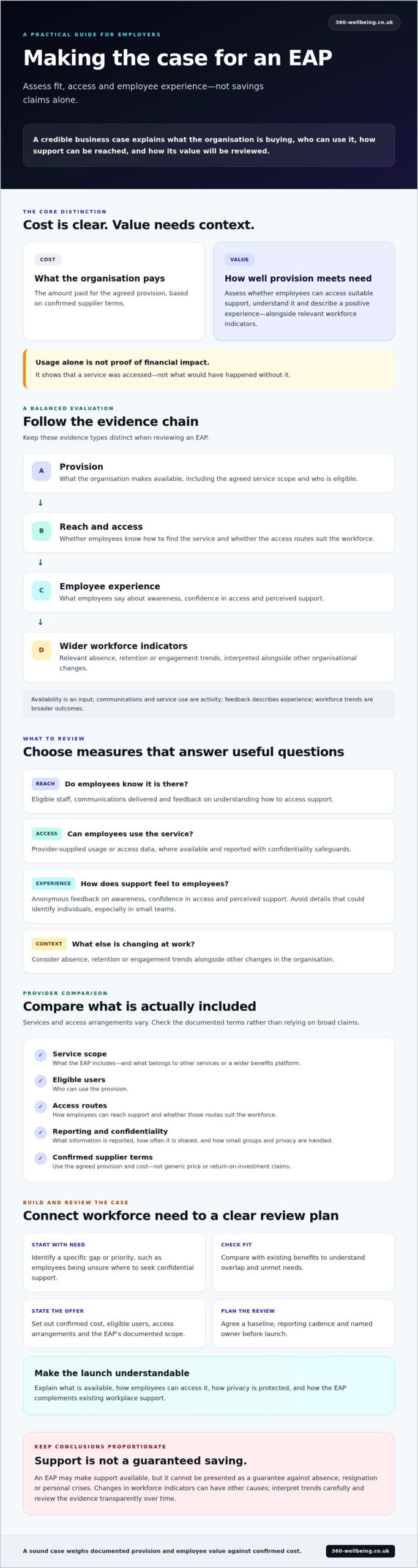
A useful evaluation follows a clear chain: what the organisation provides, whether employees can find and access it, how they experience it, and what broader workforce indicators show over time. These are different kinds of evidence. Programme availability is an input; communications and service use are activity; employee feedback describes experience; absence or retention trends are wider organisational outcomes.
Usage data alone cannot establish an EAP’s financial impact. It shows that a service was accessed, not what would have happened without it. This distinction prevents a high or low usage figure from becoming a misleading verdict on value.
Which measures can employers review?
Before launch, agree a baseline, reporting cadence and named owner. Then select measures that are available and appropriate, such as:
- Reach and awareness: eligible staff and communications delivered, alongside feedback on whether employees understand how to access support.
- Access and activity: provider-supplied usage or access data, where available and reported in a way that protects confidentiality.
- Employee experience: anonymous feedback on awareness, confidence in access and perceived support. Avoid asking for details that could identify an individual, especially in a small team.
- Workforce context: relevant absence, retention or engagement trends, interpreted alongside other changes in the organisation.
Ask the provider what information it reports, how often it is shared and how small groups are handled. Don’t assume every supplier offers the same metrics or that individual service records should be shared with an employer. The aim is to understand reach and experience without compromising trust.
How to discuss evidence without overclaiming
Compare like with like over a defined period, and record significant changes such as restructures, new management practices or changes to other benefits. If engagement improves after an EAP launches, that is an observed change, not proof that the programme caused it. A small number of responses may also make feedback less representative, so describe its limitations clearly.
External benchmarks can add context, but only if you can verify who was included, when the data was collected and how the measure was defined. Without that detail, a headline comparison may not reflect your workforce or the service you purchased.
This approach can also help employers assessing an EAP within a broader benefits offer. For example, 360 Wellbeing’s employee benefits platform includes an EAP alongside other support categories. Confirm the EAP’s specific scope and reporting arrangements before evaluating it.
What to compare when evaluating EAP cost and provision
A fair comparison starts with your workforce, not a provider’s feature list. Match each proposal to documented needs, such as the types of support employees have asked for, how your workforce is distributed and what existing benefits already cover. Then compare service scope, eligibility, access routes and availability. Confirm these details in writing rather than assuming similar programme labels mean equivalent provision.
Low uptake also needs careful interpretation. It may point to limited awareness, access barriers or a mismatch between provision and employee needs, but it doesn’t automatically mean a programme has no value. Ask what communications and onboarding support are included, and what the provider can report in aggregate. Check how confidentiality is protected, especially where a small workforce could make activity easier to identify.
Questions to ask providers before comparing proposals
Request a clear schedule of included services, eligibility rules, access conditions and exclusions. Ask how employees find the right support, what information employers receive and how reports protect individual privacy. Clarify who is responsible for implementation and staff communications, what account support is provided, and how renewal terms work. If your headcount changes, ask how that affects the subscription and when adjustments take effect.
These details help you compare the full commitment, not just the headline subscription structure. For each proposal, record the confirmed scope, expected employer responsibilities and any terms that need clarification before approval.
How wider benefits affect the value assessment
Map your current benefits before assessing a bundled offer. This can reveal overlapping provision, gaps employees still face and services that may complement one another. Judge each additional feature against an identified workforce need rather than counting features as proof of value. If an EAP sits alongside other services on a platform, distinguish what the EAP includes from what is provided separately.
For instance, an organisation may have an EAP and separately offer financial support. Consider whether each meets a distinct need and whether employees can understand how to access them. Guidance on financial support for employees can also help inform that wider benefits review.
Ultimately, justifying the cost of an employee assistance programme means comparing like with like: service scope, access, privacy, administration and terms, as well as how each option fits your workforce. Keep a record of unanswered questions and resolve them before comparing final proposals.
How to build a credible EAP cost-benefit case
A credible case doesn’t need to promise savings. It should show why support may be relevant to your workforce, what the proposed provision includes, what it will cost under confirmed supplier terms, and how you’ll review it. Keep observed results separate from forecasts, and make clear that changes in absence or retention can have causes beyond an EAP.
A sound EAP business case puts its assumptions beside its results, so decision-makers can see what is known, what is estimated and what still needs review.
A practical framework for estimating value
Use a repeatable sequence to develop and review the proposal:
- Define the need: describe the workforce challenge and which employees the provision is intended to support, drawing on appropriate feedback or existing organisational information.
- Confirm the scope: document eligible users, included services and access arrangements with the supplier. Don’t count broader platform benefits as part of the EAP unless they are confirmed inclusions.
- Model the full cost: use the proposed supplier terms to calculate the employer’s actual cost in £. List internal effort, such as coordinating implementation and communications, separately from the subscription.
- Choose measures: set a baseline and select relevant indicators before launch. These might include awareness, access information the provider can share in aggregate, employee feedback and suitable workforce trends.
- Set a review point: compare findings with the baseline and record other workplace changes that could affect results.
If you model possible outcomes, label each assumption and explain its basis. For example, a scenario can show how the assessment would change under different usage or absence assumptions. Don’t present a hypothetical reduction in absence as a guaranteed saving or a forecast attributable to the EAP.
How to respond to concerns about low uptake
Start by checking whether employees know the service exists, understand how to access it and feel confident using it. Low uptake could reflect limited awareness, access friction or a mismatch between the offer and workforce needs. It isn’t enough, on its own, to conclude that the service lacks value.
Use confidential employee feedback and provider-level aggregate data where available. Avoid collecting details that could identify individuals, and ask the provider how reporting protects privacy. Agree a review point with stakeholders. If awareness appears to be a barrier, plan clear follow-up communications before reassessing engagement.
For employers considering an EAP alongside other support, explore 360 Wellbeing’s employee support platform and confirm the EAP scope and applicable terms when assessing fit.
Putting an EAP into practice and reviewing the investment
A considered launch helps employees understand what the EAP is for, how to access it and what support it does and doesn’t provide. Appoint a named owner to coordinate implementation, liaise with the provider and plan regular reminders. Explain that the EAP complements workplace support, such as appropriate conversations with managers, but doesn’t replace an employer’s ongoing role in responding to workplace concerns.
How to encourage awareness while respecting confidentiality
Use clear, accessible messages across channels your employees already use. Explain how to find support, who is eligible and where to check the service details. Revisit the information regularly rather than relying on a single launch announcement. Don’t ask employees to disclose personal circumstances to managers to prove the programme is being used.
Before sharing launch materials, check that they match the provider’s current information about service scope, access and privacy. This helps employees make informed choices and supports confidence in the service.
Reviewing the investment with stakeholders
Set review dates in advance and bring HR, finance and relevant senior stakeholders together to consider awareness, access, employee feedback and the indicators agreed before launch. Review what has changed, what employees say about the experience and whether any barriers need attention. Interpret workforce trends carefully, since changes may reflect wider organisational factors as well as the EAP.
When a wider wellbeing platform may fit
If documented workforce priorities point to needs beyond the EAP, consider whether a broader benefits offer is relevant. 360 Wellbeing describes a platform that includes an EAP alongside services such as 24/7 access to a UK-registered GP, mental health therapy sessions and life coaching. These are distinct support categories, so confirm which services are included in the proposed arrangement and which sit outside the EAP.
Before deciding, verify the EAP’s current scope, access arrangements and eligibility, as well as applicable subscription terms. This keeps the comparison grounded in what employees can actually access and what the organisation would pay.
Justifying the cost of an employee assistance programme is an ongoing process: explain the service clearly, review the evidence responsibly and adjust communications or provision when needs change. If you’re considering a wider offer, you can review 360 Wellbeing’s employee support platform and confirm the details relevant to your workforce before making a decision.
Make your EAP decision with confidence
Justifying the cost of an employee assistance programme is strongest when the case reflects your workforce’s needs, confirms exactly what the provider includes and sets out how you’ll review access, employee experience and relevant organisational indicators. Usage or workforce trends can inform the assessment, but they shouldn’t be presented as proof of financial savings without evidence to support that conclusion.
It also helps to consider whether employees need support beyond the EAP. 360 Wellbeing’s wider employee benefits platform includes an Employee Assistance Programme and 24/7 access to a UK-registered GP, alongside mental health therapy sessions, life coaching, and financial and legal support. Confirm the current EAP scope, eligibility, access arrangements and subscription terms, and distinguish EAP provision from other platform services before comparing options.
If you’re reviewing provision for your organisation, explore 360 Wellbeing’s employee support platform and assess its confirmed details against your priorities. A clear, measured approach can help you make a thoughtful decision that supports both your people and your organisation.
Frequently Asked Questions
Is an employee assistance programme worth the cost?
An EAP can be worth the cost when its confirmed services address a genuine workforce need and employees can find and access the support. Assess awareness, access arrangements and employee experience alongside relevant organisational indicators, such as absence or retention trends. Review these over an agreed period, while recognising that changes may have other causes. No programme guarantees savings, so justifying the cost of an employee assistance programme means judging fit and evidence together.
How do you calculate the return on investment of an EAP?
Start with the actual cost quoted by the supplier, then document the assumptions behind any estimated benefits. Choose suitable measures, such as service access, employee feedback or relevant absence trends, and compare a defined baseline with follow-up data. Be cautious about assigning financial value to changes in absence or retention, as these can have multiple causes. Label estimates clearly, explain their limits and don’t present a modelled return as a guaranteed saving.
Can an EAP reduce employee absence?
An EAP can give employees access to support, but employers shouldn’t assume it will reduce absence. Time away from work can have varied causes, and changes in absence may reflect factors beyond the programme. Review relevant trends alongside workforce context, service access and employee feedback. This helps show whether employees know about the offer and can use it, without treating a change in absence alone as proof that the EAP caused it.
What should an EAP business case include?
A balanced EAP business case should set out the workforce need, intended eligible population, confirmed service scope and actual proposed cost. Include the implementation and communications plan, the measures you’ll review, a review period and any assumptions behind estimated benefits. Present limitations alongside potential value, including uncertainty about attributing changes in absence or retention to the programme. This gives decision-makers a clear basis for assessing whether the offer fits organisational priorities.
How can employers improve EAP uptake?
Build awareness with repeated, accessible communications that explain how employees can find support. Ask leaders to help make the service visible, while using provider-approved information to explain confidentiality and service scope accurately. Review aggregate awareness or usage information where available, and use anonymous feedback to identify access barriers. Don’t ask employees to disclose personal circumstances or their individual use of the programme to managers as evidence of uptake.
What is the difference between an EAP and a wider employee wellbeing platform?
An EAP is a form of employee support; a wider wellbeing platform may bring it together with additional services. For example, 360 Wellbeing describes a platform that includes an EAP alongside services such as 24/7 access to a UK-registered GP, mental health therapy sessions and life coaching. Employers should check documented inclusions, access rules and subscription terms before comparing options. Don’t assume every benefit on a platform is included in the EAP itself.
How often should an employer review its EAP?
Set a review cadence before launch, then check awareness, access, employee feedback, provider reporting and agreed business indicators. The right timing depends on your workforce, the information the provider can report and your contract terms, so there isn’t one interval that suits every employer. A planned review can help you spot communication or access issues and consider whether provision still reflects employee needs, while keeping the evidence and its limitations in view.