
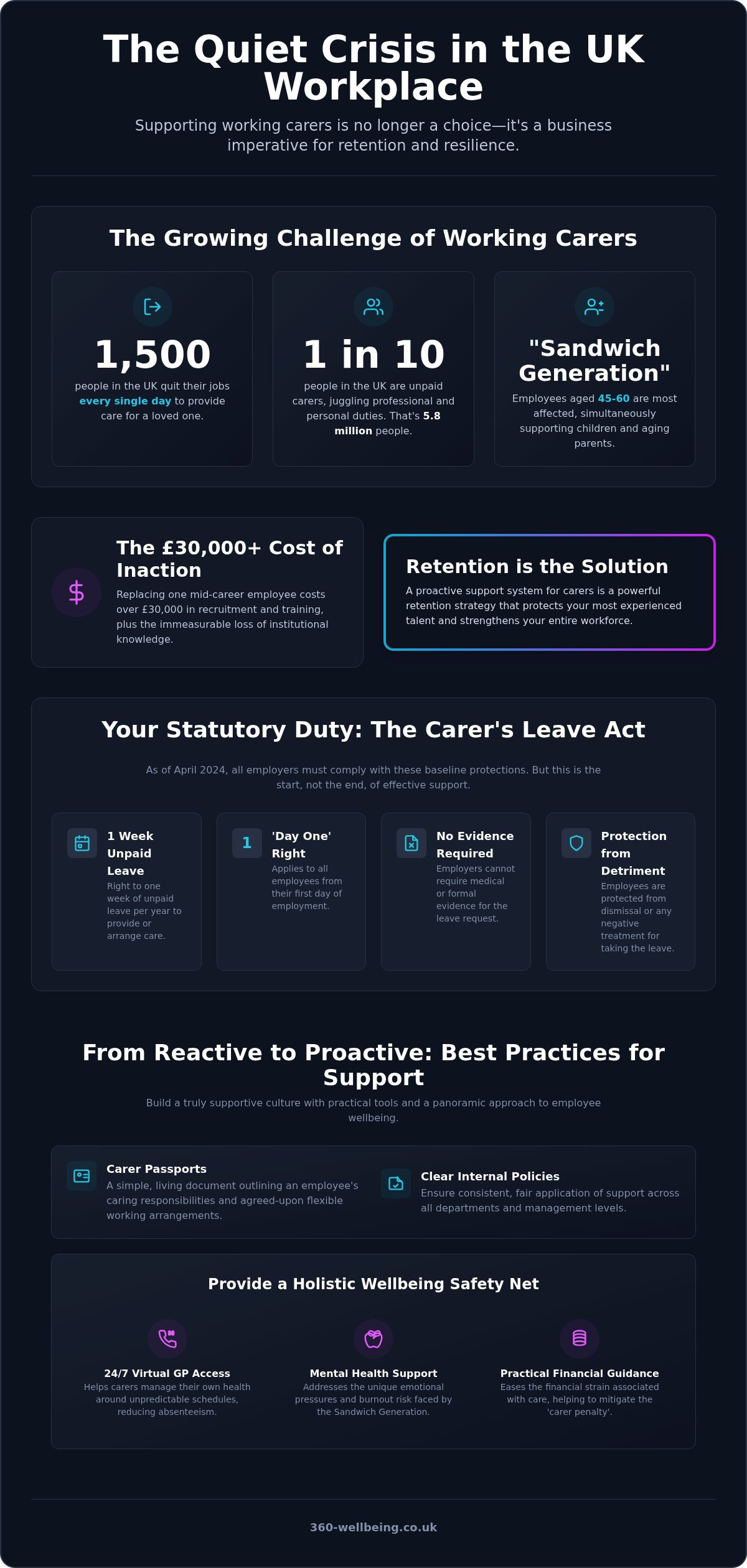
Every single day in the UK, approximately 1,500 people walk away from their careers to care for a loved one. This isn’t just a loss of talent; it’s a quiet crisis affecting your most experienced, mid-career employees who find themselves squeezed between professional duties and home responsibilities. Supporting working carers in the workplace has evolved from a compassionate gesture into a fundamental business necessity for 2026. If your organization is struggling with rising turnover or the complexities of ‘Sandwich Generation’ burnout, you aren’t alone.
We understand that managing flexible working requests while maintaining productivity can feel like a delicate balancing act. You want to protect your team’s wellbeing without compromising operational standards. This guide will show you how to build a robust support system that enhances retention and reduces absenteeism. We’ll explore how to move beyond basic compliance with the Carer’s Leave Act 2023 toward a panoramic approach to wellness. By the end, you’ll have a clear roadmap for creating a loyal, engaged workforce through proactive mental health support, 24/7 clinical access, and practical financial guidance.
Key Takeaways
- Understand your statutory obligations under the Carer’s Leave Act 2023, including the essential day-one rights for unpaid leave.
- Learn how to implement practical tools like Carer Passports and clear internal policies to provide consistent support across all management levels.
- Discover why supporting working carers in the workplace is a vital retention strategy that helps you avoid the significant £30,000+ cost of replacing mid-career talent.
- Identify how providing 24/7 Virtual GP access and mental health support can drastically reduce absenteeism by helping carers manage their own health around their busy schedules.
- Shift from a reactive approach to a proactive, panoramic wellbeing strategy that addresses the unique emotional and financial pressures faced by the Sandwich Generation.
The Rise of the Working Carer: A 2026 Workplace Priority
Within the modern UK context, the term ‘working carer’ encompasses millions of individuals who provide unpaid support to family members, friends, or neighbors with long-term illnesses, disabilities, or needs related to old age. With approximately 5.8 million unpaid carers across the country, nearly one in ten people now juggle professional responsibilities with deeply personal care duties. This demographic is increasingly dominated by the ‘Sandwich Generation’, those employees typically aged between 45 and 60 who find themselves simultaneously supporting growing children and aging parents.
For employers, this is no longer a niche HR concern; it’s a critical operational risk. When experienced staff in their prime career years feel forced to choose between their loved ones and their livelihood, the business loses decades of institutional knowledge. Replacing a mid-level professional can cost upwards of £30,000 in recruitment and training, a figure that becomes staggering when you consider that 1,500 people in the UK quit their jobs every day to provide care. Supporting working carers in the workplace has shifted from a discretionary benefit to a professional necessity, reflecting a broader change in employee expectations where holistic wellbeing is viewed as an essential human entitlement.
The Hidden Impact of Unpaid Care
Many employees endure a ‘quiet struggle’, choosing not to self-identify as carers because they fear being perceived as less committed to their roles. This silence often masks a reality of physical exhaustion and mental fatigue, as the boundaries between work and home life dissolve. Understanding the history of carers’ rights helps us recognize that these challenges aren’t new, but our response must be. The carer penalty describes the cumulative loss of career progression and lifetime earnings experienced by those who must reduce their hours or exit the workforce to provide unpaid support.
Why 2026 is a Turning Point for Carer Support
The demographic reality of an aging population means that the number of people requiring care is rising sharply, placing unprecedented pressure on the workforce. In 2026, supporting working carers in the workplace has become a key metric for Environmental, Social, and Governance (ESG) goals, as investors and talent alike look for organizations that demonstrate genuine social responsibility. We’ve moved beyond the era where flexible working was a ‘perk’; it’s now part of the essential infrastructure required to build a durable, loyal, and healthy workforce.
Understanding the Carer’s Leave Act and Statutory Rights
Since April 6, 2024, the Carer’s Leave Act has provided a baseline of protection for employees across Great Britain. It grants a statutory right to one week of unpaid leave per year to arrange or provide care for a dependant with a long-term care need. Crucially, this is a ‘day one’ right, meaning new hires are protected from their first hour on the job. Employers can’t require medical evidence for this leave, nor can they subject staff to any detriment or dismissal for requesting it. By 2026, the government’s action plan has further solidified these entitlements, emphasizing a ‘carer’s charter’ that clarifies these protections for the three million people in the UK juggling work and care.
When managing these requests, following Acas guidance on carer’s leave ensures your business remains compliant while maintaining a supportive atmosphere. A dependant is broadly defined; it covers spouses, civil partners, children, parents, or anyone who reasonably relies on the employee for care. Similarly, a ‘long-term care need’ includes disabilities under the Equality Act 2010, illnesses requiring care for over three months, or needs related to old age. Understanding these definitions is the first step in supporting working carers in the workplace effectively.
Statutory Minimums vs. Best Practice
While one week of unpaid leave is a significant step, it’s rarely enough for those in the thick of a complex care crisis. Relying solely on the legal minimum can inadvertently increase staff turnover, as the financial strain of unpaid time off often leads to the ‘carer penalty’ where skilled workers feel forced to exit the workforce. Best practice involves distinguishing between ’emergency’ leave for sudden incidents and ‘planned’ leave for medical appointments. Forward-thinking firms use digital tools to track leave transparently, avoiding a culture of surveillance while ensuring everyone gets the support they need. Providing access to holistic wellbeing resources can help bridge the gap when unpaid leave isn’t a viable long-term solution for an employee’s financial health.
Navigating Flexible Working Requests
The right to request flexible working is now a day-one entitlement for all UK employees. In 2026, the focus has shifted toward sustainable hybrid models, compressed hours, and job-sharing. Successfully supporting working carers in the workplace requires balancing these individual needs with overall team productivity. Employers should approach these requests with a presumption of ‘how’ it can work rather than ‘if’. Clear review periods help ensure that flexible arrangements remain effective for both the business and the carer, preventing burnout while maintaining high performance across the organization.
Practical Strategies for Supporting Working Carers
Moving from legal compliance to genuine care requires a structured framework that respects the employee’s time and emotional energy. A formal Carer’s Policy is the essential first step, but it shouldn’t be hidden away in a dense employee handbook. It needs to be a living document, easily accessible and clearly communicated to everyone. Alongside this, many forward-thinking organizations are adopting ‘Carer Passports’. These records document an individual’s specific caring responsibilities and any agreed adjustments, such as flexible start times. Because the passport stays with the employee, they don’t have to repeat their personal story every time they change managers, which significantly reduces the stress of internal transitions.
This proactive stance is backed by solid evidence. A UK Government report on supporting working carers explains that when businesses provide this level of support, they don’t just help the individual; they boost the wider economy by keeping skilled talent in the workforce. Ultimately, supporting working carers in the workplace is a strategic investment in your company’s long-term durability and morale.
Building a Carer-Friendly Benefits Package
Traditional benefits packages often fail to address the unique pressures of the Sandwich Generation. To truly make a difference, you need a package that offers a panoramic view of wellbeing. A 24/7 Virtual GP is often the most appreciated tool for time-poor carers. It removes the anxiety of trying to secure a local GP appointment during work hours, allowing them to consult a professional at a time that suits their care schedule. Integrating financial support into your offering is also vital. Providing access to debt advice and discount marketplaces can help offset the ‘carer penalty’ and ease the financial strain that often accompanies long-term care roles.
Manager Training and Sensitivity
Line managers act as the primary bridge between the business and the individual. They need to be equipped with the skills to spot early signs of carer burnout, such as persistent exhaustion or a sudden drop in engagement. Regular wellbeing check-ins should feel like a supportive partnership, focusing on how the business can help the employee maintain their vitality. Creating a network of ‘Mental Health Champions’ can also provide a safe space for staff to disclose their challenges without fear of judgment. These champions can offer tailored mental health first aid, ensuring that supporting working carers in the workplace is both scientifically grounded and deeply personal.
The ROI of Empathy: Why Support Makes Business Sense
Investing in your team’s personal resilience pays dividends in professional performance. Empathy isn’t just a soft skill; it’s a fiscal priority that protects your company’s most valuable assets. Supporting working carers in the workplace is one of the most effective ways to safeguard your bottom line. While we’ve already noted the £30,000 replacement cost for mid-level roles, the true price of losing a seasoned employee includes the erosion of team morale and the loss of specialized skills that take years to cultivate. When you provide a safety net, you’re not just preventing departures; you’re fostering a culture of profound loyalty.
Loyal employees don’t just stay; they contribute more. This ‘discretionary effort’ is the natural result of a psychological contract where the employee feels truly seen and valued as a human being. When a leader supports a carer during a family crisis, that employee often returns to work with a level of dedication that exceeds their job description. This creates a positive ripple effect throughout the company culture, enhancing your employer brand and making recruitment significantly easier in a competitive market.
Quantifying the Cost of Inaction
Without adequate support, the cumulative stress of care often manifests as long-term sick leave. This isn’t just a health issue; it’s a resource drain that forces other team members to pick up the slack, potentially leading to wider burnout. The productivity gap caused by care-related stress is often the result of an employee’s inability to focus when their support system at home is crumbling. Presenteeism, where a carer is physically at their desk but mentally managing a crisis, hurts the bottom line just as much as a total absence. By offering foresight through structured help, you move from a reactive stance to a proactive vision of workplace harmony.
Case Study: The SME Advantage
Smaller businesses often worry they can’t match the benefits of large corporations. However, SMEs have a unique agility that allows them to implement carer support faster and more personally. Using a digital platform allows even the smallest teams to provide enterprise-level benefits on a per-seat budget. We’ve seen numerous retention wins where employees stay with an SME specifically because the flexible care support felt more human and responsive than a rigid corporate policy. This agility allows small teams to pivot quickly, offering customized solutions that keep their best talent engaged and productive.
Ready to protect your talent and boost your team’s resilience? Explore our comprehensive support platform to see how we can help you build a more sustainable, carer-friendly workforce.
How 360 Wellbeing Bridges the Gap for Working Carers
Most discussions about supporting working carers in the workplace focus heavily on statutory leave, but time off is only one piece of a much larger puzzle. To truly thrive, carers need a support system that mirrors the complexity of their lives. 360 Wellbeing offers a panoramic solution that integrates physical, mental, and financial health into a single, accessible platform. We move beyond the basic legal requirements to provide a proactive vision of vitality that benefits both the individual and the organization.
One of the greatest hurdles for a carer is managing their own health alongside their dependant’s needs. Our 24/7 Virtual GP removes the requirement to miss work for basic medical consultations, providing clinical expertise at any hour of the day or night. This flexibility is essential for those whose schedules are often dictated by the unpredictable needs of a loved one. When medical advice is just a click away, the stress of ‘fitting it all in’ begins to dissolve.
The emotional weight of care can lead to a quiet erosion of an employee’s wellbeing. We provide professional Mental Health Support and Life Coaching to help staff process the unique stresses of the Sandwich Generation. Whether it’s managing burnout or navigating complex family dynamics, our experts offer a compassionate partnership. Additionally, our platform includes complimentary Will Writing and Financial Support & Debt Advice, helping to alleviate the financial strain often associated with long-term care. To further support the household budget, the 360 Rewards Marketplace offers meaningful discounts on daily essentials, helping carers stretch their earnings further.
A Panoramic View of Carer Health
We believe that physical, mental, and social health are inextricably linked. A carer worried about debt or legal paperwork cannot focus on their mental wellbeing, and chronic stress eventually manifests as physical illness. By housing all these tools in a single, intuitive app, we make support manageable rather than overwhelming for time-poor staff. For moments of acute pressure, our Employee Assistance Programme (EAP) provides immediate crisis support, ensuring no staff member feels they’re carrying the burden alone. This unified narrative of wellness is what makes supporting working carers in the workplace a sustainable reality.
Implementation: Getting Started in 2026
Onboarding is designed to be seamless, particularly for SMEs and sole traders who need ‘big-company’ benefits without the administrative heavy lifting. We act as a dedicated partner to your HR team, providing the expert caregiver persona your employees can rely on for long-term support. Our approach is methodical and calm, mirroring a professional consultation to ensure every team member feels safe and valued. Discover our comprehensive wellbeing platform for your team and take the first step toward a more resilient and loyal workforce.
Building a Resilient, Carer-Friendly Future
The landscape of the UK workforce has shifted, making the wellbeing of the Sandwich Generation a central pillar of organizational health. While statutory rights provide a necessary foundation, true loyalty is built when employees feel their personal challenges are met with genuine partnership. Supporting working carers in the workplace requires a panoramic strategy that addresses the physical exhaustion of care, the mental weight of responsibility, and the financial pressures of the modern economy. By moving beyond basic compliance, you protect your most experienced talent and foster a culture of durability and mutual respect.
Providing enterprise-level care doesn’t have to be complex or prohibitively expensive. With an affordable per-employee monthly subscription, you can offer your team 24/7 access to UK-registered Virtual GPs, alongside holistic mental health and financial support. This foresight ensures your staff can manage their own health around their care duties, reducing absenteeism and burnout. Empower your working carers with 360 Wellbeing and turn workplace harmony into your greatest competitive advantage. Together, we can create an environment where every employee has the vitality to thrive both at home and at work.
Frequently Asked Questions
What are the legal rights of a working carer in the UK in 2026?
In 2026, UK employees have a statutory right to one week of unpaid leave per year to care for a dependant with long-term needs. This is a day-one right under the Carer’s Leave Act 2023. Additionally, all staff can request flexible working from their first day of employment. These legal protections ensure that supporting working carers in the workplace is a mandatory priority rather than a discretionary choice for modern businesses.
How can I identify which employees have caring responsibilities?
Identification starts with building a culture of trust where employees feel safe disclosing their personal circumstances. You might use anonymous surveys or dedicated Mental Health Champions to encourage dialogue. Many people don’t realize they fit the definition of a carer. By consistently communicating your commitment to supporting working carers in the workplace, you make it easier for the Sandwich Generation to step forward and access the help they need.
What is a Carer’s Passport and how does it work?
A Carer’s Passport is a living document that records an employee’s caring role and the specific adjustments agreed with their employer. It might include flexible start times or hybrid working patterns. The primary benefit is portability; if the employee moves to a new department, their new manager immediately understands their needs. This reduces the emotional burden of repeatedly explaining complex family situations and ensures that support remains consistent and reliable.
Is Carer’s Leave paid or unpaid in the UK?
Statutory carer’s leave in the UK is currently unpaid. While the law mandates a minimum of one week of unpaid time off, many organizations offer paid leave as a strategic benefit to improve retention. Providing paid leave helps alleviate the financial strain often associated with the carer penalty. It demonstrates a proactive commitment to employee vitality, ensuring that those with significant responsibilities at home can still maintain their financial stability and professional focus.
How does a Virtual GP help employees with caring duties?
A 24/7 Virtual GP provides clinical expertise at any time, removing the need for carers to take time off for daytime appointments. Carers often prioritize their dependant’s health over their own. By offering digital access to UK-registered doctors, 360 Wellbeing ensures that staff can manage their own health around their care duties. This convenience reduces absenteeism and helps prevent minor health issues from escalating into long-term physical or mental fatigue.
What should be included in a workplace Carer’s Policy?
Your policy should clearly define who qualifies as a carer and outline the process for requesting leave or flexible working. It’s essential to include information on both statutory rights and any enhanced benefits your company offers, such as Life Coaching or financial advice. Signposting to your Employee Assistance Programme (EAP) ensures staff know exactly where to turn during a crisis. A well-structured policy provides a sense of safety and order for everyone.
Can an employer refuse a flexible working request from a carer?
Employers can refuse a flexible working request, but they must have a valid business reason for doing so. Common grounds include an inability to redistribute work or a negative impact on performance. However, you must consult with the employee before making a decision. In 2026, the emphasis is on finding a middle ground that balances business needs with the employee’s human entitlement to a manageable work-life balance and long-term professional durability.
How can I support the mental health of staff who are carers?
Supporting mental health requires a panoramic approach that addresses the emotional toll of care. Offering access to professional Mental Health Support and life coaching sessions allows staff to process their experiences in a safe, confidential space. You can also implement regular wellbeing check-ins and train managers to spot early signs of burnout. Providing holistic tools, such as debt advice and legal support, further reduces the external pressures that often contribute to mental fatigue.