Did you know that nearly one million UK workers are currently struggling with work-related mental ill-health, costing businesses an estimated £56 billion every single year? As the Health and Safety Executive (HSE) makes psychological safety a primary enforcement priority in 2026, understanding your employer duty of care mental health uk obligations isn’t just a legal necessity; it’s a vital part of looking after your most valuable asset. We know it’s often difficult to draw a clear line between an employee’s personal struggles and your professional liability. You might worry about the complexity of employment tribunals or feel overwhelmed by the prospect of conducting a formal stress risk assessment on a tight budget.
We’re here to help you navigate these sensitive waters with clarity and compassion. This guide provides a definitive blueprint for mastering your statutory duties under the Health and Safety at Work etc. Act 1974 and the Equality Act 2010. You’ll learn how to implement defensible risk assessments that protect both your team and your organization. We will also explore how modern support frameworks, including virtual GP access and qualified mental health therapy, can transform your workplace into a space where everyone truly thrives.
Key Takeaways
- Learn why UK law equates psychiatric harm with physical injury, necessitating a robust and panoramic approach to employee safety.
- Discover how to align your business with the Health and Safety at Work etc. Act 1974 and the Equality Act 2010 to meet your employer duty of care mental health uk requirements.
- Master the six HSE Management Standards to create a defensible and structured workplace stress risk assessment that identifies hazards before they escalate.
- Identify effective reasonable adjustments and proactive support frameworks that reduce absenteeism while restoring team vitality and productivity.
- Explore how integrating clinically-led tools, such as 24/7 virtual GP access and qualified mental health therapy, moves your strategy from reactive compliance to sustainable wellbeing.
What Is an Employer’s Duty of Care for Mental Health in the UK?
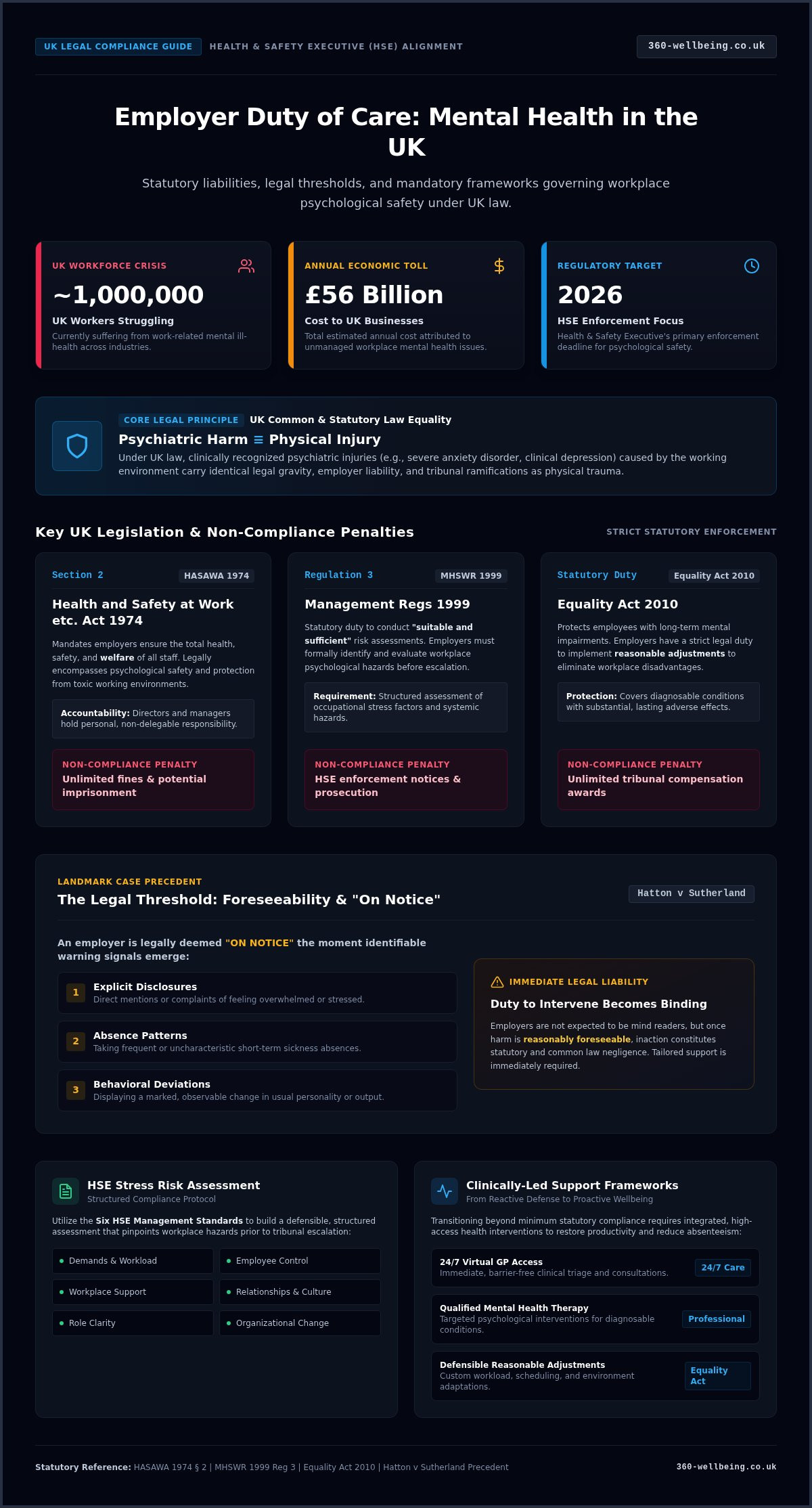
At its core, your employer duty of care mental health uk is a commitment to the total wellbeing of your staff. It isn’t just about preventing accidents on the warehouse floor or in the office kitchen; it’s about fostering a culture where psychological safety is treated with the same gravity as physical protection. Under UK law, a clinically recognized psychiatric injury caused by work is legally equivalent to a physical injury. This means if an employee develops a diagnosable condition like clinical depression or a severe anxiety disorder due to their working environment, the legal repercussions are just as serious as if they had suffered a physical trauma.
It’s helpful to distinguish between everyday workplace pressure and actual psychological harm. Pressure can often be a positive motivator that helps people grow, but when it becomes excessive and unmanaged, it transforms into debilitating stress. The law doesn’t expect you to eliminate every challenging deadline, but it does require you to prevent that pressure from causing a lasting, diagnosable illness. This duty rests on two pillars: common law negligence and specific statutory regulations.
Common Law vs. Statutory Health and Safety Obligations
Your common law duty is an implied part of every employment contract. It requires you to provide a safe system of work and maintain a relationship of mutual trust and confidence with your team. Beyond this, you must strictly adhere to the Health and Safety at Work etc. Act 1974. This statutory duty is non-negotiable. While a breach of common law might lead to a civil claim for damages, failing to meet statutory duties can result in direct regulatory intervention, criminal prosecution, and significant fines from the Health and Safety Executive (HSE).
The Legal Threshold for Psychiatric Injury and Foreseeability
The landmark case of Hatton v Sutherland established the primary guidelines for employer liability regarding occupational stress. For a legal claim to succeed, the harm suffered by the employee must be “reasonably foreseeable.” You aren’t expected to be a mind reader, but the law looks for clear signals that an individual was struggling. If a staff member mentions they are feeling overwhelmed, starts taking frequent short-term absences, or displays a marked change in their usual personality, you’re legally considered “on notice.” Once these early warning signs appear, your legal duty to intervene and provide tailored support becomes immediate and binding.
Key UK Legislation Governing Workplace Psychological Safety
Navigating the legalities of the workplace can feel daunting, yet UK legislation provides a clear framework for protecting your team. It’s critical to realize that an employer duty of care mental health uk isn’t optional. Ignorance of these statutory provisions offers zero defense in an employment tribunal. These laws overlap to mandate continuous mental health risk management, ensuring that psychological safety is never sidelined.
| Statute | Core Employer Duty | Non-Compliance Penalty |
|---|---|---|
| HASAWA 1974 | Ensure health, safety, and welfare of all staff. | Unlimited fines, potential imprisonment. |
| Management Regs 1999 | Conduct “suitable and sufficient” risk assessments. | HSE enforcement notices and prosecution. |
| Equality Act 2010 | Provide reasonable adjustments for disabilities. | Unlimited tribunal compensation awards. |
Health and Safety at Work etc. Act 1974 (HASAWA)
Section 2 of this Act is the bedrock of UK safety. It mandates that you ensure the health, safety, and welfare of all employees. In a modern context, “welfare” legally encompasses psychological health and protection from toxic environments. Directors and managers are held personally accountable for maintaining these standards; you cannot delegate the ultimate responsibility for a safe culture.
Management of Health and Safety at Work Regulations 1999
Regulation 3 takes this further by requiring “suitable and sufficient” risk assessments. You must assess psychological hazards just as rigorously as physical ones. The HSE confirms that you have a legal responsibility for mental health, which means identifying triggers for stress and implementing preventative measures based on your specific findings. It’s about foresight and durability in your safety systems.
Equality Act 2010 and Long-Term Mental Impairments
A mental health condition qualifies as a disability if it has a “substantial and long-term adverse effect” on normal day-to-day activities. “Long-term” typically means the condition has lasted, or is likely to last, at least 12 months. When this threshold is met, you have a statutory obligation to make proactive reasonable adjustments. This might include altering working hours or redistributing tasks to alleviate acute pressure. Integrating qualified mental health support into your business strategy helps you fulfill these duties while empowering your team to stay productive and balanced.
Conducting a Compliant Mental Health Risk Assessment
Fulfilling your employer duty of care mental health uk requires a structured approach that goes beyond casual check-ins. A formal risk assessment is your primary tool for identifying systemic issues before they lead to burnout or litigation. To be truly compliant, your audit should align with the HSE guidance on mental health at work, focusing on the six management standards: demands, control, support, relationships, role, and change. By examining these areas, you can pinpoint exactly where workplace design might be failing your team.
Don’t rely solely on intuition. Capture objective data to build a panoramic view of your organization’s health. Rising staff turnover, frequent short-term absenteeism, and an increase in formal grievances are often the first measurable signs of a stressed workforce. Documenting these metrics alongside your interventions creates a robust paper trail. This structured documentation is your best defense against civil negligence claims, proving that you’ve taken “suitable and sufficient” steps to mitigate psychological hazards.
Step-by-Step Risk Assessment Methodology for Managers
Consistency is key when evaluating psychological safety. Follow this methodical four-step process to ensure no stone is left unturned:
- Step 1: Identify Hazards. Look for excessive workloads, unrealistic deadlines, or poor communication channels across different teams and environments.
- Step 2: Determine Who Might Be Harmed. Evaluate which groups are most exposed and assess whether your current support measures are actually reaching them.
- Step 3: Evaluate Risk and Record Findings. Determine the likelihood of harm. If you have five or more employees, you must legally record these significant findings in writing.
- Step 4: Implement and Review. Apply preventative interventions, such as workload redistribution, and schedule regular reviews to ensure these changes remain effective.
Identifying Early Warning Signs and Behavioural Changes
While you aren’t expected to be a clinician, managers must be trained to spot shifts in employee behavior that suggest a deteriorating mental state. Look for cognitive markers like uncharacteristic mistakes, missed deadlines, or a sudden inability to focus. Emotional indicators often include social withdrawal, visible fatigue, or increased irritability during team interactions.
The goal is to document objective observations rather than attempting to diagnose a specific condition. For example, noting that an employee has missed three deadlines in a week or has become uncharacteristically erratic in their attendance provides a factual basis for intervention. Training your leadership to recognize these signs early allows for the kind of foresight that prevents long-term absence and fulfills your ongoing legal obligations.
Implementing Workplace Reasonable Adjustments and Support Systems
Fulfilling your employer duty of care mental health uk obligations transitions from theory to practice when you implement reasonable adjustments. These aren’t just legal boxes to tick under the Equality Act 2010; they’re essential tools for restoring staff performance and retaining your most talented people. Success requires a panoramic partnership between HR, occupational health specialists, and the individuals themselves. By addressing stressors inside and outside the office, such as providing Financial Support for Employees, you reduce the external burdens that often exacerbate workplace anxiety. A holistic approach ensures your team feels supported in every aspect of their lives.
Practical Adjustments for Mental Health in Daily Operations
Effective adjustments are often simpler than they seem. Implementing flexible start times or hybrid working models can significantly alleviate the morning pressure that triggers acute stress for many. You might also consider structured workload reallocations, ensuring tasks are distributed fairly based on current capacity rather than just job titles. Dedicated quiet spaces in the office provide a necessary sanctuary for employees who feel overwhelmed by sensory input or social demands.
To ensure these changes are durable, develop tailored Wellness Action Plans (WAPs). These documents allow you to record agreed accommodations clearly, providing a roadmap for both the manager and the employee. When a team member returns from prolonged medical leave, a structured pathway is vital. Phased returns and regular check-ins help the individual reintegrate without feeling an immediate, crushing weight of expectation. This methodical approach builds long-term resilience within your workforce.
Manager Training and Reducing Workplace Psychological Stigma
Your line managers are your first line of defense. Upskilling them to hold compassionate, legally compliant check-ins is a professional necessity. They don’t need to be therapists, but they must know how to listen without judgment and identify when to escalate concerns. When managers lead with empathy, they help dismantle the stigma that often prevents employees from reporting difficulties until they reach a crisis point. Open dialogue should be encouraged as a standard part of your culture, not a rare exception.
Clear escalation protocols are equally important for maintaining your employer duty of care mental health uk. If an employee exhibits signs of severe acute distress, your leadership needs to know exactly who to contact and what professional resources are available. Quick intervention can prevent a temporary struggle from becoming a long-term disability. If you’re ready to implement a professional support framework that protects your business and your people, you can discover how our Mental Health Support tools can protect your organization. Providing direct access to qualified therapists and 24/7 Virtual GP services ensures your team has expert care whenever they need it most.
Moving Beyond Minimum Compliance: Building a Proactive Wellbeing Strategy
Meeting your employer duty of care mental health uk obligations through bare-minimum compliance is like wearing a seatbelt but never checking the brakes. While following the letter of the law protects you from immediate prosecution, it doesn’t necessarily protect your people from burnout or your business from the hidden costs of presenteeism. In 2024/25, an estimated 22.1 million working days were lost due to work-related stress, depression, or anxiety. A proactive strategy moves beyond simply avoiding harm; it focuses on fostering durability and vitality across your entire team.
Investing in a panoramic corporate health strategy isn’t just a moral choice. It’s a sound financial decision. Research indicates that for every £1 invested in mental health support, there’s an average return of £5.30 through reduced absenteeism and staff turnover. By integrating physical, mental, and financial wellbeing into a single narrative, you create a safety net that shields your business from personal injury liability. Early clinical intervention is the most effective way to prevent a temporary challenge from escalating into a complex tribunal case or a long-term disability claim.
The Crucial Role of EAPs and 24/7 Virtual Healthcare
Traditional support systems often fail because of significant waiting times. Providing your staff with an Employee Assistance Programme (EAP) offers them immediate, confidential access to qualified mental health therapy and counseling when they need it most. This removes the barrier of NHS delays and ensures that support is available at the point of need. When you pair this with 24/7 Virtual GP access, you ensure your employees have round-the-clock clinical support for both physical and psychological concerns. Adding life coaching to the mix helps individuals resolve personal and professional challenges before they impact their performance or wellbeing.
Transforming Duty of Care with 360 Wellbeing
We believe that premium health support should be accessible to every business, from sole traders to large corporations. By leveraging a unified platform, you can offer your team qualified mental health therapy, Virtual GP access, and 360 Rewards in one place. This demonstrates a genuine, compassionate commitment to your workforce while fulfilling your legal duties seamlessly. You don’t have to manage these complex needs alone. You can partner with a dedicated UK national provider to ensure your strategy is both scientifically grounded and deeply personal. Explore how 360 Wellbeing’s comprehensive employee platform fulfills your duty of care seamlessly, protecting your organization’s future while empowering your people to thrive today.
Cultivating a Resilient and Protected Workplace Culture
Fulfilling your employer duty of care mental health uk obligations is a continuous journey of foresight and compassion rather than a one-off compliance exercise. By understanding the statutory interplay between health and safety laws and the Equality Act 2010, you can move away from reactive crisis management. Implementing structured risk assessments and introducing practical adjustments protects your organization from civil negligence while keeping your teams vital and productive. True corporate wellness integrates psychological safety directly into your daily operations, creating a durable environment where staff feel safe to speak up early.
You don’t have to navigate these complex legal and emotional landscapes alone. Our comprehensive wellbeing platform is built specifically for UK businesses of all sizes, unifying mental health, physical health, and financial support into an all-in-one ecosystem. Your team gains direct 24/7 access to UK-registered GPs and accredited mental health therapists, ensuring expert care is always within reach. Please discover how 360 Wellbeing helps UK employers fulfill their duty of care, allowing you to protect your business while building a healthier, happier workforce.
Frequently Asked Questions
Is an employer legally responsible for an employee’s mental health in the UK?
Yes, you have a clear legal responsibility to safeguard your team’s psychological wellbeing. The Health and Safety at Work etc. Act 1974 mandates that you ensure the welfare of all staff, which includes protecting them from work-related mental ill-health. Failing to address these hazards can lead to regulatory enforcement by the HSE. Maintaining a robust employer duty of care mental health uk strategy ensures you are meeting these statutory requirements while fostering a supportive culture.
Can an employee claim compensation or sue an employer for work-related stress?
Employees can pursue civil claims for compensation if they suffer a clinically recognized psychiatric injury due to workplace stress. To succeed, the claimant must prove that the harm was a reasonably foreseeable consequence of their work and that you failed to take appropriate preventative action. These claims can result in significant financial settlements and reputational damage. Proactively offering tools like an Employee Assistance Programme (EAP) helps mitigate these risks by providing early, professional intervention.
What qualifies as a mental health disability under the Equality Act 2010?
Under the Equality Act 2010, a mental health condition is classified as a disability if it has a substantial, long-term adverse effect on an individual’s ability to carry out normal day-to-day activities. “Long-term” generally means the condition has lasted, or is likely to last, for at least 12 months. When this threshold is met, you’re legally required to implement reasonable adjustments to ensure the employee isn’t disadvantaged compared to their colleagues who don’t have a disability.
What are an employer’s obligations regarding stress risk assessments?
You are legally required to conduct “suitable and sufficient” risk assessments for work-related stress. This obligation falls under the Management of Health and Safety at Work Regulations 1999. If your business employs five or more people, these assessments must be formally documented. You should evaluate factors like workload demands, the level of control employees have over their tasks, and the quality of workplace relationships. Regular reviews ensure your employer duty of care mental health uk remains effective as your business evolves.
How do reasonable adjustments work for employees with mental health conditions?
Reasonable adjustments are practical changes made to a job or working environment to support an employee with a mental health condition. These might include flexible start times to avoid peak travel stress, structured workload reallocations, or providing a dedicated quiet space for focus. The goal is to remove barriers that prevent the individual from performing their role effectively. These adjustments should be agreed upon collaboratively and documented within a Wellness Action Plan to ensure long-term durability.
What happens if an employer ignores clear signs of workplace burnout?
Ignoring signs of burnout, such as uncharacteristic mistakes or emotional withdrawal, significantly increases your legal liability. Once signs of distress become apparent, the harm is considered “reasonably foreseeable,” placing an immediate duty on leadership to intervene. Failure to act can lead to personal injury stress claims, constructive dismissal cases, or enforcement action by the HSE. A panoramic approach to health, including 24/7 Virtual GP access, allows you to address these issues before they reach a crisis point.
Can an employer dismiss an employee who is off sick with long-term mental illness?
Dismissal for long-term mental illness is a complex legal area and should only be a last resort. You must follow a fair and transparent capability procedure, which includes consulting with the employee and obtaining medical evidence. You’re also required to consider all possible reasonable adjustments and alternative roles before considering termination. Rushing this process without clinical guidance or legal support often leads to successful unfair dismissal or disability discrimination claims in an employment tribunal.