Procedural rigour and compassionate pastoral care are not opposing forces; they are mutually reinforcing pillars of a legally sound inquiry. Even so, managing employee stress during workplace investigations often feels like an impossible balancing act for UK employers and HR leaders. You likely recognise the sinking feeling when a critical disciplinary or grievance process stalls overnight behind a stress-related GP fit note, leaving your organisation stranded between statutory procedural obligations and the looming threat of constructive dismissal claims.
Protecting your people from acute distress isn’t just a moral imperative; it is an active legal duty that safeguards your business from operational disruption and costly tribunal disputes. In this guide, you’ll discover how to conduct fair, compliant workplace investigations while proactively safeguarding employee mental health and mitigating legal risk. From structured communication protocols to independent wellbeing safeguards, we explore how to maintain an unbroken duty of care that brings fair resolution without triggering prolonged sickness absence.
Key Takeaways
- Understand the acute neurological impact of formal scrutiny and how unresolved ambiguity triggers fight-or-flight responses in employees.
- Clarify your statutory duty of care under UK health and safety legislation alongside common law protections against foreseeable psychiatric harm.
- Discover practical operational protocols for managing employee stress during workplace investigations, including transparent communication cadences and neutral suspension framing.
- Learn how to erect an independent pastoral firewall using confidential Employee Assistance Programmes (EAPs) to separate objective inquiry from staff support.
- Implement structured post-investigation reintegration pathways that restore psychological safety and workplace culture regardless of the findings.
Understanding Investigation-Induced Stress: The Hidden Human and Organisational Cost
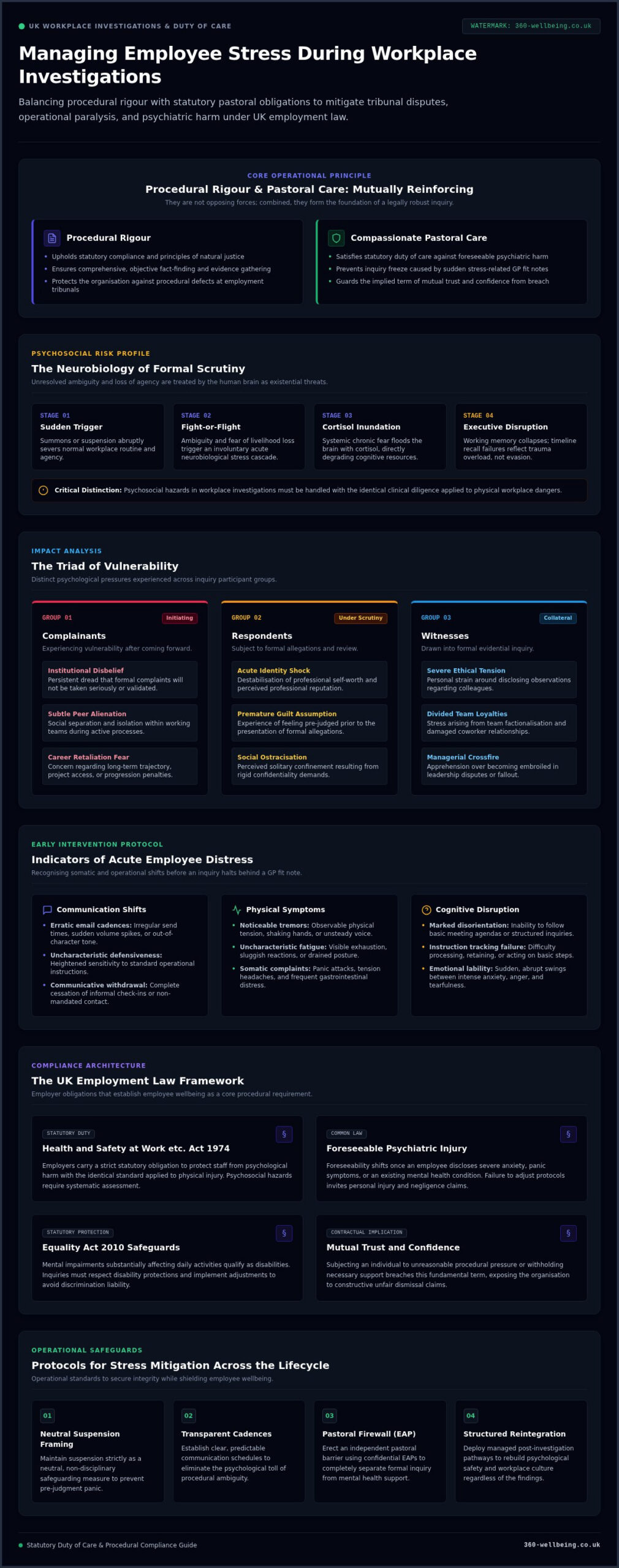
Workplace investigations inevitably introduce severe disruption to an employee’s sense of psychological safety. Often viewed strictly through a procedural or legal lens, formal inquiries trigger acute neurobiological stress responses. When an individual faces formal scrutiny, the brain interprets ambiguity and loss of agency as an existential threat, initiating an involuntary fight-or-flight cascade. Addressing these severe pressures requires psychosocial hazards in the workplace to be treated with the same clinical diligence as physical workplace dangers.
For organisations, unmanaged distress rarely stays contained. When internal tension peaks, investigations slow to a crawl, administrative costs mount, and key personnel disengage or resign. Strict confidentiality protocols, while legally essential, frequently mutate into perceived solitary confinement. Without intentional pastoral interventions, managing employee stress during workplace investigations becomes reactive damage limitation rather than proactive governance.
The Anatomy of Investigation Stress: Why Formal Procedures Overwhelm
Sudden suspensions and formal interview summons sever normal daily routines instantly. Employees often experience an overwhelming fear of reputational damage and catastrophic loss of livelihood. This chronic fear state floods the system with cortisol, directly degrading working memory and executive functioning. Consequently, an employee struggling to recall precise dates or timelines during a disciplinary interview is frequently suffering from trauma-induced cognitive overload rather than demonstrating calculated evasion.
The Triad of Vulnerability: Complainants, Respondents, and Witnesses
Every participant in a workplace inquiry experiences distinct psychological pressures:
- Complainants: Grapple with persistent dread of institutional disbelief, subtle peer alienation, and career retaliation.
- Respondents: Suffer acute identity shock, feelings of premature guilt, and social ostracisation while awaiting formal allegations.
- Witnesses: Experience severe ethical tension, navigating divided team loyalties and fear of being drawn into managerial crossfire.
Early Behavioural and Physical Indicators of Acute Employee Distress
Skilled managers must spot distress early, long before an unexpected fit note halts an active inquiry. Effective protocols for managing employee stress during workplace investigations rely on recognising subtle somatic and operational shifts:
- Communication shifts: Highly erratic email patterns, uncharacteristic defensiveness, or complete communicative withdrawal.
- Physical symptoms: Noticeable tremors, uncharacteristic fatigue, panic attacks, or frequent digestive and tension-related complaints.
- Cognitive disruption: Marked disorientation in basic meetings, inability to track simple instructions, or sudden emotional lability.
The Legal Framework: Employer Duty of Care Under UK Law
UK employment law places employee wellbeing at the centre of formal procedural compliance. Under the Health and Safety at Work etc. Act 1974, businesses carry a statutory obligation to protect staff from psychological harm as well as physical injury. Paired with common law principles guarding against foreseeable psychiatric injury, managing employee stress during workplace investigations is a non-negotiable legal duty. Withholding support or subjecting an employee to unreasonable procedural pressure risks breaching the implied term of mutual trust and confidence, exposing the business to costly constructive unfair dismissal and personal injury claims.
Fulfilling this mandate requires actively operationalising the employer’s legal duty to protect workers from stress throughout the inquiry. Legal integrity and empathetic communication must operate together, ensuring principles of natural justice remain robust from start to finish.
Statutory Obligations and Foreseeability of Psychiatric Injury
Foreseeability shifts dramatically once an employee discloses severe anxiety, panic symptoms, or an existing mental health condition. Under the Equality Act 2010, mental health impairments that substantially impact daily activities may qualify as disabilities, legally obligating employers to enact reasonable adjustments. Conducting formal individual stress risk assessments the moment distress is flagged helps organisations demonstrate proactive risk mitigation, substantially reducing legal vulnerability.
Applying the Acas Code of Practice Fairly Under Duress
The Acas Code of Practice on disciplinary and grievance procedures explicitly dictates that matters must be handled without unreasonable delay. Prolonged timelines heighten anxiety and weaken procedural integrity. Employers protect both the process and participant wellbeing by upholding core standards:
- Clear communication: Deliver written notifications that outline specific allegations plainly, removing ambiguity without adopting an accusatory tone.
- Statutory accompaniment: Respect the absolute right to be accompanied by a trade union representative or certified workplace colleague to ensure procedural fairness.
- Impartial evidence gathering: Give all parties adequate time and space to present their version of events in a balanced, objective forum.
Managing Fit Notes and Medical Sickness During Active Investigations
Receiving a GP fit note citing work-related stress during an ongoing inquiry often leaves HR teams uncertain about how to proceed. It is vital to remember that an employee certified as unfit for their standard contractual duties may still possess the capacity to participate in an adapted investigation. Rather than pausing indefinitely, which often intensifies distress, consider proportionate adjustments:
- Offering written representations instead of high-pressure oral hearings.
- Permitting frequent pauses and comfort breaks during formal discussions.
- Utilising independent clinical guidance and confidential resources via integrated employee mental health support to assess fitness to participate without managerial bias.
Operational Strategies to Mitigate Stress Across the Investigation Lifecycle
Transforming an inquiry from an adversarial trial into an objective fact-finding exercise requires structured operational planning. Procedural fairness alone is insufficient if the journey leaves participants psychologically drained. Effective strategies for managing employee stress during workplace investigations embed emotional intelligence directly into administrative steps, protecting human dignity without blunting investigative rigor.
One decisive operational measure is establishing dedicated communication liaisons. Separating the investigator from day-to-day administrative check-ins creates an essential buffer. While investigators remain focused on dispassionate evidence collection, dedicated liaisons offer neutral points of contact, ensuring participants receive routine procedural guidance without fear of compromising their testimony.
Pre-Investigation Protocols: Framing and Neutral Communication
Setting the proper tone early prevents catastrophic spirals. Terms of reference must employ measured, non-judgmental language rather than inflammatory accusations. When temporary suspension is unavoidable to protect evidence or personnel, employers must handle it with extreme discretion. Communicate suspensions explicitly as neutral risk management rather than disciplinary sanctions, and provide seamless operational cover stories to colleagues to protect the individual’s workplace standing.
Conducting Empathetic, Objective Investigation Interviews
Interview logistics dictate psychological reactions. Holding sessions in sterile, glass-walled office suites often fuels anxiety. Instead, choose private, discreet environments or secure video links that guarantee absolute confidentiality. During the interview itself, small practical adjustments preserve focus and composure:
- Provide complex documentation or evidence bundles at least 24 hours in advance, allowing participants to process materials without cognitive overwhelm.
- Permit mandatory comfort breaks every 45 minutes, or whenever emotional agitation appears.
- Adopt open, non-confrontational questioning formats that invite factual narratives rather than defensive rebuttals.
Maintaining Momentum: Eliminating Damaging Procedural Delays
Silence breeds panic. Lengthy delays between interviews allow worst-case scenarios to take root in an employee’s mind. Successful frameworks for managing employee stress during workplace investigations introduce strict internal service-level agreements for evidence gathering. If an unavoidable roadblock occurs, implement a mandatory weekly holding update. Even a brief note confirming that the review continues reassures participants that their lives are not left in permanent administrative limbo.
Building a Safety Net: Independent Mental Health and Wellbeing Support
Investigative questioning and pastoral care cannot come from the same desk. When an HR officer or line manager attempts to interrogate factual events while offering emotional counsel, employees instinctively put up walls. Trust fractures. Effective frameworks for managing employee stress during workplace investigations establish an independent pastoral firewall, providing clinical, emotional, and practical care completely detached from disciplinary decision-making.
By surrounding employees with external clinical safety nets, employers neutralise accusations of bias while fulfilling their duty of care. A multi-layered support infrastructure addresses distress across physiological, psychological, and social dimensions.
Protecting Confidentiality Through Independent Health Services
Scepticism often prevents distressed employees from seeking internal help. They fear vulnerability will be weaponised or interpreted as an admission of guilt. Deploying a dedicated Employee Assistance Programme (EAP) guarantees absolute clinical confidentiality. Therapy sessions, structured counselling, and 24/7 crisis helplines operate behind strict ethical barriers. Disclosures made to external clinicians never enter investigative files or influence evidentiary findings, giving staff a genuinely safe space to decompress.
Utilising 24/7 Virtual GP Services for Rapid Clinical Triage
Stress during formal proceedings routinely triggers acute somatic reactions, from severe insomnia and migraine clusters to debilitating panic attacks. Relying on routine NHS appointments often leaves staff waiting weeks in acute distress, stalling proceedings indefinitely. Giving employees 24/7 access to UK-registered virtual GPs ensures prompt clinical evaluations when physical symptoms strike. Rapid triage helps clarify whether practical hearing adjustments or targeted medical interventions are needed, keeping the investigation moving without compromising staff welfare.
Addressing Tangential Stress: Legal Information and Financial Pressures
Inquiries rarely occur in isolation; they collide with personal lives. A respondent placed on precautionary suspension often panics about job security, household bills, and mortgage payments. Complainants might obsess over potential legal backlash. Comprehensive support must look beyond the immediate grievance. Offering independent legal support helplines demystifies personal rights, while life coaching builds personal resilience during turbulent periods.
Directing staff toward dedicated financial support and independent debt advice alleviates parallel household pressures that amplify workplace panic. To establish these vital protective firewalls across your organisation, explore 360 Wellbeing’s comprehensive employee support solutions and protect your team before acute crises unfold.
Post-Investigation Reintegration: Healing and Cultural Restoration
Delivering an investigation outcome does not automatically resolve workplace trauma. While an investigative report legally concludes formal findings, the emotional repercussions often linger across teams for months. Managing employee stress during workplace investigations requires a deliberate post-inquiry phase focused on restoring psychological safety, mending fractured relationships, and reinforcing cultural stability across the wider organisation.
Without proactive reintegration, returning employees frequently battle profound feelings of isolation, vulnerability, and resentment. Rebuilding workplace trust demands structured, compassionate management rather than expecting teams to return to business as usual overnight.
Delivering Findings and Managing the Immediate Emotional Aftermath
Outcome meetings require exceptional emotional sensitivity and preparation. Deliver written determinations accompanied by clear, balanced rationales so participants understand the evidence base behind every decision. Train line managers to hold these discussions with steady empathy, allowing individuals sufficient time to process grief, anger, or relief without defensive interruptions. Maintain active check-ins throughout subsequent appeal windows, ensuring that pastoral care remains continuous even when findings prove challenging.
Structured Reintegration and Workplace Relationship Repair
Bringing an exonerated respondent or an anxious complainant back into the daily workflow requires methodical planning. Adopting structured protocols eases this delicate transition:
- Phased returns: Introduce flexible hours or temporary hybrid arrangements following protracted suspensions to rebuild confidence gradually.
- Workplace mediation: Engage independent, accredited mediators to facilitate structured dialogues between disputing colleagues, resolving underlying friction before it escalates.
- Anti-victimisation boundaries: Reiterate strict, zero-tolerance standards against office gossip, subtle ostracisation, or retaliatory behaviour, protecting participants from secondary victimisation.
Embedding Long-Term Cultural Resilience Across the Organisation
Formal investigations often illuminate broader organisational vulnerabilities. Use post-investigation debriefs to pinpoint recurring friction points, training managers in early dispute resolution before grievances formalise. Sustained success in managing employee stress during workplace investigations lies in embedding proactive wellbeing architectures into the regular workplace routine. Providing ongoing access to comprehensive mental health services, virtual GP consultations, and independent advice helplines ensures staff retain the psychological stamina required to thrive through operational challenges.
Building a Resilient Framework for Fair, Empathetic Investigations
A rigorous workplace inquiry doesn’t have to come at the expense of your people’s psychological wellbeing. By establishing independent pastoral boundaries, maintaining clear communication cadences, and prioritising post-inquiry restoration, you protect your organisation from costly tribunal claims while honouring your statutory duty of care. Successfully managing employee stress during workplace investigations isn’t merely about legal compliance; it’s about safeguarding workplace trust and operational momentum when pressure runs high.
Empowering your workforce requires an all-encompassing safety architecture that operates before, during, and after acute crises. With round-the-clock access to 24/7 UK-registered Virtual GPs, a comprehensive Employee Assistance Programme staffed by accredited therapists, and a holistic wellbeing platform supporting physical, mental, and financial health, you can insulate your team from severe trauma while conducting balanced, unimpeachable procedures. Discover how 360 Wellbeing protects your team’s mental health and build an organisation where natural justice and authentic care go hand in hand.
Frequently Asked Questions
Can an employee refuse to attend an investigation meeting due to work-related stress?
No, an employee cannot indefinitely refuse to attend, but employers must assess their medical fitness before proceeding. When stress is cited, explore reasonable adjustments like offering written representations, permitting virtual attendance, or allowing a supportive companion. Obtaining prompt clinical guidance through a virtual GP or occupational assessment clarifies whether participation is medically safe or poses a genuine risk of psychiatric harm.
Is an employer legally obligated to pause an investigation if a doctor issues a fit note?
Not necessarily, as being signed off from daily contractual duties doesn’t automatically mean someone cannot participate in an inquiry. Pausing proceedings indefinitely often compounds anxiety and breaches Acas guidelines against unreasonable delays. Effectively managing employee stress during workplace investigations involves evaluating whether the individual can review evidence in writing, submit written statements, or attend shortened sessions with structured comfort breaks.
What happens if an employee experiences a severe panic attack during an interview?
Immediately halt the interview, offer privacy, and provide access to appropriate medical or pastoral care. Never pressure an employee to push through acute physiological distress. Document that the meeting was paused for welfare reasons, offer water in a quiet setting, and signpost immediate clinical help via a 24/7 Virtual GP or Employee Assistance Programme before rescheduling.
Can offering emotional support to a respondent be perceived as pre-judging guilt?
No, providing pastoral support does not indicate pre-judgment when it is handled independently from the factual investigation. Employers protect procedural neutrality by establishing separate support channels, such as an external Employee Assistance Programme or an unaligned workplace liaison. Remind all parties that access to mental health counselling is an absolute duty-of-care entitlement, not a determination of innocence or guilt.
How can HR maintain investigation confidentiality without making the employee feel isolated?
HR can preserve confidentiality while preventing isolation by establishing scheduled, predictable communication touchpoints with an independent welfare contact. Instruct employees not to discuss case details with peers, but clearly specify safe outlets, including union representatives, external counsellors, and designated HR liaisons. Proactive weekly updates prevent silence from feeling punitive, which is essential when managing employee stress during workplace investigations.
Is suspension appropriate if an employee is already experiencing severe acute anxiety?
Suspension must remain a rare, precautionary measure of last resort rather than a default reaction. Suspending an already anxious individual often accelerates acute distress, compounding feelings of shame and isolation. Explore non-punitive operational alternatives first, such as temporary role reassignments, adjusted reporting lines, or remote working arrangements. If suspension proves unavoidable, explicitly frame it as neutral risk management.
What reasonable adjustments should employers make for neurodivergent staff facing an investigation?
Employers should adapt investigation formats to accommodate distinct cognitive, sensory, and communication profiles under the Equality Act 2010. Effective adjustments include distributing interview questions and evidence bundles well in advance, avoiding figurative language, and allowing extra processing time. Providing quiet interview rooms, scheduling frequent pauses, and permitting written evidence over rapid oral questioning helps prevent severe sensory or cognitive overwhelm.