
A salary advance can ease an immediate cash-flow problem, but it shouldn’t become an informal fix for recurring financial strain. In the UK, employers aren’t legally required to offer advances; when they do, clear written terms should explain the repayment and any payroll deductions. Knowing how to handle employee requests for pay advances means balancing a fair, consistent process with a thoughtful response to the person behind the request.
It’s understandable to want to help when an employee faces a bill before payday. But a pay advance, a loan and earned wage access work differently, and each can affect when and how someone receives or repays money. Explaining the options clearly helps employees make informed decisions without adding confusion to their finances.
This guide compares those options, outlines practical ways to handle requests and explains what repeat requests may indicate about financial wellbeing. It also covers transparent repayment terms and empathetic, consistent responses across your team.
Key Takeaways
- Set a consistent written process for reviewing requests, agreeing repayment terms and recording advances through payroll.
- Understand how an advance differs from a loan or earned wage access before deciding which option may suit an employee’s needs.
- Treat repeat requests as a reason for a supportive conversation about underlying financial pressures, not simply as a payroll issue.
- Consider how employee support, including an Employee Assistance Programme, can complement clear pay policies and promote wellbeing.
1. What is a salary advance?
A salary advance is part of an employee’s wages paid before their usual payday. UK employers aren’t required to offer advances, so a written policy helps staff understand eligibility, how decisions are made and when repayment is due. A consistent approach to how to handle employee requests for pay advances starts with a formal written request to the employer or payroll team.
Before approving a request, record the amount and get the employee’s written agreement to the repayment method. Explain when the advance will be paid, whether it will be recovered in one deduction or across pay periods, and how each deduction will affect take-home pay. Keep the agreement with the employee’s records so both sides can refer to it if questions arise.
Process the payment through payroll rather than handling it informally. A salary advance is a pre-payment of wages, so usual PAYE tax and National Insurance deductions apply. Record it clearly and include it in the Full Payment Submission for the relevant period. If the regular pay run has closed, an additional payment may be needed, with the RTI report showing the correct payment date. Delayed reporting rules may apply to qualifying advances.
Consider payroll timing and cash flow: paying wages early can leave less for the next payday, while manual adjustments raise the risk of mistakes. A dedicated payroll category helps distinguish advances from regular wages and track repayment. Explain the payslip entry and check that the agreed deduction matches the balance owed.
Late or incorrect payroll information submissions can bring penalties of £100 to £400 per month, depending on the number of employees. Separately, tax and National Insurance payments more than six months late incur an additional penalty of 5% of the unpaid amount. Accurate records and timely payroll processing help reduce these risks.
2. Salary advances compared with loans and earned wage access
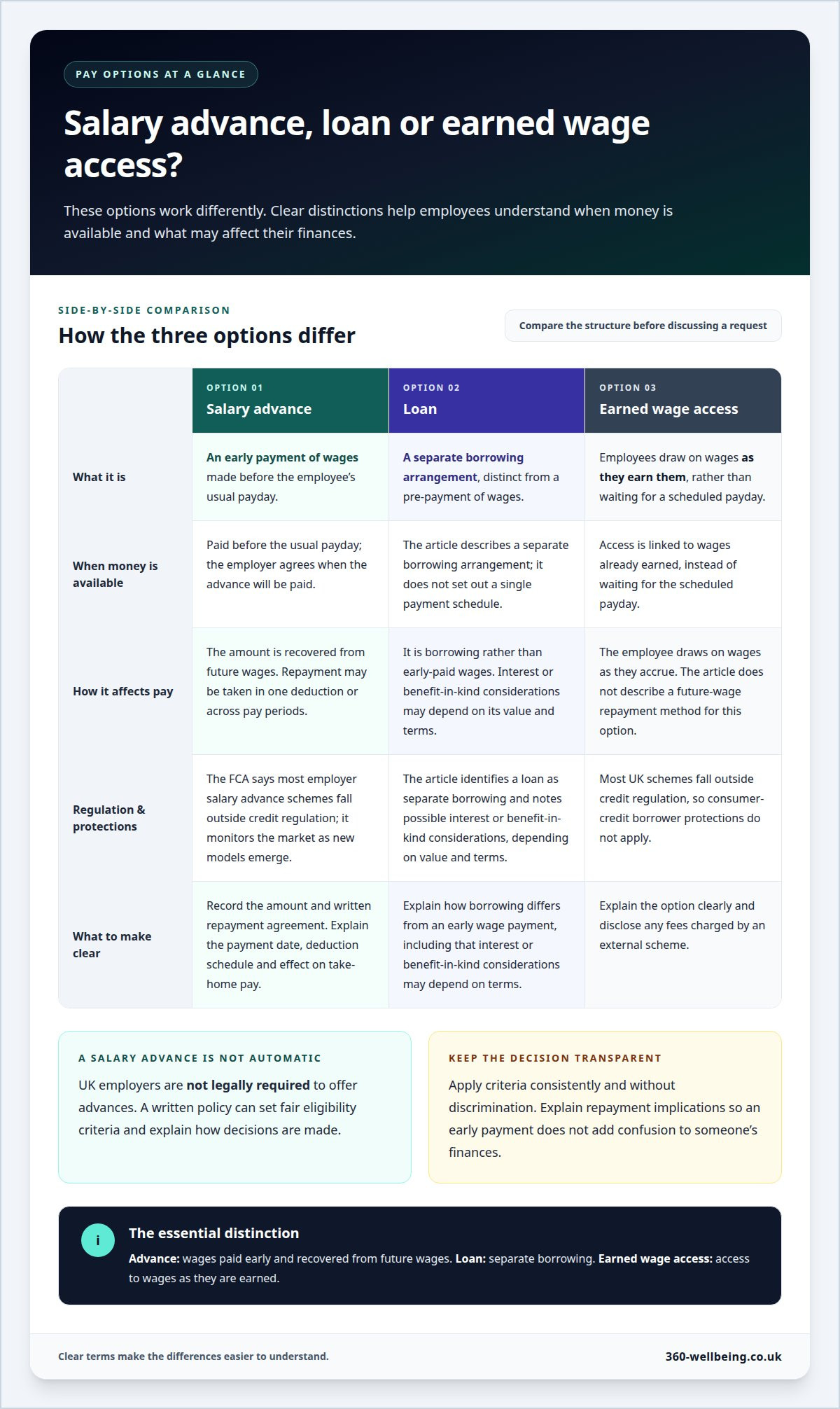
A salary advance can be understood as an early payment of wages, distinct from a conventional loan. The employer pays an employee before their usual payday, then recovers the amount from future wages. A loan is a separate borrowing arrangement and may involve interest or benefit-in-kind considerations, depending on its value and terms.
Earned wage access works differently: employees draw on wages as they earn them rather than waiting for a scheduled payday. Most UK earned wage access schemes fall outside credit regulation, so consumer-credit borrower protections don’t apply. The Financial Conduct Authority says most employer salary advance schemes also fall outside credit regulation, while it monitors the market as new models emerge.
Reporting arrangements have changed over time. Before 6 April 2024, UK employers had to submit an additional Full Payment Submission for salary advances. In September 2023, HMRC issued draft regulations proposing that advances no longer needed separate reporting before contractual payday. Under the proposed approach, employers would report the full contractual salary once, on payday. Delayed reporting applies only when conditions are met, including regular salary intervals between one week and one month.
Employees may request an advance to manage bills or everyday spending between paydays. A policy should set fair eligibility criteria, explain any fees charged by an external scheme and avoid discrimination based on personal circumstances. Consider whether requests point to cash-flow pressure that a one-off payment won’t resolve. Distinguishing an advance from a loan or earned wage access helps employees understand the options and repayment implications.
Pairing a transparent pay policy with employee wellbeing support can help address financial pressure beyond the immediate payment.
3. Handling repeat requests and employee financial wellbeing
Handle repeat requests consistently and have a private, non-judgemental conversation. Apply the same written eligibility rules, then ask whether the employee would like to explain what is making it difficult to manage money between paydays. They don’t need to share personal details to receive a fair decision.
Look for patterns rather than treating each request as an isolated payroll task. For example, repeated advances for household bills or everyday costs may suggest that an early payment isn’t resolving the underlying cash-flow pressure. Before agreeing to further support, discuss how another deduction could affect the employee’s next take-home pay.
A policy can set a frequency limit, such as one advance per quarter, and explain how repeat applications are considered. Another option is a six-month interval between advances. These are policy choices, not universal rules. Choose an approach that fits payroll operations, explain any exceptions and apply the criteria consistently without discrimination.
Employers may also set an advance cap at 30-50% of earned net pay. If using a cap, define how payroll calculates available earnings, especially for employees with variable hours. A written limit can help prevent an advance from leaving too little salary for the next pay period. Make the repayment schedule clear before any decision is final.
Keep the approval decision separate from the wellbeing conversation. A manager can explain the policy, while a confidential support route gives the employee space to discuss money worries without making disclosure a condition of approval. Financial Support & Debt Advice can help employees explore budgeting or debt concerns, while an Employee Assistance Programme offers a broader confidential support route. Keep access to support separate from payroll records and decisions.
Review request patterns periodically, for example as part of a policy review, while protecting employee privacy. If requests cluster around the same point in the pay cycle, consider whether budgeting support or wider financial wellbeing resources could help employees plan ahead for bills. Record policy changes and communicate them to the whole workforce.
4. What UK payroll and HMRC rules apply when repaying a pay advance?
Record the advance and repayment clearly in payroll, then show the deduction on the employee’s payslip. Explain when repayment starts, whether it comes from one pay packet or several, and how it affects take-home pay. Keep the written agreement with the payroll record. This helps both sides understand the outstanding balance and repayment schedule.
A salary advance is a pre-payment of wages, so usual PAYE tax and National Insurance deductions apply. Tax on wages paid earlier than usual is generally calculated at the time of payment. Keep the advance in payroll records so it counts towards the employee’s total earnings for the tax year. For an early wage payment repaid within the same pay cycle, pension auto-enrolment calculations usually remain based on total earnings as normal.
Under current UK reporting rules, submit an RTI Full Payment Submission on or before each occasion money is paid. For qualifying salary advances, reporting can be delayed until the remaining salary instalment is paid, so only one report is expected for each pay period. This applies when the advance reasonably represents work already undertaken or obligations performed under the contract, and no other relevant payment has been made.
When using delayed reporting, reduce the regular payday payment by the amount of advances already paid. For example, if an employee receives an advance during the period, the next salary instalment must reflect it. If a third party pays an advance for the employer, the employer still has the reporting obligation. Record the payment date and adjustment consistently.
If an arrangement resembles a loan rather than an advance of earned wages, employment-income rules may need consideration. A properly documented advance repaid within the next pay period will not usually create additional tax charges for an SME. For a complicated repayment or reporting arrangement, take payroll advice before processing it. Explore employee financial wellbeing support alongside clear payroll procedures.
360 Wellbeing: Employee Assistance Programme (EAP)
360 Wellbeing’s Employee Assistance Programme (EAP) can complement a clear pay-advance policy when employees need support beyond a payroll decision. If repeat requests point to financial worries, Financial Support & Debt Advice can help employees explore their situation and possible next steps. Mental Health Support may also be relevant when money pressures are affecting wellbeing.
These options don’t replace fair, consistent decisions or clear repayment terms. They can help employers support employees while keeping financial wellbeing in view. Consider them when an employee could benefit from guidance alongside a practical conversation about pay.
To discuss support for employee wellbeing, contact 360 Wellbeing.
Build a workplace where support is part of the plan
A consistent framework for how to handle employee requests for pay advances can form part of a wider commitment to employee wellbeing. Make support easy to understand and access, so employees can seek help before financial pressure affects their confidence or focus at work.
360 Wellbeing can complement that approach with an Employee Assistance Programme, Mental Health Support and 24/7 Virtual GP access. 360 Rewards can also provide employees with access to a discount marketplace. Together, these options help employers consider wellbeing across more than one aspect of working life, while keeping pay decisions clear and consistent.
Choose support that fits your organisation’s priorities and explain it clearly to employees. A considered approach can help people feel more comfortable seeking guidance and enable managers to respond with care.
Contact 360 Wellbeing for support and take a positive next step towards a more supportive employee experience.
Frequently Asked Questions
What is a salary advance?
A salary advance is wages paid to an employee before their regular payday. For example, an employee may receive part of their pay early to cover an expense, with the amount accounted for against later wages. It’s not an extra payment on top of salary: an advance brings pay forward rather than increasing the employee’s agreed earnings.
What UK laws apply to employers providing pay advances?
UK employers aren’t legally required to provide salary advances. If an employer chooses to offer them, written policy terms can explain eligibility, approval and repayment. A deduction should be supported by the employee’s written agreement. The substance of the arrangement also matters: if it resembles a loan rather than an early payment of wages, employment-income rules may need consideration.
Can UK employers deduct a salary advance from an employee’s wages?
Yes. An employer can recover an advance through future wages when the employee has agreed to the deduction in writing. The agreement should set out the amount and repayment timing, so the employee understands what will be taken from each pay packet. Repayments might be made in one deduction or split across later pay periods, as agreed.
How should employers assess and approve requests for pay advances?
Use the same written criteria for each request, then assess the amount requested, wages already earned and likely effect on the employee’s next take-home pay. A request form can capture the reason, amount and preferred repayment approach without asking for unnecessary personal details. For variable-hours staff, base the decision on wages earned and the employer’s policy.
What repayment schedules and limits are typical for UK salary advances?
There’s no single standard schedule or limit for every UK employer. Policies may allow one advance per quarter or cap an advance at 30-50% of earned net pay. Repayment may be taken in one agreed deduction or spread over pay periods. For variable-hours employees, the available earned wages and expected next payment can shape a practical schedule.
Are pay advances taxable or subject to National Insurance in the UK?
Yes. A salary advance treated as an early payment of wages is subject to usual PAYE tax and National Insurance deductions. Tax on wages paid earlier than usual is generally calculated at the time of payment. Record the advance in payroll so it is reflected in the employee’s earnings for the tax year.