
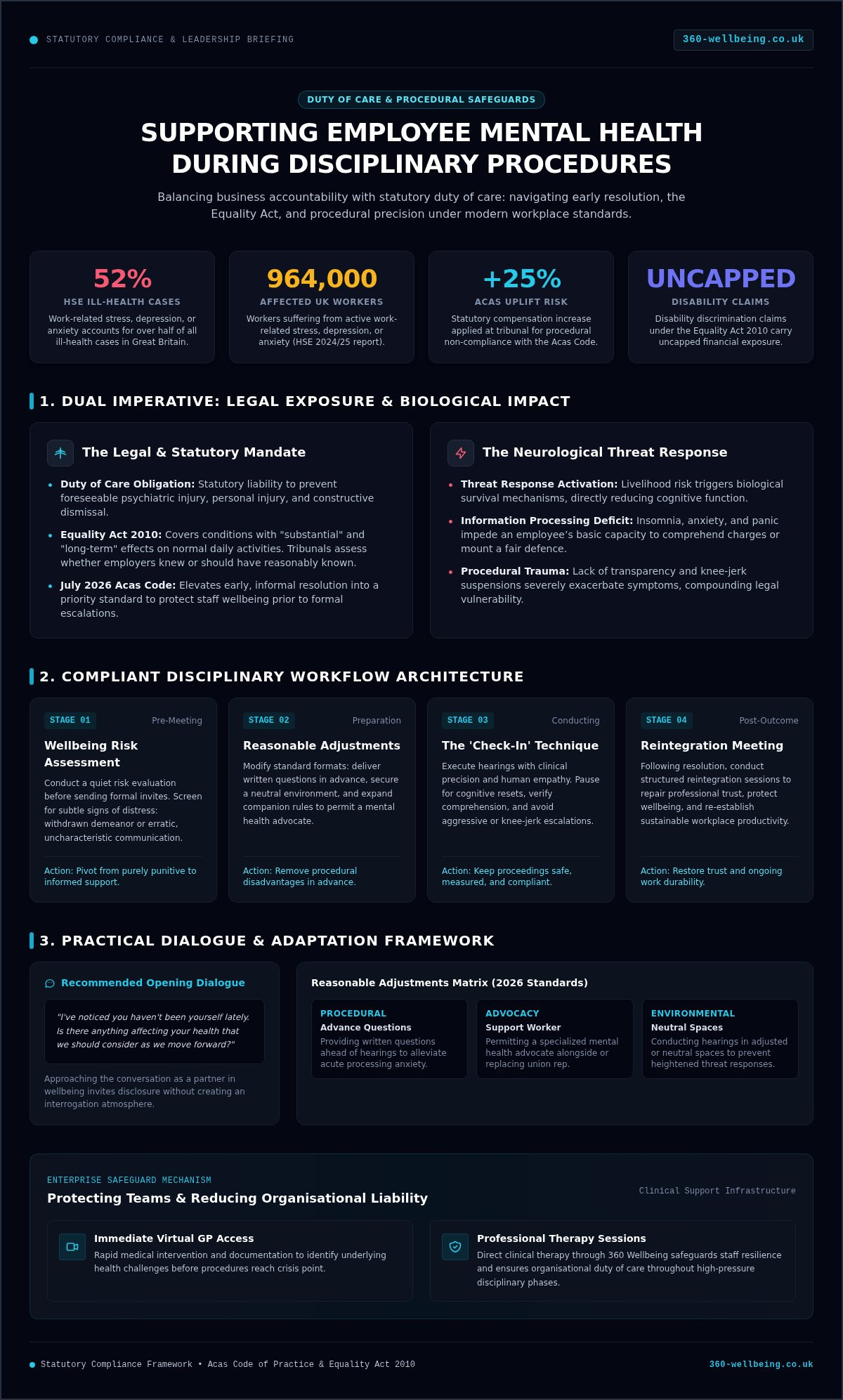
Did you know that by 2026, work-related stress, depression, or anxiety accounted for 52% of all work-related ill-health cases in Great Britain? When you’re tasked with addressing conduct or performance, the stakes are higher than ever. You aren’t just managing a process; you’re managing a person’s wellbeing. Effectively supporting employee mental health during disciplinary procedures is now a core management competency rather than an optional act of kindness. Failing to get this right doesn’t just risk a vulnerable person’s health; it also exposes your organisation to significant legal risks, including uncapped disability discrimination awards and the 25% Acas compensation uplift for procedural non-compliance.
It’s understandable if you feel anxious about “breaking” a struggling team member or getting lost in the confusion between genuine mental health symptoms and poor performance. You want to be a supportive leader, but you also have a business to run and productivity targets to meet. This guide will show you how to bridge that gap. You’ll learn how to fulfill your duty of care, implement essential reasonable adjustments in line with the latest 2026 regulations, and navigate these sensitive conversations with confidence. We’ll provide a structured path forward that keeps your procedures compliant while ensuring every employee feels seen, heard, and supported throughout the process.
Key Takeaways
- Understand your legal duty of care in a 2026 workplace context and why the updated Acas Code now prioritises early, informal resolution to protect staff wellbeing.
- Learn practical strategies for supporting employee mental health during disciplinary procedures, including how to conduct a pre-meeting risk assessment to identify hidden vulnerabilities.
- Master the ‘Check-in’ technique to ensure formal meetings are conducted with clinical precision and human empathy, keeping the process safe and compliant.
- Discover how to manage the ‘Reintegration Meeting’ to rebuild trust and maintain productivity after a disciplinary outcome has been reached.
- Explore how providing immediate access to a Virtual GP and professional therapy sessions through 360 Wellbeing can safeguard your team and your business during high-pressure periods.
Understanding Your Duty of Care During Disciplinary Procedures
For any manager, a disciplinary meeting is a formal administrative process. For the employee, it’s often the most stressful event of their professional life. Your legal duty of care isn’t just a corporate phrase; it’s a statutory obligation to prevent foreseeable physical or psychiatric injury to your staff. In the 2026 workplace, supporting employee mental health during disciplinary procedures is a core legal necessity. If a process triggers a mental health crisis, you risk more than just a damaged relationship. You risk costly tribunal claims for personal injury or constructive dismissal that can devastate a company’s reputation and finances.
The Legal Framework: ACAS and The Equality Act
Under the Equality Act 2010, many mental health conditions qualify as disabilities if they have a “substantial” and “long-term” effect on daily activities. Tribunals now scrutinise whether an employer knew, or should have reasonably known, about these conditions before starting a formal process. The updated July 2026 Acas Code of Practice prioritises early, informal resolution as a statutory requirement. Failing to follow these steps can lead to a 25% uplift in compensation awards if a case reaches a tribunal. Reasonable adjustments in 2026 mean modifying the standard disciplinary process to remove disadvantages faced by employees with mental health conditions, such as providing written questions in advance or allowing a support worker to attend the hearing.
The Psychological Impact of Disciplinary Action
Disciplinary action triggers a deep-seated “threat response” in the human brain. According to the HSE 2024/25 annual report, 964,000 workers suffered from work-related stress, depression, or anxiety, accounting for 52% of all ill-health cases. When an employee feels their livelihood is at risk, their cognitive function often drops. They might experience insomnia, panic attacks, or severe anxiety, which makes it harder for them to process information or defend themselves fairly. Procedural unfairness, such as a lack of transparency or “knee-jerk” suspensions, significantly worsens these symptoms. By prioritising clear communication and empathetic check-ins, you reduce the psychological load and ensure the process remains focused on resolution rather than punishment.
Balancing business accountability with empathy is a skill that protects everyone involved. You don’t have to choose between maintaining standards and being a compassionate leader. When you approach these sensitive situations with clinical precision and a human touch, you create a culture of safety. This foresight ensures that even when difficult conversations are necessary, they are handled with the durability and care that modern corporate wellness demands.
Preparing for the Meeting: Identifying Vulnerabilities and Adjustments
Preparation is the foundation of a fair and durable process. Before any formal invitation is sent, a manager should conduct a quiet wellbeing risk assessment. This isn’t a complex clinical audit. It’s a methodical check to see if the employee shows signs of distress that might impede their ability to engage fairly. Are they unusually withdrawn? Is their communication erratic or uncharacteristically emotional? Spotting these subtle signs early allows you to pivot from a purely punitive approach to one of informed support. Supporting employee mental health during disciplinary procedures starts long before you sit down in the meeting room.
When you need to ask about their health, approach the conversation as a partner in their wellbeing. You might say, “I’ve noticed you haven’t been yourself lately. Is there anything affecting your health that we should consider as we move forward?” This opens the door for disclosure without making the employee feel interrogated. Remember that under 2026 standards, the role of the companion can be expanded. While the law specifies a colleague or union representative, allowing a mental health advocate can provide the emotional stability needed for a productive and calm hearing.
Implementing Reasonable Adjustments Pre-Meeting
Adjusting the environment is often the simplest way to reduce acute anxiety. You might hold the meeting in a quiet, neutral venue or offer a remote option if the workplace itself has become a source of stress. Providing the agenda and all evidence well in advance is a vital step in providing reasonable adjustments for mental health. This gives the individual necessary time to process information without the pressure of an immediate, high-stakes response. You should also consider allowing more frequent breaks or even a supportive neutral observer to ensure the tone remains professional and safe.
Training Managers to Spot Red Flags
Distinguishing between “difficult” behaviour and symptoms of a condition like clinical depression or neurodivergence is a critical management skill. If an employee becomes defensive or loses focus during an investigation, it may not be misconduct. It could be cognitive overload. If you’re unsure of the underlying cause, it’s always safer to pause the procedure. Seeking clinical advice through a 24/7 Virtual GP ensures you have the foresight to handle the situation correctly before it escalates. A calm, methodical communication rhythm prevents the threat response from taking over, keeping the focus on a sustainable resolution for both the business and the individual.
Conducting the Disciplinary Meeting with Empathy and Precision
The meeting room is where policy meets reality. Supporting employee mental health during disciplinary procedures isn’t about avoiding the facts; it’s about how you present them. You should set a tone that is calm and methodical, moving away from a punitive atmosphere toward one of structured problem-solving. An expert caregiver persona helps here. You aren’t just an adjudicator. You’re a leader ensuring the process remains safe, fair, and human. When the environment feels safe, employees are more likely to engage honestly, which leads to more accurate outcomes for the business.
One effective tool is the ‘Check-in’ technique. Start the meeting by asking how the employee is feeling and if they’re fit to continue. Don’t just tick a box. Listen to the answer. If they’re visibly shaking or unable to make eye contact, acknowledge it. End the meeting the same way. This ensures the individual doesn’t leave the room in a state of high distress without a clear path to support. It maintains the psychological contract even during difficult conversations.
Active encouragement of the right to a companion is also vital. In 2026, many managers still treat this as a legal formality. Instead, frame it as an essential emotional safety net. A companion provides a steadying presence that can prevent emotional shutdowns or defensive outbursts. If the employee arrives alone, ask if they’re sure they don’t want someone there for support. This small gesture demonstrates that you value their wellbeing over rushing through a checklist.
Communication Strategies for High-Stress Meetings
Your language choice directly impacts the employee’s threat response. Use “I” statements, such as “I’ve noticed a change in performance,” rather than “You’ve failed to meet targets.” This lowers defensiveness and keeps the conversation constructive. Active listening is your most powerful tool. Validate their perspective by saying, “I hear that you’ve been feeling overwhelmed.” You aren’t necessarily agreeing with the misconduct, but you’re acknowledging their lived experience. Delivering difficult news requires honesty and kindness. Be direct about the outcome, but explain the support available to help them move forward.
When to Adjourn: Prioritising Safety Over Process
There are moments when the process must stop. If an employee becomes hyperventilating, completely non-responsive, or expresses thoughts of self-harm, adjourn immediately. Following HSE guidance on mental health at work means recognising when a situation has become a health risk. Provide immediate access to your Employee Assistance Programme (EAP) or a confidential helpline. Don’t leave them in isolation after an adjournment. Schedule a brief, non-disciplinary welfare call for the next day to check on their safety and outline the next steps in a non-threatening way.
Post-Disciplinary Support: Rebuilding Trust and Wellbeing
Once the formal decision is delivered, the work of supporting employee mental health during disciplinary procedures shifts toward restoration. For employees who remain in the business, a “Reintegration Meeting” is essential. This isn’t a repeat of the disciplinary hearing. It’s a forward-looking consultation designed to identify the support needed to prevent future issues. You might discover that performance dips were linked to external factors like debt or family crisis. By integrating financial support tools into your response, you address the root cause rather than just the symptom. This panoramic approach ensures that the individual feels valued as a whole person, not just a resource to be corrected.
Don’t overlook the “survivors” of the process. When a colleague undergoes a disciplinary, the wider team often feels a ripple of anxiety or guilt. Transparent communication, within the bounds of confidentiality, helps maintain stability. Providing access to life coaching or therapy sessions can help both the individual and the team process the stress of the preceding weeks. This foresight builds a more durable culture where wellbeing is a professional necessity rather than a luxury. By proactively managing the aftermath, you prevent a cycle of low morale and repeat performance issues.
Rehabilitating the Employment Relationship
Successful rehabilitation requires clear, supportive goals. Instead of just monitoring failures, celebrate the small wins during regular check-ins. You must actively work to dismantle the stigma of disciplinary action within your workplace culture. If an employee feels “marked,” they’re less likely to engage fully with their work. Professional growth in 2026 requires a culture where mistakes are viewed as milestones for development rather than permanent stains on a career. This methodical focus on growth helps rebuild the psychological contract and restores the employee’s confidence in their role.
Managing the Impact of Termination on Mental Health
Even when a dismissal is the only viable path, your duty of care doesn’t abruptly end at the exit door. Providing “outplacement” wellbeing support can be a vital safety net for someone facing the trauma of job loss. Many modern employers now ensure that departed staff retain access to EAP resources for a grace period, such as three months, to help them navigate the transition. You must also consider the manager’s own mental health. Delivering a dismissal is emotionally taxing. Managers need their own space to decompress and process the stress of these high-stakes decisions. Explore how our holistic platform supports your entire team through every stage of the employment journey.
Leveraging 360 Wellbeing to Protect Your Team and Business
Integrating a digital health ecosystem into your HR workflow transforms the disciplinary process from a point of friction into a moment of managed care. Supporting employee mental health during disciplinary procedures is significantly easier when you have immediate access to clinical expertise. Our 24/7 Virtual GP service provides UK-registered doctors who can offer clinical advice and mental health referrals without the delays often found in traditional primary care. This speed is vital when you need to determine if an employee is fit to participate in a hearing or if an adjournment is medically necessary.
Direct access to BACP-accredited therapy sessions allows your staff to bypass long waiting lists, addressing symptoms of anxiety or depression before they lead to long-term absenteeism. The Employee Assistance Programme (EAP) serves as a neutral, confidential sanctuary where employees can process their feelings about the disciplinary process outside of the workplace hierarchy. This separation is essential for maintaining the psychological contract and ensuring that the individual feels supported even when their conduct is being questioned. By providing these tools, you move away from a reactive “crisis-only” model toward a proactive vision of workplace harmony.
A Proactive Safety Net for Managers
Using a comprehensive platform allows you to demonstrate a proactive duty of care if a case ever reaches an employment tribunal. In the 2026 legal environment, showing that you provided immediate, high-quality support can be a powerful defence against claims of procedural unfairness. It gives your managers the confidence to lead difficult conversations, knowing that expert third-party care is always available. This reduces the emotional burden on internal HR teams, allowing them to focus on policy while we focus on the person. It’s a partnership that ensures your business remains resilient and your staff remain protected.
Holistic Support: Beyond Just Mental Health
Often, performance issues are symptoms of wider life challenges that require more than just a clinical conversation. Our platform addresses these root causes through confidential debt helplines and legal support, helping employees resolve the underlying stressors that may have triggered the disciplinary in the first place. For those moving through a performance improvement plan, 1-to-1 life coaching provides a positive path for personal development and professional growth. This unified narrative of wellness ensures that every team member has the tools they need to succeed. Discover how our Employee Wellbeing Platform supports your whole team.
Cultivating Workplace Harmony Through Empathetic Leadership
Managing conduct or performance doesn’t have to come at the cost of a person’s wellbeing. By understanding your legal duty of care and implementing reasonable adjustments, you protect your organisation from tribunal risks while maintaining the dignity of your staff. Supporting employee mental health during disciplinary procedures is a commitment to a durable and human-centric culture. It ensures that even the most difficult professional moments are handled with the foresight and care they deserve.
You don’t have to navigate these complexities alone. Providing your team with a 24/7 UK-registered Virtual GP, confidential mental health support, and a comprehensive Employee Assistance Programme (EAP) creates a safety net for everyone involved. This panoramic approach to health transforms the workplace into a space where vitality and professional standards coexist. Protect your team and your business with our all-in-one wellbeing platform.
Let’s move forward with a proactive vision for workplace harmony. When you lead with empathy and precision, you build a foundation of trust that lasts long after the meeting ends. You have the power to turn a challenging process into a catalyst for positive growth and long-term resilience.
Frequently Asked Questions
Can an employee postpone a disciplinary meeting due to mental health?
Yes, an employee can request a postponement if they are medically unfit to attend. Under the 2026 Acas Code, you should act reasonably by considering a short delay or an alternative meeting format. While you have a business to run, forcing a meeting when someone is in crisis risks a tribunal finding of procedural unfairness. Supporting employee mental health during disciplinary procedures involves balancing these timelines with the individual’s current capacity to engage fairly.
What are reasonable adjustments for a disciplinary hearing for someone with anxiety?
Reasonable adjustments for anxiety include providing all meeting materials and questions at least 48 hours in advance to reduce the fear of the unknown. You might also move the meeting to a quiet, neutral venue or a remote setting. Allowing for regular ten minute breaks or permitting a mental health advocate to attend as a companion ensures the individual remains grounded and able to process the information without experiencing a panic attack.
Should I pause a disciplinary if an employee goes on stress leave?
You aren’t legally required to stop the process, but you must determine if the employee is fit to participate. Proceeding while someone is on stress leave without a medical assessment is high risk. You should use a 24/7 Virtual GP or Occupational Health service to get a clinical opinion. If they are unfit, pausing the procedure is a necessary step to fulfill your duty of care and avoid discrimination claims in the 2026 landscape.
Can an employee bring a therapist or mental health worker to a disciplinary meeting?
The statutory right is limited to a colleague or trade union representative, but you can choose to go beyond this. Allowing a therapist or mental health worker is a practical reasonable adjustment under the Equality Act 2010. This support can help keep the employee calm and focused, making the meeting more productive. It demonstrates that you are taking a panoramic view of their wellbeing rather than just following a rigid checklist.
How do I deal with an employee who claims stress only after a disciplinary is triggered?
You must treat the claim with the same level of care as one made earlier. While the timing may feel convenient, you cannot assume it’s a tactical move. Refer the employee to your EAP or Virtual GP for an immediate assessment. If a genuine condition is identified, you may need to adjust your process. Ignoring a legitimate health concern just because it was raised late can lead to costly injury to feelings awards at a tribunal.
Is it legal to discipline an employee for conduct caused by their mental health?
It is legal, but it requires extreme caution. You must prove that the disciplinary action is a proportionate response to the conduct. If the behaviour was a direct symptom of a disability, you must first show that you implemented all possible reasonable adjustments to support them. Disciplining someone for symptoms of their illness without prior support is often seen as discriminatory by employment tribunals in the current 2026 legal landscape.
How can an EAP help during a formal HR process?
An EAP acts as a vital, neutral third party during high-pressure HR events. It gives employees a confidential space to process their anxiety and receive professional therapy sessions away from the workplace. By supporting employee mental health during disciplinary procedures through an EAP, you ensure the individual has the emotional resilience to participate. This reduces the risk of the situation escalating into a long-term sickness absence or a total breakdown in relations.
What should I do if an employee mentions suicidal thoughts during a meeting?
You must stop the meeting immediately and prioritise the person’s safety. Do not leave the employee alone. Ask if they have a support network you can contact; or facilitate an immediate call to your EAP crisis line or 24/7 Virtual GP. If the risk is imminent, you should contact emergency services. The disciplinary process is secondary to the preservation of life and your fundamental moral and legal duty of care.