Could a new ache need urgent attention, or is physiotherapy a sensible first step? When symptoms leave you unsure, physiotherapy triage can help clarify what to do next by considering what you’re experiencing, how it affects you and how quickly you may need support.
It’s understandable to want a definite answer straight away, especially when pain is disrupting work, sleep or everyday tasks. Triage offers a structured way to discuss your concern and consider an appropriate next step. It isn’t the same as a full clinical assessment, and it can’t answer every health question, but it can help indicate when further assessment or urgent medical help may be needed.
In this guide, you’ll learn what physiotherapy triage is designed to do, what it can and can’t tell you, and which details about your symptoms can make the conversation more useful. We’ll also look at how urgency is considered and what different next steps might involve, so you can approach the decision with greater confidence. Physiotherapy can also form part of a broader approach to employee wellbeing, alongside support for other aspects of health.
Key Takeaways
- Physiotherapy triage can help you understand a musculoskeletal concern and consider a sensible next step.
- Explaining when symptoms began, how they affect daily activities and what has changed can make the conversation more useful.
- Triage helps guide decisions about urgency, but it isn’t a guarantee or a substitute for a full assessment.
- Knowing the difference between triage, assessment and treatment can help set clear expectations about what happens next.
- Physiotherapy can be part of a broader workplace wellbeing approach that recognises physical health alongside wider wellbeing.
What is physiotherapy triage, and when can it help?
An ache that makes walking uncomfortable, a stiff shoulder that limits reaching, or a change in how you move can leave you wondering what to do next. It may be hard to judge whether the concern needs attention or whether physiotherapy is a sensible place to start. You don’t need to know what is causing your symptoms before seeking guidance.
Physiotherapy triage is an initial process for understanding a person’s movement-related concern and helping guide an appropriate next step. It focuses on the symptoms, their effect on everyday life and relevant context. The purpose is to help consider what kind of support may be suitable, not to label every condition or promise a particular outcome.
It’s useful to distinguish triage from other stages of care. Triage is an initial guide; a comprehensive physiotherapy assessment explores a person’s health and physical function in greater depth. Diagnosis and treatment involve further clinical consideration and care where appropriate. Triage alone isn’t a full assessment, a treatment plan or a substitute for urgent medical help. For general background on the wider field, see Physical Therapy (Physiotherapy).
What questions does physiotherapy triage help answer?
A triage conversation can explore what you’ve noticed, when it began, whether it has changed and what makes it better or worse. It may also consider how the concern affects activities such as walking, lifting, sleeping or carrying out tasks at work. The aim is to understand the pattern and impact, rather than assume the same response fits everyone.
For example, someone with a recurring ache after a long day on their feet may be unsure whether to seek movement-related support. Explaining when the discomfort occurs, whether it eases with rest and how much it limits daily activity gives useful context for considering what to do next. The conversation is about understanding the concern, not automatically assigning a diagnosis.
When might someone consider physiotherapy triage?
You might consider seeking advice about a new, persistent or recurring movement-related concern, particularly if it is affecting activities that matter to you. The effect on everyday function can be useful context: perhaps you’re finding stairs harder, avoiding a usual activity or struggling with a task that was previously comfortable. These changes don’t establish a cause, but they help explain why you’re concerned and what you want to get back to doing.
Some symptoms may need urgent medical attention rather than a routine discussion about physiotherapy. If you’re worried that a health problem is urgent, seek appropriate urgent medical help; don’t wait for triage to determine whether emergency care is needed. Triage can help guide next steps for concerns within its scope, but it isn’t an emergency service.
- Note what has changed and when you first noticed it.
- Consider which everyday activities are affected and how.
- Share any concerns about worsening symptoms or urgency clearly.
There’s no need to arrive with a diagnosis or a perfect description. A clear account of what feels different is a helpful starting point for working out what may be appropriate next.
How does physiotherapy triage assess symptoms and urgency?
A useful triage conversation starts with what you’ve noticed, not with a medical label. Describe the concern in everyday language, explain how it affects you and share relevant health context. The nature and combination of symptoms can then help inform how urgent the concern may be and what next step could be appropriate.
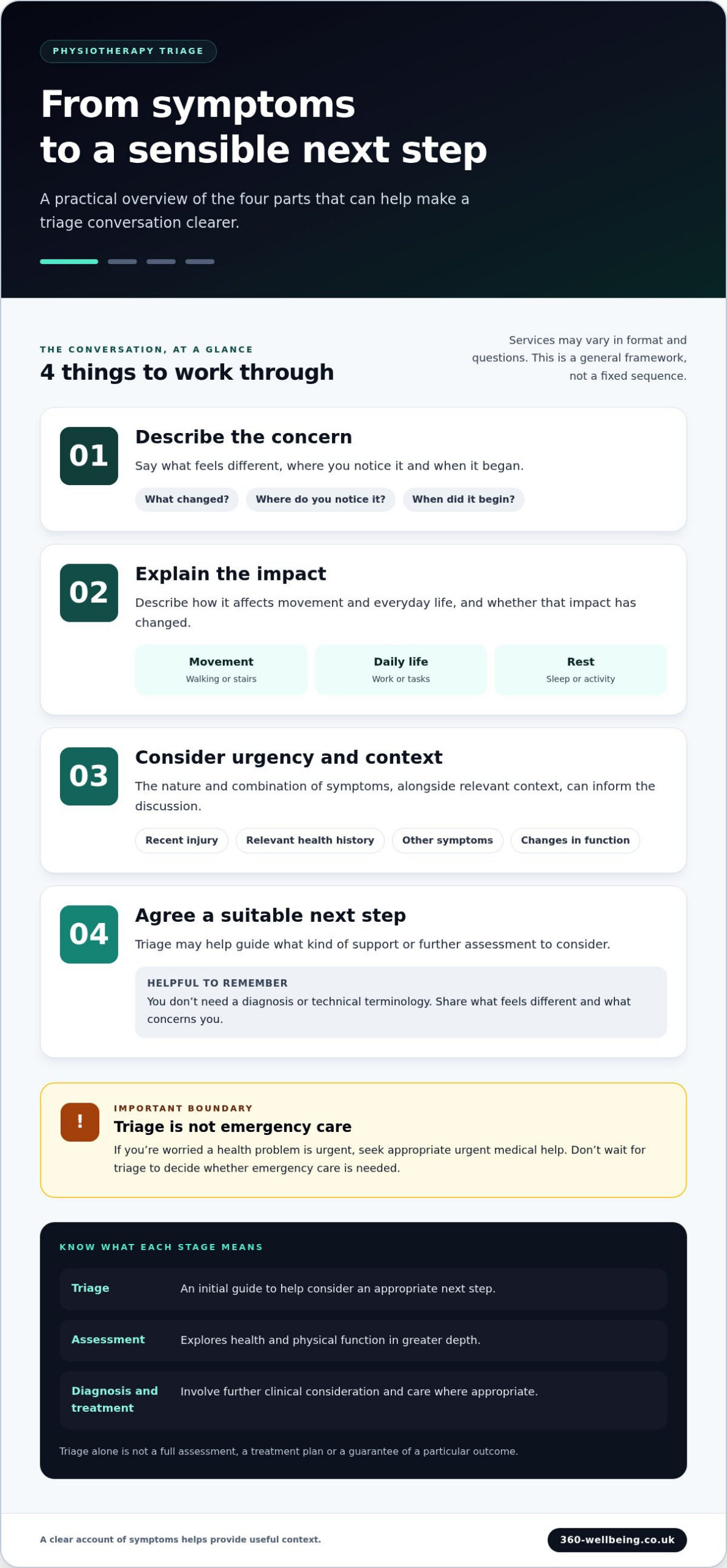
There isn’t one universal process used by every service. The format and questions can vary, but a general framework is:
- Describe the concern. Say what feels different, where you notice it and when it began.
- Discuss its impact. Explain how it affects movement, work, sleep or daily activities, and whether that impact has changed.
- Consider urgency and context. Relevant health history, a recent injury or other symptoms may help inform the discussion.
- Agree a suitable next step. The conversation may help guide what kind of support or further assessment to consider.
This sequence is a practical overview, not a promise that every service will follow the same steps or reach the same recommendation. A clinician may ask follow-up questions to understand the full picture, including changes in function and health factors that could affect the advice. If you’re unsure whether a detail matters, mention it rather than leaving it out.
Which details can help make a triage conversation clearer?
Think about when the concern started, whether it is improving, worsening or coming and going, and which activities are affected. Mention a recent injury, relevant health history or other symptoms if they may help explain the context. You don’t need technical terminology or a guessed diagnosis. A simple description, such as “my knee feels uncomfortable when I use the stairs”, is more useful than trying to name a condition.
If you’re unsure what matters, start with the change that prompted you to seek advice. You can also explain what you’re most concerned about, such as whether a new difficulty with movement needs further attention. Clear, honest details help the person speaking with you understand your priorities without you needing to work out the cause yourself.
How can triage help identify urgency?
Urgency depends on the nature of the symptoms and how they occur together, as well as relevant health context. A movement-related concern may be suitable for a non-emergency discussion, while other symptoms could call for prompt medical attention. Triage can help guide that distinction, but it cannot rule out every serious cause or replace emergency care.
If you think someone is experiencing a life-threatening emergency, call 999. For urgent medical advice that isn’t an emergency, use NHS 111. Don’t wait for a physiotherapy conversation if symptoms feel acutely serious or rapidly concerning.
For organisations considering how physical health support fits alongside wider employee wellbeing, the 360 Wellbeing platform brings physiotherapy together with other wellbeing support. Physiotherapy triage is a guide to next steps, not a diagnosis or treatment. A full clinical assessment may be needed to understand a concern in depth.
What physiotherapy triage can, and cannot, tell you
It’s natural to hope that an initial conversation will explain exactly what is causing discomfort. In practice, physiotherapy triage is a guide to possible next steps, not a guarantee, complete assessment or final answer about every symptom. Its value is helping make sense of the concern and whether further assessment or another kind of care may be appropriate.
Urgency depends on the overall clinical picture, including the nature and combination of symptoms, relevant health context and changes in function. A single detail rarely tells the whole story, so a recommendation may change as more information becomes available.
Triage versus a full physiotherapy assessment
Triage is an initial decision-support step, while a full physiotherapy assessment can explore movement, function and relevant health history in greater depth. Diagnosis and treatment are separate clinical activities that may follow when appropriate. These stages aren’t interchangeable, and an initial conversation doesn’t mean every person will follow the same pathway.
| Stage | What it can involve | What to expect |
|---|---|---|
| Triage | Considering the concern, its impact and relevant context. | Guidance about a suitable next step, not a complete examination or guaranteed answer. |
| Full physiotherapy assessment | A more detailed exploration of movement, physical function and relevant history. | A fuller understanding of the person’s needs to inform appropriate care. |
| Diagnosis or treatment | Clinical evaluation and, where appropriate, care directed at the problem identified. | May require assessment beyond the initial triage conversation. |
The table is a general distinction, not a promise of a particular service process. Depending on the symptoms and context, further assessment may be appropriate from the outset. It may also become relevant if the problem is complex, changes over time or doesn’t progress as expected. If your concern persists or worsens, share that change with an appropriate health professional rather than assuming an earlier conversation settles the matter.
When might another type of care be more appropriate?
Some concerns may need medical assessment rather than routine physiotherapy, particularly if symptoms seem serious, urgent or unrelated to a movement problem. Triage can help indicate that another route should be considered, but it can’t rule out every cause. Don’t dismiss symptoms that worry you; explain them clearly and seek appropriate medical advice.
If you believe someone is facing a life-threatening emergency, call 999. For urgent medical advice that isn’t an emergency, contact NHS 111. If you’re unsure which level of help is appropriate, use NHS 111 for guidance. Physiotherapy triage doesn’t replace emergency services or a full clinical assessment; its role is to help orient the next step, with further care considered according to the person’s needs.
How to prepare for a physiotherapy triage conversation
You don’t need to prepare perfectly before discussing a movement-related concern. A few notes can help you explain what has changed and what you’d like help understanding, especially if you feel unsure or find it difficult to describe the issue in the moment. If you haven’t written anything down, simply start with what you’ve noticed.
For physiotherapy triage, focus on your experience rather than trying to decide what condition you might have. Clear everyday language gives a more useful picture than a guessed diagnosis. Share relevant health information honestly, and mention if symptoms have changed since you first sought advice.
What to note before discussing your symptoms
Consider jotting down when the concern began, whether it’s improving, worsening or recurring, and which movements or tasks are affected. You might note that lifting a shopping bag feels uncomfortable, for example, or that getting up from a chair has become difficult. Include relevant health history, a recent injury or other symptoms if they may help explain the wider context.
This is a prompt, not an entry requirement. You can use a short list, make a note on your phone or simply think through the points beforehand. You don’t need to track every sensation or remember exact dates if you’re unsure.
- Timing: When did you first notice the concern, and how has it changed?
- Function: Which everyday activities or movements are affected?
- Context: Is there relevant health history, a recent injury or another symptom to mention?
- Priority: What is the main thing you want help understanding?
How to describe concerns clearly and calmly
Describe what you feel and what happens in practical terms. For instance, you could say, “My shoulder feels stiff when I reach overhead,” or “The discomfort returns after I’ve been walking for a while.” You don’t need clinical vocabulary. If you’re unsure how to explain a sensation, say so rather than choosing a label that may not fit.
It can also help to say what you’re most concerned about: perhaps you want to understand whether a change in movement needs further attention, or how to approach an activity that has become harder. If symptoms are new, worsening or different from what you first described, make that clear during the conversation. That update may be important context.
Keep the focus on what matters to you. If a symptom is affecting work, sleep or a valued activity, explain how. There’s no need to minimise the impact or compare it with anyone else’s experience. A straightforward account helps the discussion centre on your needs and the question you want answered.
If you’re exploring how physiotherapy can sit within wider employee wellbeing support, explore 360 Wellbeing physiotherapy support. Physiotherapy is part of a broader platform that brings physical and wider wellbeing support together.
Physiotherapy triage as part of a more connected workplace wellbeing approach
Physical concerns don’t sit neatly apart from the rest of life. An ache or difficulty moving can affect comfort during the working day, make everyday tasks harder or leave someone unsure about taking part in usual activities. For employers, including physical health support in a broader wellbeing approach can help employees feel that their wellbeing is considered as a whole, not just when a problem becomes difficult to manage.
Physiotherapy triage can help someone consider what kind of support may be appropriate for a movement-related concern. It can help orient a next step, but it isn’t a complete clinical assessment or a replacement for medical care. A supportive workplace approach also recognises that employees may need different forms of help at different times, alongside suitable workplace adjustments where needed.
Why physical health support belongs in employee wellbeing
Comfort and movement can shape how someone experiences both work and life outside it. A physical concern might make a particular task uncomfortable, limit a usual activity or contribute to worry about how symptoms will change. Access to appropriate support gives employees a route to discuss physical wellbeing as part of their wider health, without assuming that one resource will suit everyone or guarantee a particular result.
Employers can consider how wellbeing provision fits alongside open conversations, practical workplace support and appropriate clinical care. These elements have different roles. Physiotherapy support doesn’t replace workplace adjustments or medical assessment when those are needed, and an employee’s needs should guide what is suitable.
How 360 Wellbeing brings support together
360 Wellbeing is a UK employee benefits platform that includes physiotherapy alongside wider health and wellbeing support, including access to a UK-registered GP and mental health support. Bringing different areas of wellbeing together recognises that physical health is one part of a person’s overall experience. This broader perspective can help organisations consider wellbeing as an integrated part of working life, rather than a collection of disconnected concerns.
The platform offers physiotherapy as one element of that wider support. For employers, this means physical wellbeing sits alongside support for other health and lifestyle needs. The appropriate next step for an individual still depends on their circumstances, symptoms and clinical needs.
For employers looking to take a more connected approach to employee wellbeing, explore 360 Wellbeing for your organisation. A thoughtful wellbeing strategy recognises physical health alongside mental and wider support, while leaving room for each person’s circumstances and needs.
Make your next step one that feels right for you
Uncertainty can make it tempting to wait until you have a clear explanation for a physical concern. You don’t need to solve it on your own first. Use what you’ve noticed, what feels important to you and how it’s affecting daily life to start a thoughtful conversation about support.
For employers, this is also an opportunity to consider how wellbeing support can feel more connected. Physiotherapy is part of the 360 Wellbeing employee benefits platform, alongside wider health and wellbeing support. This brings physical health into a broader view of employee wellbeing, while recognising that each person’s needs and next steps are individual.
If you’re considering how physiotherapy could fit into your organisation’s approach, explore physiotherapy support with 360 Wellbeing. A clear, considered next step can help people feel more confident about seeking the support that suits their circumstances.
Frequently Asked Questions
Do I need a GP referral to access physiotherapy triage in the UK?
Not always; whether you need a referral depends on the service and how you access physiotherapy. Some routes allow people to seek support directly, while others may involve a GP or another healthcare professional. NHS arrangements can vary across the UK, so check the access instructions for the specific service you plan to use. If you’re unsure where to start, your GP practice can explain local options.
Can a physiotherapist refer me for an X-ray or scan?
Some physiotherapists can request diagnostic imaging, but this depends on their role, training and the arrangements of the service. It isn’t something every physiotherapist can do, and imaging may not be needed to decide what support is appropriate. If a scan or X-ray seems relevant, the clinician can explain whether it may be considered and what the next step is. Don’t assume triage itself includes a referral.
Can a physiotherapist prescribe medication in the UK?
Only physiotherapists with the appropriate prescribing qualification and authority can prescribe medicines, and prescribing must be within their professional scope. Many physiotherapists aren’t prescribers. If you’re already taking medication, mention it during a health conversation, especially if it may affect your symptoms or care. For questions about starting, stopping or changing a medicine, speak to a prescriber or pharmacist rather than adjusting it yourself.
What should I do if my symptoms get worse after triage?
Seek further medical advice if symptoms worsen, change or cause new concern after triage. Contact the service that advised you or your GP practice for guidance, and explain what has changed and when. For urgent medical advice that isn’t an emergency, contact NHS 111. If you believe there’s a life-threatening emergency, call 999. Don’t rely on an earlier triage conversation if your circumstances have changed.
Can physiotherapy triage help with a workplace-related injury?
Yes, physiotherapy triage can help someone discuss a movement-related concern that began at work and consider an appropriate next step. Be ready to explain what happened, when symptoms started and which work tasks are affected. Follow your employer’s process for reporting an injury, too. Triage doesn’t replace workplace reporting, any necessary adjustments or medical care, but it may help clarify what support to consider for your physical concern.
Is physiotherapy triage suitable for recurring pain or stiffness?
It can be a useful starting point for recurring pain or stiffness, particularly if it keeps returning or affects activities you need or want to do. In physiotherapy triage, explain how often it happens, what seems to bring it on and whether the pattern is changing. A recurring symptom doesn’t reveal its cause by itself. If it becomes severe or you’re concerned, seek medical advice rather than waiting for routine support.