
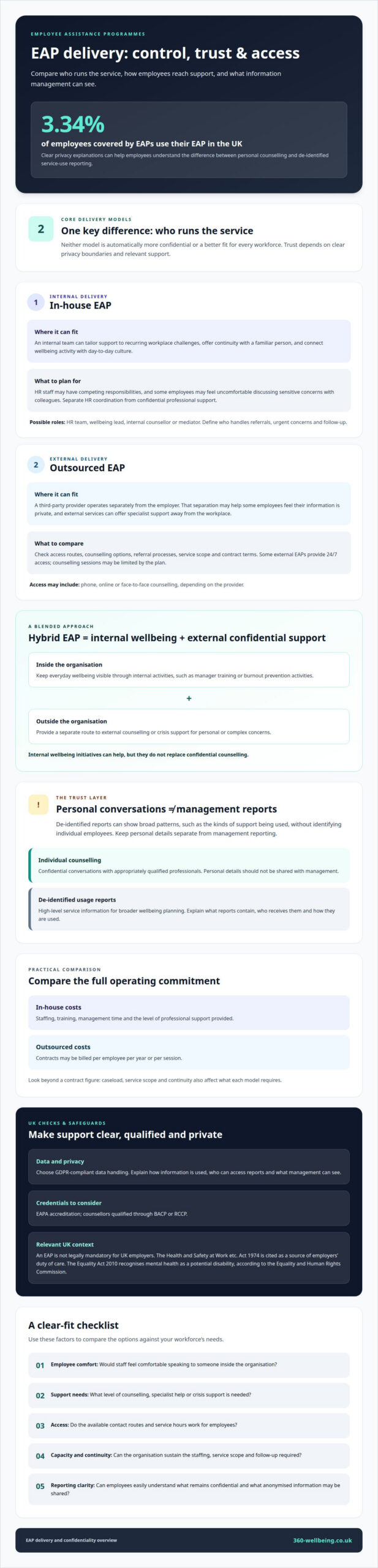
The in-house vs outsourced employee assistance programme decision comes down to who runs the service. An in-house EAP sits within the organisation, while an outsourced EAP is delivered by an external provider. Neither model is automatically more confidential or better suited to every workforce: both need clear privacy boundaries and relevant support.
It’s understandable to weigh familiarity and control against the independence of external support. The right fit depends on how employees prefer to access help, the support they need and whether they feel comfortable using the service. This comparison explains confidentiality, the differences between the models and how to match an EAP to your people’s needs.
You’ll also see how an EAP fits alongside other workplace support, and why clear communication can influence whether employees feel able to use it. The aim is to help you make a considered choice that supports wellbeing while keeping trust, access and your organisation’s circumstances in view.
Key Takeaways
- Compare internal and external delivery by considering control, employee comfort and the kind of support your organisation can sustain.
- Make confidentiality clear to employees, including how any service-use reporting is shared with management.
- Match access routes and support options to your workforce’s preferences, working patterns and wellbeing needs.
- Explore how 360 Wellbeing’s Virtual GP, Mental Health Support, 360 Rewards and Physiotherapy can complement your employee wellbeing approach.
Are EAPs confidential?
Confidentiality depends on how personal conversations and service-use data are handled. Clear boundaries help employees understand what they can share and what management can see.
Confidentiality and De-identified Reporting
De-identified reporting gives employers high-level information about EAP use without identifying individual employees. It can show broad patterns, such as the kinds of support being used, while keeping personal details separate from management reports. This distinction matters because employees may hesitate to seek help if they fear their conversations could affect their standing at work. Explain what reports contain, who receives them and how they inform workplace planning.
Confidential Counselling and Crisis Support
EAPs can connect employees with confidential, accredited counsellors for mental health concerns, counselling and crisis support. Support may begin with clinical triage to direct someone to an appropriate level of care. An employee facing acute distress, for example, needs a clear route to timely support, not uncertainty about where to turn. EAP counselling can help employees address personal or work-related pressures, supporting wellbeing and productivity. This is separate from an employer receiving personal details about an employee’s conversations.
Data Protection and Employment Rules
UK EAP arrangements should protect sensitive personal information and set clear boundaries around access and reporting. Choose a service with GDPR-compliant data handling, and explain to employees how information is used. An EAP is not legally mandatory for UK employers, but the Health and Safety at Work etc. Act 1974 is cited as a source of employers’ duty of care. The Equality Act 2010 recognises mental health as a potential disability, according to the Equality and Human Rights Commission.
Confidentiality also affects whether employees use the support available. In the UK, 3.34% of employees covered by EAPs use their EAP. Reassure staff that management does not receive personal details, and explain the difference between individual counselling and de-identified usage reports. For example, tell employees that reports may inform broader wellbeing planning, not reveal who sought help. These messages make the service easier to understand and can reduce concerns about seeking support.
Embedded EAPs
An in-house EAP is run within the organisation, often through HR or an internal wellbeing team. Its design can reflect workplace challenges, while an outsourced provider operates separately. The in-house vs outsourced employee assistance programme decision often turns on whether direct organisational knowledge or external independence better suits employees.
Internal Teams and Required Qualifications
An in-house EAP needs a clear division between HR coordination and confidential professional support. An organisation may use its HR team, appoint a wellbeing lead, or hire an internal counsellor or mediator. Employees raising mental health concerns need access to appropriately qualified counselling, not just general HR advice. Define who handles referrals, urgent concerns and follow-up, so staff know where each conversation belongs.
Confidentiality and Employee Trust
Internal support may feel accessible because employees recognise the people involved, but familiarity can also make some staff cautious. An outsourced EAP operates separately from the employer, which may help employees feel their information is private. External services can also provide specialist support away from the workplace. Neither model guarantees trust: explain privacy boundaries and reporting clearly, then make confidential help easy to find.
In-House EAP Advantages and Disadvantages
An internal team can tailor support to recurring workplace challenges and provide continuity with a familiar person. It can also connect wellbeing activities with the organisation’s day-to-day culture. The trade-off is that HR staff may have competing responsibilities, and employees might feel uncomfortable discussing sensitive concerns with colleagues. Internal initiatives, such as manager training or burnout prevention activities, can help, but they don’t replace confidential counselling.
A hybrid EAP combines internal wellbeing activities with external counselling or crisis support. This lets an employer keep everyday wellbeing visible while providing a separate route for personal or complex concerns.
Comparing In-House and Outsourced Costs
In the UK, outsourced EAP contracts may be billed per employee per year or per session. Internal costs depend on staffing, training, management time and the level of professional support provided. Compare the full operating commitment, not just a contract figure: caseload, service scope and continuity all affect what each model requires. When weighing the in-house vs outsourced employee assistance programme options, organisations exploring a blended wellbeing approach can consider workplace wellbeing support as one potential part of their wider provision.
External EAPs delivered by third-party providers
An external EAP is delivered by a provider operating separately from the employer. Its scope, access routes and contract terms shape the support employees can use.
Choosing and Comparing EAP Providers
Compare providers by the practical support they offer, how employees reach it and what leaders can learn from service reports. Some external EAPs provide 24/7 access, while counselling sessions may be limited by the plan. For example, compare whether phone, online or face-to-face counselling is available and how referrals work. In the UK, relevant credentials to consider include EAPA accreditation and counsellors qualified through BACP or RCCP, alongside GDPR compliance.
Ask for overall, anonymised usage data and use employee feedback to understand whether access feels clear. If employees don’t know how to reach mental health support, leaders can improve communication before judging the service’s value. Compare the reporting offered, too: trends can inform wellbeing planning, while individual counselling details remain private.
Outsourced EAP Costs
The cost of an outsourced EAP in the UK depends on its scope, charging model and the organisation’s needs. Providers may charge per employee per year or per session, so compare what each arrangement includes rather than treating the billing method as the full cost. Session limits, counselling access and additional support can all affect what is provided.
Some plans cap counselling at around six sessions per employee per year. A lower session allowance may suit short-term support, while employees with more complex needs may require a route beyond the EAP. During renewal, review staff feedback, access and anonymised usage patterns with the provider. If the service no longer fits, compare alternative contract scopes and plan a transition that keeps support routes clear for employees.
Aligning EAP services with employee needs
Employee needs vary by role, working pattern and life pressure. EAP services fit better when access and support reflect those differences.
Scalability and Digital Self-Service
Scalability means an organisation can make support accessible as its workforce and needs change. Modern digital EAPs can offer access through apps, websites, chat and video, including 24/7 access. This can suit employees working varied shifts or remotely, rather than relying only on traditional 9-to-5 hotline access.
Use staff surveys to identify preferred access routes and recurring concerns, such as stress or financial worries. Compare those findings with anonymised engagement patterns, then adjust how the service is communicated. For example, a distributed team may value online access, while employees who prefer conversation may need counselling options explained clearly.
EAP Services and Their Limitations
EAP services can address more than mental health concerns. Depending on the programme, employees may access face-to-face or online counselling, childcare or elder-care support, and guidance on consumer rights or legal matters. Some programmes also help people seeking medical treatment or support to change habits. Mapping these needs helps an organisation assess whether its provision reflects employees’ real pressures.
Set clear expectations about the help available. EAP counselling is generally short-term support, not a replacement for long-term clinical treatment. An employee experiencing ongoing difficulties, for example, may need support beyond the EAP’s counselling scope. Clear signposting helps staff understand what the programme can provide and where its boundaries lie.
Review fit over time: consider employee feedback, access preferences and service engagement alongside the organisation’s wellbeing and retention plans for the next 3-5 years. If financial pressure is a recurring concern, ensure staff can find relevant guidance within the support available. Explore workplace wellbeing support as part of a broader approach to employee needs.
360 Wellbeing: 24/7 Virtual GP
360 Wellbeing brings practical health and wellbeing support together for employers seeking options beyond an EAP model alone. Its 24/7 Virtual GP, Mental Health Support, Physiotherapy and 360 Rewards can complement an organisation’s approach, giving employees different forms of support for health and everyday wellbeing needs.
Consider this broader mix when reviewing how workplace benefits can support employees’ physical and mental wellbeing. It can help you weigh connected support alongside the question of how an EAP should be delivered.
To discuss your organisation’s wellbeing needs, contact 360 Wellbeing.
Make your next wellbeing decision with confidence
Choosing between an in-house vs outsourced employee assistance programme is not a one-off decision. Treat it as part of a wider, evolving approach to employee wellbeing, shaped by how your people work and the support they value. Turn your priorities into a clear plan: decide what you want the service to help with, how employees will learn about it and how you’ll use feedback to refine your approach.
That plan can also consider the wider support available across your organisation. 360 Wellbeing offers a 24/7 Virtual GP, Mental Health Support and 360 Rewards as part of its employee wellbeing provision. If you’re considering how EAP support could fit into your approach, contact 360 Wellbeing to discuss EAPs.
Thoughtful choices can make support easier to understand and more relevant to employees. Start with what your people need, then build a wellbeing approach that can grow with them.
Frequently Asked Questions
What is an external employee assistance programme (EAP)?
An external EAP is an employee support service delivered by a provider independent of the employer. The organisation arranges access, while employees contact the service directly about work or personal concerns. For example, an employee experiencing stress could use the programme’s counselling route without asking their manager to arrange a session. Its value depends on whether staff understand how to access the support.
How do the four types of EAP compare?
There isn’t one universal four-type classification, but EAPs can be compared across two choices: who delivers support and where it’s delivered. This creates four broad combinations: internal or external support, each provided on-site or off-site. An internal counsellor might meet staff at work or remotely; an external provider might offer workplace appointments or remote access. This comparison separates delivery structure from location.
How do you choose the right type of EAP?
Choose a model your organisation can make accessible, trusted and sustainable. Consider whether employees need a familiar internal contact, a separate external service or a blend of both. Then map the route from first contact to appropriate support, including who communicates the service and how urgent concerns are handled. A clear explanation for employees can make the chosen model easier to use.
Type four: What is an EAP alternative?
An EAP alternative is another form of workplace support, chosen for a particular need rather than as a direct substitute for every EAP function. Occupational health, for example, can support fitness-to-work assessments, workplace adjustments and medical recommendations. Manager training and wellbeing activities can also help address workplace pressures. These options serve different purposes and can be combined with counselling or other employee support where appropriate.
Type one: What is an external EAP?
An external EAP is run by a third-party organisation rather than the employer’s own team. “Type one” isn’t a standard UK label, so focus on the delivery arrangement, not the number. For instance, an employer can arrange access to a separate provider, which then manages the service. This distinction helps when comparing an EAP’s structure with the support employees need.
What is an employee assistance programme (EAP) in the UK?
A UK EAP is a workplace benefit that connects employees with support for personal or work-related difficulties. Depending on its design, it may include counselling, practical guidance or help with issues affecting wellbeing at work. An employer can make it one part of a wider support approach, alongside appropriate workplace conversations and other services. The programme’s scope depends on the support arrangement.